

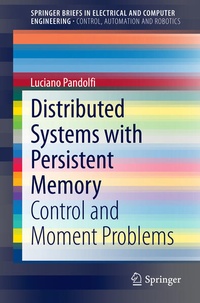
Distributed Systems with Persistent Memory
Control and Moment Problems
Published on 20. November 2014
Book
Paperback/Softback
IX, 152 pages
978-3-319-12246-5 (ISBN)
Description
The subject of the book includes the study of control problems for systems which are encountered in viscoelasticity, non-Fickian diffusion and thermodynamic with memory. The common feature of these systems is that memory of the whole past history persists in the future. This class of systems is actively studied now, as documented in the recent book. This book will attract a diversified audience, in particular, engineers working on distributed systems, and applied mathematicians. Background of mathematics are the elements of functional analysis, which is now standard among people working on distributed systems, and the author describes very clearly the instruments which are used at every step.
Reviews / Votes
"The book introduces all of the tools of functional analysis which are used in the proofs and each chapter contains more than ten problems . . All these make reading interesting both for mathematicians and engineers working on distributed systems." (Sergei A. Ivanov, Mathematical Reviews, January, 2016)
More details
Series
Edition
2014 ed.
Language
English
Place of publication
Cham
Switzerland
Publishing group
Springer International Publishing
Target group
Professional and scholarly
Research
Illustrations
7 farbige Abbildungen, 2 s/w Abbildungen
IX, 152 p. 9 illus., 7 illus. in color.
Dimensions
Height: 235 mm
Width: 155 mm
Thickness: 10 mm
Weight
260 gr
ISBN-13
978-3-319-12246-5 (9783319122465)
DOI
10.1007/978-3-319-12247-2
Schweitzer Classification
Other editions
Additional editions
E-Book
11/2014
1st Edition
Springer
€53.49
Available for download
Person
aaaaaa
Content
An Example.- The Model and Preliminaries.- Moment Problems and Exact Controllability.- Controllability of the Wave Equation.- Systems with Persistent Memory: Controllability via Moment Methods.- Systems with Persistent Memory: The Observation Inequality.