

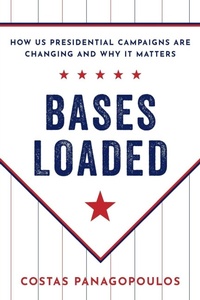
Bases Loaded
How US Presidential Campaigns Are Changing and Why It Matters
Published on 15. December 2020
Book
Paperback/Softback
160 pages
978-0-19-753307-9 (ISBN)
Description
Presidential campaigns in recent years have shifted their strategy to focus increasingly on base partisans, a shift that has had significant consequences for democracy in America.
Over the past few decades, political campaign strategy in US elections has experienced a fundamental shift. Campaigns conducted by both Republicans and Democrats have gradually refocused their attention increasingly toward their respective partisan bases. In Bases Loaded, Costas Panagopoulos documents this shift toward base mobilization and away from voter persuasion in presidential elections between 1956 and 2016. His analyses show that this phenomenon is linked to several developments, including advances in campaign technology and voter targeting capabilities as well as insights from behavioral social science focusing on voter mobilization. Demonstrating the broader implications of the shift toward base mobilization, he links the phenomenon to growing turnout rates among strong partisans and rising partisan polarization. A novel, data-rich account of how presidential campaigns have evolved in the past quarter century, Bases Loaded argues that what campaigns do matters--not only for election outcomes, but also for political processes in the US and for American democracy.
Over the past few decades, political campaign strategy in US elections has experienced a fundamental shift. Campaigns conducted by both Republicans and Democrats have gradually refocused their attention increasingly toward their respective partisan bases. In Bases Loaded, Costas Panagopoulos documents this shift toward base mobilization and away from voter persuasion in presidential elections between 1956 and 2016. His analyses show that this phenomenon is linked to several developments, including advances in campaign technology and voter targeting capabilities as well as insights from behavioral social science focusing on voter mobilization. Demonstrating the broader implications of the shift toward base mobilization, he links the phenomenon to growing turnout rates among strong partisans and rising partisan polarization. A novel, data-rich account of how presidential campaigns have evolved in the past quarter century, Bases Loaded argues that what campaigns do matters--not only for election outcomes, but also for political processes in the US and for American democracy.
Reviews / Votes
In a fresh and richly informed volume, Panagopoulos examines why campaigns--especially those for president--have increasingly tended to focus on their party's base. Technology is culprit and increased polarization is the result. This book is data crack cocaine for political junkies. * Karl Rove, Campaign Manager for George Bush, 2000 and 2004 * How have US election campaign strategies changed in recent times? Through targeting moves, have the parties been favoring their base voters and leaving centrist voters in the dust? Here is a deft examination of the what's, why's, and so-what's of that topic. * David Mayhew , Sterling Professor of Political Science Emeritus, Yale University * Trump focused his campaign - and his presidency - on appealing to his political base. Instead of winning new converts, he focuses on maintaining enthusiasm in his base. Panagopoulos shows us that Trump's actions are not unique but are the product of the nature of campaigns in the twenty-first century. To do so, Panagopoulos deftly integrates voter opinion and behavior, campaign strategy, and the nature of new media in the age of Big Data. * John Aldrich , Pfizer, Inc./Edmund T. Pratt, Jr. University Distinguished Professor of Political Science, Duke University * Panagopoulos has produced a clear, comprehensive and detailed overview of the dramatic changes in the ways presidential campaigns are conducted in today's era of deep partisan polarization. He explains why modern presidential campaigns focus primarily on identifying and turning out partisans rather than persuading swing voters. This book will be a valuable resource for scholars, students and practitioners of American elections and voting behavior. * Alan Abramowitz , Alben W. Barkley Professor of Political Science, Emory University * Through meticulous research, Panagopoulos helps us understand how the advent of 'Big Data' fundamentally changed the way campaigns relate to voters, as well as the opportunities and threats this presents to our democracy moving forward.A This is the book to read if you actually want to understand how our politics came to be so polarized * Robby Mook , Campaign Manager, Hillary for America, 2016 *More details
Language
English
Place of publication
New York
United States
Target group
Professional and scholarly
Dimensions
Height: 210 mm
Width: 140 mm
Thickness: 9 mm
Weight
205 gr
ISBN-13
978-0-19-753307-9 (9780197533079)
Copyright in bibliographic data and cover images is held by Nielsen Book Services Limited or by the publishers or by their respective licensors: all rights reserved.
Schweitzer Classification
Other editions
Additional editions

Book
12/2020
Oxford University Press Inc
€139.20
Shipment within 15-20 days

E-Book
10/2020
1st Edition
OUP eBook
€13.49
Available for download

E-Book
10/2020
1st Edition
OUP eBook
€13.49
Available for download
Person
Costas Panagopoulos is Professor of Political Science and interim Chair in the Department of Political Science in the College of Social Sciences and Humanities at Northeastern University, where he was previously director of big data and quantitative initiatives. A leading expert on campaigns and elections, voting behavior, political psychology, campaign finance, and experimental research, Panagopoulos has been part of the Decision Desk team at NBC News since the 2006 election cycle.He is an editor of American Politics Research. He is also author, co-author or editor of several books, including Political Campaigns: Concepts, Context, and Consequences (Oxford) and A Citizen's Guide to US Elections (with Aaron Weinschenk).
Content
Chapter 1: Introduction
Chapter 2: Big Data and Other Big Changes
Chapter 3: The Elusive Persuadable Voter
Chapter 4: Switching Gears: Changing Voter Contact Strategies in Presidential Elections
Chapter 5: Priming the Party
Chapter 6: Turning Out or Tuning Out?
Chapter 7: Why in America so Polarized?
Chapter 8: Conclusion
Appendix
References
Chapter 2: Big Data and Other Big Changes
Chapter 3: The Elusive Persuadable Voter
Chapter 4: Switching Gears: Changing Voter Contact Strategies in Presidential Elections
Chapter 5: Priming the Party
Chapter 6: Turning Out or Tuning Out?
Chapter 7: Why in America so Polarized?
Chapter 8: Conclusion
Appendix
References