

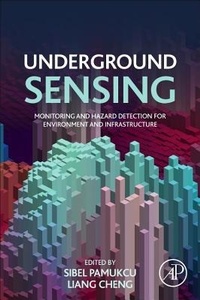
Underground Sensing
Monitoring and Hazard Detection for Environment and Infrastructure
Published on 22. October 2017
Book
Paperback/Softback
522 pages
978-0-12-803139-1 (ISBN)
Description
Underground Sensing: Monitoring and Hazard Detection for Environment and Infrastructure brings the target audience the technical and practical knowledge of existing technologies of subsurface sensing and monitoring based on a classification of their functionality. In addition, the book introduces emerging technologies and applications of sensing for environmental and geo-hazards in subsurface - focusing on sensing platforms that can enable fully distributed global measurements. Finally, users will find a comprehensive exploration of the future of underground sensing that can meet demands for preemptive and sustainable response to underground hazards.
New concepts and paradigms based on passively powered and/or on-demand activated, embeddable sensor platforms are presented to bridge the gap between real-time monitoring and global measurements.
New concepts and paradigms based on passively powered and/or on-demand activated, embeddable sensor platforms are presented to bridge the gap between real-time monitoring and global measurements.
More details
Language
English
Place of publication
San Diego
United States
Publishing group
Elsevier Science Publishing Co Inc
Target group
Professional and scholarly
Product notice
Paperback (trade)
Unsewn / adhesive bound
Dimensions
Height: 228 mm
Width: 154 mm
Thickness: 30 mm
Weight
850 gr
ISBN-13
978-0-12-803139-1 (9780128031391)
Copyright in bibliographic data and cover images is held by Nielsen Book Services Limited or by the publishers or by their respective licensors: all rights reserved.
Schweitzer Classification
Other editions
Additional editions
Sibel Pamukcu | Liang Cheng
Underground Sensing
Monitoring and Hazard Detection for Environment and Infrastructure
E-Book
10/2017
Academic Press
€119.00
Available for download
Persons
Dr. Pamukcu conducts research on soil and groundwater decontamination using electrochemical technologies, and on application of fiber-optic and wireless sensors for distributed measurements in geo-media and civil infrastructure. An expert on electro-remediation of soils and groundwater for more than a decade, Dr. Pamukcu co-owns patents in US and abroad; and currently focuses on the application of direct current electric field for in-situ destruction of contaminants through enhanced redox in clay-rich soils. Her other major work involves application of distributed fiber-optic and wireless sensor networks for detection of soil water and contaminants, and infrastructure health monitoring in subsurface Dr. Cheng has been the Principal Investigator (PI) and a Co-PI of more than ten grants supported by national and state agencies, as well as industry and foundation, in research areas of distributed sensing and computing and system instrumentation and analytics, with major applications in infrastructure and environment monitoring and the Internet of Things. Dr. Cheng has authored/co-authored more than 90 peer-reviewed papers, including a best paper, a best paper award nomination, and papers in premium conference/journals. He has been invited to serve on proposal panels for programs of NSF, DOE, NIH (National Institute of Health), GENI (Global Environment for Network Innovations), and as an expert reviewer for ACS (American Chemical Society), NRI (Nebraska Research Initiative), and research foundations in Europe.
Content
1. Overview of applied underground sensing and monitoring technologies
2. Acoustic, optical and electromagnetic sensing and monitoring
3. Geotechnical underground sensing and monitoring
4. Environmental underground sensing and monitoring
5. Wireless underground sensor networks
6. Fiber-optic underground sensor networks
7. Advances and challenges in underground sensing
8. Underground Sensing Strategies for the health assessment of buried pipelines
9. Outlook: advanced hybrid sensing for pre-emptive response
2. Acoustic, optical and electromagnetic sensing and monitoring
3. Geotechnical underground sensing and monitoring
4. Environmental underground sensing and monitoring
5. Wireless underground sensor networks
6. Fiber-optic underground sensor networks
7. Advances and challenges in underground sensing
8. Underground Sensing Strategies for the health assessment of buried pipelines
9. Outlook: advanced hybrid sensing for pre-emptive response