

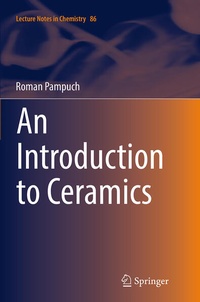
An Introduction to Ceramics
Published on 23. August 2016
Book
Paperback/Softback
VIII, 91 pages
978-3-319-36350-9 (ISBN)
Description
This book embraces both traditional and advanced ceramics produced from synthetic or deeply transformed natural raw materials. Following the path of ceramic innovation, this introduction explains electric properties of ceramic conductors, like high-temperature superconductors, reflects on the interaction of material and electromagnetic radiation, presents the importance of voids and defects in the material, and provides an outlook on most recent developments in the field of ceramics, such as smart or self-healing materials . It provides a quick grasp of the main points of ceramic thinking and is an ideal starting point for students in the field of chemistry, materials science or solid state physics.
More details
Series
Edition
Softcover reprint of the original 1st ed. 2014
Language
English
Place of publication
Cham
Switzerland
Publishing group
Springer International Publishing
Target group
Primary & secondary/elementary & high school
Illustrations
74 s/w Abbildungen, 4 farbige Abbildungen
VIII, 91 p. 78 illus., 4 illus. in color.
Dimensions
Height: 23.5 cm
Width: 15.5 cm
Weight
454 gr
ISBN-13
978-3-319-36350-9 (9783319363509)
DOI
10.1007/978-3-319-10410-2
Schweitzer Classification
Other editions
Additional editions
Person
Roman Pampuch is a professor-emeritus for Materials Science at the University of Science and Technology, Krakow, an internationally established expert on ceramics, recipient of the Leo Stuits Prize from the European Ceramic Society and from 1973 till 2013 Editor-in-Chief of the journal "Ceramic International". He gave lectures on ceramics at numerous universities, such as the Technical University Clausthal, Germany, Ecole Nationale Supérieure de Céramique Industrielle, France.
Content
A Brief History of Ceramic Innovation.- The Tradition Continued.- Ceramics to Overcome Brittleness.- Voids are Important.- Unusual Dielectrics and Conductors.- Materials versus Light,- Imitating and Supporting Nature.- Appendix.