

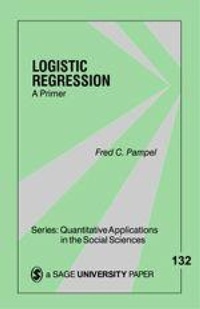
Logistic Regression
A Primer
1st Edition
Published on 19. July 2000
Book
Paperback/Softback
96 pages
978-0-7619-2010-6 (ISBN)
Description
Pampel's book offers readers the first `nuts and bolts' approach to doing logistic regression through the use of careful explanations and worked-out examples. This book will enable readers to use and understand logistic regression techniques and will serve as a foundation for more advanced treatments of the topic.
More details
Series
Language
English
Place of publication
Thousand Oaks
United States
Target group
College/higher education
Product notice
Paperback (trade)
Dimensions
Height: 218 mm
Width: 138 mm
Thickness: 10 mm
Weight
126 gr
ISBN-13
978-0-7619-2010-6 (9780761920106)
Copyright in bibliographic data and cover images is held by Nielsen Book Services Limited or by the publishers or by their respective licensors: all rights reserved.
Schweitzer Classification
Other editions
New editions
Book
11/2020
2nd Edition
SAGE Publications Inc
€65.79
Shipment within 15-20 days
Person
FRED C. PAMPEL is Research Professor of Sociology and a Research Associate in the Population Program at the University of Colorado Boulder. He received a Ph.D. in sociology from the University of Illinois, Champaign-Urbana, in 1977, and has previously taught at the University of Iowa, University of North Carolina, and Florida State University. His research focuses on socioeconomic disparities in health behaviors, smoking in particular, and on the experimental and quasi-experimental methods for evaluation of social programs for youth. He is the author of several books on population aging, cohort change, and public policy, and his work has appeared in the American Sociological Review, the American Journal of Sociology, Demography, Social Forces, and the European Sociological Review.
Content
The Logic of Logistic Regression
Interpreting Logistic Regression Coefficients
Estimation and Model Fit
Probit Analysis
Conclusion
Interpreting Logistic Regression Coefficients
Estimation and Model Fit
Probit Analysis
Conclusion