

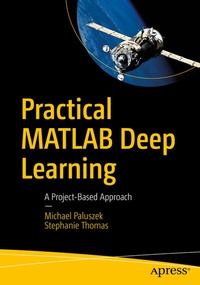
Practical MATLAB Deep Learning
A Project-Based Approach
Published on 8. February 2020
Book
Paperback/Softback
XV, 252 pages
978-1-4842-5123-2 (ISBN)
Description
Harness the power of MATLAB for deep-learning challenges. This book provides an introduction to deep learning and using MATLAB's deep-learning toolboxes. You'll see how these toolboxes provide the complete set of functions needed to implement all aspects of deep learning.
Along the way, you'll learn to model complex systems, including the stock market, natural language, and angles-only orbit determination. You'll cover dynamics and control, and integrate deep-learning algorithms and approaches using MATLAB. You'll also apply deep learning to aircraft navigation using images.
Finally, you'll carry out classification of ballet pirouettes using an inertial measurement unit to experiment with MATLAB's hardware capabilities.
What You Will Learn
Engineers, data scientists, and students wanting a book rich in examples on deep learning using MATLAB.
Along the way, you'll learn to model complex systems, including the stock market, natural language, and angles-only orbit determination. You'll cover dynamics and control, and integrate deep-learning algorithms and approaches using MATLAB. You'll also apply deep learning to aircraft navigation using images.
Finally, you'll carry out classification of ballet pirouettes using an inertial measurement unit to experiment with MATLAB's hardware capabilities.
What You Will Learn
- Explore deep learning using MATLAB and compare it to algorithms
- Write a deep learning function in MATLAB and train it with examples
- Use MATLAB toolboxes related to deep learning
- Implement tokamak disruption prediction
Engineers, data scientists, and students wanting a book rich in examples on deep learning using MATLAB.
More details
Edition
1st ed.
Language
English
Place of publication
Berkeley
United States
Target group
Professional and scholarly
Illustrations
11 s/w Abbildungen, 100 farbige Abbildungen
XV, 252 p. 111 illus., 100 illus. in color.
Dimensions
Height: 25.4 cm
Width: 17.8 cm
Weight
515 gr
ISBN-13
978-1-4842-5123-2 (9781484251232)
DOI
10.1007/978-1-4842-5124-9
Schweitzer Classification
Other editions
New editions
Michael Paluszek | Stephanie Thomas | Eric Ham
Practical MATLAB Deep Learning
A Projects-Based Approach
Book
09/2022
2nd Edition
APress
€64.19
Shipment within 15-20 days
Additional editions
E-Book
02/2020
APress
€36.99
Available for download
Persons
Michael Paluszek is the co-author of MATLAB Recipes published by Apress. He is President of Princeton Satellite Systems, Inc. (PSS) in Plainsboro, New Jersey. Mr. Paluszek founded PSS in 1992 to provide aerospace consulting services. He used MATLAB to develop the control system and simulation for the Indostar-1 geosynschronous communications satellite, resulting in the launch of PSS' first commercial MATLAB toolbox, the Spacecraft Control Toolbox, in 1995. Since then he has developed toolboxes and software packages for aircraft, submarines, robotics, and fusion propulsion, resulting in PSS' current extensive product line. He is currently leading an Army research contract for precision attitude control of small satellites and working with the Princeton Plasma Physics Laboratory on a compact nuclear fusion reactor for energy generation and propulsion. Prior to founding PSS, Mr. Paluszek was an engineer at GE Astro Space in East Windsor, NJ. At GE he designed the Global Geospace Science Polar despun platform control system and led the design of the GPS IIR attitude control system, the Inmarsat-3 attitude control systems and the Mars Observer delta-V control system, leveraging MATLAB for control design. Mr. Paluszek also worked on the attitude determination system for the DMSP meteorological satellites. Mr. Paluszek flew communication satellites on over twelve satellite launches, including the GSTAR III recovery, the first transfer of a satellite to an operational orbit using electric thrusters. At Draper Laboratory Mr. Paluszek worked on the Space Shuttle, Space Station and submarine navigation. His Space Station work included designing of Control Moment Gyro based control systems for attitude control. Mr. Paluszek received his bachelors in Electrical Engineering, and master's and engineer's degrees in Aeronautics and Astronautics from the Massachusetts Institute of Technology. He is author of numerous papers and has over a dozen U.S. Patents.
Stephanie Thomas is the co-author of MATLAB Recipes, published by Apress. She received her bachelor's and master's degrees in Aeronautics and Astronautics from the Massachusetts Institute of Technology in 1999 and 2001. Ms. Thomas was introduced to PSS' Spacecraft Control Toolbox for MATLAB during a summer internship in 1996 and has been using MATLAB for aerospace analysis ever since. She built a simulation of a lunar transfer vehicle in C++, LunarPilot, during the same internship. In her nearly 20 years of MATLAB experience, she has developed many software tools including the Solar Sail Module for the Spacecraft Control Toolbox; a proximity satellite operations toolbox for the Air Force; collision monitoring Simulink blocks for the Prisma satellite mission; and launch vehicle analysis tools in MATLAB and Java, to name a few. She has developed novel methods for space situation assessment such as a numeric approach to assessing the general rendezvous problem between any two satellites implemented in both MATLAB and C++. Ms. Thomas has contributed to PSS' Attitude and Orbit Control textbook, featuring examples using the Spacecraft Control Toolbox, and written many software User's Guides. She has conducted SCT training for engineers from diverse locales such as Australia, Canada, Brazil, and Thailand and has performed MATLAB consulting for NASA, the Air Force, and the European Space Agency.
Stephanie Thomas is the co-author of MATLAB Recipes, published by Apress. She received her bachelor's and master's degrees in Aeronautics and Astronautics from the Massachusetts Institute of Technology in 1999 and 2001. Ms. Thomas was introduced to PSS' Spacecraft Control Toolbox for MATLAB during a summer internship in 1996 and has been using MATLAB for aerospace analysis ever since. She built a simulation of a lunar transfer vehicle in C++, LunarPilot, during the same internship. In her nearly 20 years of MATLAB experience, she has developed many software tools including the Solar Sail Module for the Spacecraft Control Toolbox; a proximity satellite operations toolbox for the Air Force; collision monitoring Simulink blocks for the Prisma satellite mission; and launch vehicle analysis tools in MATLAB and Java, to name a few. She has developed novel methods for space situation assessment such as a numeric approach to assessing the general rendezvous problem between any two satellites implemented in both MATLAB and C++. Ms. Thomas has contributed to PSS' Attitude and Orbit Control textbook, featuring examples using the Spacecraft Control Toolbox, and written many software User's Guides. She has conducted SCT training for engineers from diverse locales such as Australia, Canada, Brazil, and Thailand and has performed MATLAB consulting for NASA, the Air Force, and the European Space Agency.
Content
1 What is Deep Learning?2 MATLAB Machine and Deep Learning Toolboxes3 Finding Circles with Deep Learning4 Classifying Movies5 Algorithmic Deep Learning6 Tokamak Disruption Detection7 Classifying a Pirouette8 Completing Sentences9 Terrain Based Navigation10 Stock Prediction11 Image Classification12 Orbit Determination