

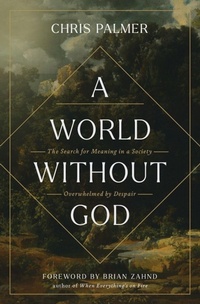
A World Without God
The Search for Meaning in a Society Overwhelmed by Despair
Will be published approx. on 2. July 2026
Book
Paperback/Softback
224 pages
978-0-310-17722-7 (ISBN)
Description
Is the existence of God essential to humanity?
A World Without God is a philosophical exploration that challenges readers to consider the implications of a hypothetical society without divine influence.
Like Dostoyevsky's enigmatic characters and the brutal depictions of reality in the book of Judges, this book considers--in the form of narrative philosophy--the consequences of abandoning faith in God. Journeying into the nihilistic haze of technological oversaturation and moral decline, Chris Palmer, PhD, confronts today's most persistent questions about meaning, purpose, and existence in a world adrift.
A World Without God offers an honest yet hopeful path for those open to God but unsure why they should commit to a belief they cannot ground in science. In its fresh look at key influences in literature--from Albert Camus to Jordan Peterson--this book examines how people search for meaning without a creator and how the absence of the divine can lead to chaos and psychological collapse.
Whether you're a Christian, a skeptic, or simply curious about the implications of a world without God, this book will spark imagination and deep reflection.
A World Without God is a philosophical exploration that challenges readers to consider the implications of a hypothetical society without divine influence.
Like Dostoyevsky's enigmatic characters and the brutal depictions of reality in the book of Judges, this book considers--in the form of narrative philosophy--the consequences of abandoning faith in God. Journeying into the nihilistic haze of technological oversaturation and moral decline, Chris Palmer, PhD, confronts today's most persistent questions about meaning, purpose, and existence in a world adrift.
A World Without God offers an honest yet hopeful path for those open to God but unsure why they should commit to a belief they cannot ground in science. In its fresh look at key influences in literature--from Albert Camus to Jordan Peterson--this book examines how people search for meaning without a creator and how the absence of the divine can lead to chaos and psychological collapse.
Whether you're a Christian, a skeptic, or simply curious about the implications of a world without God, this book will spark imagination and deep reflection.
Reviews / Votes
'A fantastic guide to the practical power of worldview, this book shows how our views of God quietly shape how we live, choose, and endure in a tough world--whether with despair or with hope.' * <b>Josh Rasmussen, professor of philosophy, Baylor University; author, Who Are You, Really?</b>b> * 'Chris Palmer doesn't just diagnose our meaning crisis. He leads us by the hand into Novemberton to see and experience the existential emptiness in the faces and lives of those who dwell there. With clarity and heart, he exposes the futility of life without God while offering a way back home to meaning, wonder, and the fullness of life found only in Him. A must read for those who guide others toward meaning and for those still searching for it.' * <b>Jana Harmon, PhD, author, Atheists Finding God; host, eX-skeptic Podcast</b> * 'Christopher Palmer is a tour guide through the sloughs of despondence that have afflicted the modern world, where the revolutions that have conquered nature have left the human soul feeling more despairing than ever. He shows from poetry, novels, music, and art the dark side of the moon that many feel trapped in. Yet Palmer also points us towards an audacious hope centred on the Lord Jesus Christ who brings us into joy, beauty, and enchantment. A timely book for an anxious age.' * <b>Rev. Dr. Michael F. Bird (PhD University of Queensland), Deputy Principal, Ridley College, Melbourne, Australia</b> * 'Christopher Palmer's book A World Without God is a biting critique of the way we have chosen to live: free of God. Its prophetic message and graceful invitation will leave you wondering how we've lived so long without a deep and hungry heart for God. Read this at your own risk. It won't feel good. But it will wake you up.' * <b>A.J. Swoboda (Ph.D., University of Birmingham), Associate Professor of Bible and Theology at Bushnell University; pastor, Faith Center in Eugene, Oregon; author, A Teachable Spirit </b> * 'Reading A World Without God is like taking a meandering walk with someone who is a good thinker, a good listener, and a good friend. Chris Palmer reflects on the most enticing bits of philosophy, literature, and theology, making connections with the real world around us in a way that is illuminating and inviting. You'll come away from this book inspired to be more thoughtful and engaged with both deep questions and the everyday world.' * <b>Karen Swallow Prior, author, On Reading Well: Finding the Good Life through Great Books</b> * 'Reading A World Without God is like wandering through dark, plague-filled streets reeking of death, before suddenly darting into a pine-scented room illuminated by a Christmas tree. Chris Palmer--a writer with a lyrical voice--is your sure-footed and beguiling guide on this crosstown journey.' * <b>Timothy Larsen, Wheaton College</b> * 'The eerie town of 'Novemberton' (along with its cast of quirky characters) is a perfectly pitched allegory of our own increasingly shallow and distracted world. In A World Without God, Christopher Palmer draws masterfully on the thinking of existentialists, nihilists and theologians alike to paint a picture of how a whole culture can lose its soul. But in doing so he also lights a path back to finding hope, faith and love again. This is an evocative, imaginative and prescient piece of writing that underscores why a weary world seems to be waking up again to its need for God.' * <b>Justin Brierley, host, The Surprising Rebirth Of Belief In God and Uncommon Ground podcasts</b> * Though we are designed to find meaning by living out our God-given purpose, many moderns have taken wrong turns, have gotten lost, or are stuck in distraction or boredom. They have become disoriented, despairing, and hopeless. In his personal, honest book, Christopher Palmer weaves together literary and cultural themes, using them as pointers to help us navigate this confused, haunted modern world. He offers a sure and wise path forward through life's difficulties. This world is, after all, a God-haunted one: the God who made this world that fell away from him came to bring light and truth and healing through Christ, and our hearts are restless until they find their rest--their true home--in him.' * <b>Paul Copan, Pledger Family Chair of Philosophy and Ethics, Palm Beach Atlantic University, West Palm Beach, Florida; author, Is God a Moral Monster? and Is God a Vindictive Bully?</b> *More details
Language
English
Place of publication
Grand Rapids
United States
Product notice
Unsewn / adhesive bound
Dimensions
Height: 213 mm
Width: 140 mm
Thickness: 14 mm
Weight
236 gr
ISBN-13
978-0-310-17722-7 (9780310177227)
Copyright in bibliographic data and cover images is held by Nielsen Book Services Limited or by the publishers or by their respective licensors: all rights reserved.
Schweitzer Classification
Persons
Chris Palmer (PhD Bangor University, Wales UK) is the Dean of the Barnett College of Ministry and Theology at Southeastern University in Lakeland, FL. He has 18 years of fulltime ministry experience, missionary work in over 40 nations, and taught at Moody Theological Seminary, Austin Christian University, and Theos University.
Content
Chapter One: Why is the World Experiencing a Meaning Crisis?
"Existential Dread" is one of the trendier topics in social spaces. Users from all ages seem to relate - we're living our best lives and dreading it! The internet prophet and media sensation, Bo Burnham, has become wildly popular because his content captures the dread of having everything at our fingertips, and no meaning to show for it. Overexposure causes us to wonder what, if anything, is sure enough to anchor the meaning of our lives.
Chapter Two: What Happens When Society Tries to Find Meaning Apart from God?
Nihilism is the belief that life has no meaning. Having been overexposed to endless content, the world now resigns itself to the fact that life is so immense and chaotic, and full of so much suffering and disappointment, that it is irrational to think any real meaning exists - especially meaning which is divine. Fyodor Dostoyevsky believed that nihilism is an intellectual distortion and that any society that gives into it will experience the end of itself. Three of Dostoyevsky's darkest characters - Kirillov, Raskolnikov, and Filippovna - are developed throughout his writings to deter future societies from giving in to the defeat that is nihilism and becoming like the monsters nihilism produces.
Chapter Three: How Will Humans Live If God is Dead?
Imagine waking up tomorrow: God is dead, and the Holy Scriptures aren't around to tell anyone what to do. Now what? It seems like an impossible thought but. with the rise of AI and super technologies, it's becoming harder and harder for the overexposed masses to see God as a reasonable prospect. So, how will humans live if God is dead? Nietzsche believed in the rise of the 'overman', the person who thinks they are greater than they really are - a human who deifies themself by means of their godless ego. The impulse of the overman is what is animating our current achievement society wherein the purpose of existence is the curation and commoditization of the individual self.
Chapter Four: The World Is Cold and Silent - How Can There Possibly Be Meaning?
Our dreams, at one point or another, will come face to face with the arbitrary silence of the world. School shootings. Tsunamis. A family member killed in a car wreck. When tragedy strikes, the universe is cold and indifferent. Albert Camus called our confrontation with the unsympathetic universe 'the absurd'. Through overexposure, we meet the unsympathetic universe daily.. These constant confrontations have caused society to back away from any hope of divine meaning. Is there a way to accept the cold universe and maintain hope of divine meaning? Albert Camus grappled honestly with the absurd and was no proponent of settling for cheap answers. He seems to think there is.
Chapter Five: What Can't I Do If God Does Not Exist to Tell Me Not to Do It?
Without a Creator, we are left to decide who we are and what is best for ourselves. If there is no God, we are innately free from any moral commitments. Yet, moral commitments still exist. This enigma isn't anything new. Jean Paul Sartre, an atheist philosopher, believed on the one hand that since God does not exist, we can do anything we want. Yet, on the other hand, he acknowledges that killing a human is wrong - "directly, absolutely wrong." Sartre's contradiction alludes to something about the state of a world wherein there seems to be no God: everyone still remembers God, and there is no forgetting him - no matter how disillusioned the world has become. Thus the world will never live without God or, at least, the memory of God. The skeptic's slightest moral commitments betray their most palpable disavowals.
Chapter Six: Why Try If Our Existence Is Temporal?
The meaning crisis has produced a disdain for effort. Overexposure has shaped a world that believes that life is a failed project. All the trying in the world will not change this. Trying is cringe, and insincere. It's pretending. To live an authentic l
"Existential Dread" is one of the trendier topics in social spaces. Users from all ages seem to relate - we're living our best lives and dreading it! The internet prophet and media sensation, Bo Burnham, has become wildly popular because his content captures the dread of having everything at our fingertips, and no meaning to show for it. Overexposure causes us to wonder what, if anything, is sure enough to anchor the meaning of our lives.
Chapter Two: What Happens When Society Tries to Find Meaning Apart from God?
Nihilism is the belief that life has no meaning. Having been overexposed to endless content, the world now resigns itself to the fact that life is so immense and chaotic, and full of so much suffering and disappointment, that it is irrational to think any real meaning exists - especially meaning which is divine. Fyodor Dostoyevsky believed that nihilism is an intellectual distortion and that any society that gives into it will experience the end of itself. Three of Dostoyevsky's darkest characters - Kirillov, Raskolnikov, and Filippovna - are developed throughout his writings to deter future societies from giving in to the defeat that is nihilism and becoming like the monsters nihilism produces.
Chapter Three: How Will Humans Live If God is Dead?
Imagine waking up tomorrow: God is dead, and the Holy Scriptures aren't around to tell anyone what to do. Now what? It seems like an impossible thought but. with the rise of AI and super technologies, it's becoming harder and harder for the overexposed masses to see God as a reasonable prospect. So, how will humans live if God is dead? Nietzsche believed in the rise of the 'overman', the person who thinks they are greater than they really are - a human who deifies themself by means of their godless ego. The impulse of the overman is what is animating our current achievement society wherein the purpose of existence is the curation and commoditization of the individual self.
Chapter Four: The World Is Cold and Silent - How Can There Possibly Be Meaning?
Our dreams, at one point or another, will come face to face with the arbitrary silence of the world. School shootings. Tsunamis. A family member killed in a car wreck. When tragedy strikes, the universe is cold and indifferent. Albert Camus called our confrontation with the unsympathetic universe 'the absurd'. Through overexposure, we meet the unsympathetic universe daily.. These constant confrontations have caused society to back away from any hope of divine meaning. Is there a way to accept the cold universe and maintain hope of divine meaning? Albert Camus grappled honestly with the absurd and was no proponent of settling for cheap answers. He seems to think there is.
Chapter Five: What Can't I Do If God Does Not Exist to Tell Me Not to Do It?
Without a Creator, we are left to decide who we are and what is best for ourselves. If there is no God, we are innately free from any moral commitments. Yet, moral commitments still exist. This enigma isn't anything new. Jean Paul Sartre, an atheist philosopher, believed on the one hand that since God does not exist, we can do anything we want. Yet, on the other hand, he acknowledges that killing a human is wrong - "directly, absolutely wrong." Sartre's contradiction alludes to something about the state of a world wherein there seems to be no God: everyone still remembers God, and there is no forgetting him - no matter how disillusioned the world has become. Thus the world will never live without God or, at least, the memory of God. The skeptic's slightest moral commitments betray their most palpable disavowals.
Chapter Six: Why Try If Our Existence Is Temporal?
The meaning crisis has produced a disdain for effort. Overexposure has shaped a world that believes that life is a failed project. All the trying in the world will not change this. Trying is cringe, and insincere. It's pretending. To live an authentic l