

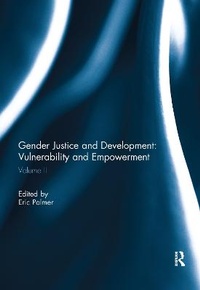
Gender Justice and Development: Vulnerability and Empowerment
Volume II
1st Edition
Published on 24. May 2017
Book
Paperback/Softback
138 pages
978-1-138-06026-5 (ISBN)
Description
Vulnerability and empowerment are central concepts of contemporary development theory and ethics. Vulnerability associated with human interdependence is a wellspring of values in care ethics, while vulnerability arising from social problems demands remedy, of which empowerment is frequently the just form. Development planners and aid providers focus upon improving the wellbeing of the most vulnerable - especially women - by empowering them economically, socially and politically.
Both vulnerability and empowerment are considered in this volume. Drydyk argues that empowerment is necessarily relational, not simply a matter of expanding choices. Koggel reviews Drydyk's discussion through the lens of feminist relational theory, considering how norms, structures and institutions shape, delimit, and promote empowerment. Presbey examines empowerment in East African women's lives through the writings and biography of Wangari Maathai. Kosko considers indigenous self-governance and participation in shared governance. Khader reflects upon postcolonial feminist criticism of the concept of adaptive preference. Panitch discusses the economic vulnerability that surrounds the global market in surrogate birth. Pandey provides a review of third world eco-feminist activism and literature. Cudd envisions international humanitarian intervention to support female autonomy against oppressive state and social institutions.
This book was originally published as a special issue of the Journal of Global Ethics.
Both vulnerability and empowerment are considered in this volume. Drydyk argues that empowerment is necessarily relational, not simply a matter of expanding choices. Koggel reviews Drydyk's discussion through the lens of feminist relational theory, considering how norms, structures and institutions shape, delimit, and promote empowerment. Presbey examines empowerment in East African women's lives through the writings and biography of Wangari Maathai. Kosko considers indigenous self-governance and participation in shared governance. Khader reflects upon postcolonial feminist criticism of the concept of adaptive preference. Panitch discusses the economic vulnerability that surrounds the global market in surrogate birth. Pandey provides a review of third world eco-feminist activism and literature. Cudd envisions international humanitarian intervention to support female autonomy against oppressive state and social institutions.
This book was originally published as a special issue of the Journal of Global Ethics.
More details
Language
English
Place of publication
London
United Kingdom
Publishing group
Taylor & Francis Ltd
Target group
College/higher education
Dimensions
Height: 246 mm
Width: 174 mm
Weight
453 gr
ISBN-13
978-1-138-06026-5 (9781138060265)
Copyright in bibliographic data and cover images is held by Nielsen Book Services Limited or by the publishers or by their respective licensors: all rights reserved.
Schweitzer Classification
Other editions
Additional editions
E-Book
10/2017
1st Edition
Routledge
€45.99
Available for download
E-Book
10/2017
1st Edition
Routledge
€45.99
Available for download
Book
04/2015
1st Edition
Routledge
€133.69
Shipment within 10-20 days
Person
Eric Palmer is Professor of Philosophy at Allegheny College, Pennsylvania, USA. His recent research in development ethics concerns multinational corporate responsibility in for-profit credit and payment schemes directed towards the poor through microfinance, e-payment systems, credit cards and payday lending. He is co-editor of the Journal of Global Ethics.
Content
Preface: Gender Justice and Development 1. Introduction: Vulnerability and Empowerment 2. Empowerment, agency, and power 3. A Critical analysis of recent work on empowerment: implications for gender 4.Women's empowerment: The insights of Wangari Maathai 5. Agency vulnerability, participation, and the self-determination of indigenous peoples 6. Identifying adaptive preferences in practice: Lessons from Postcolonial Feminism 7. Global surrogacy: Exploitation to empowerment 8. Globalization and ecofeminism in the South: Keeping the 'Third World' Alive 9. Truly humanitarian intervention: Considering just causes and methods in a feminist frame