

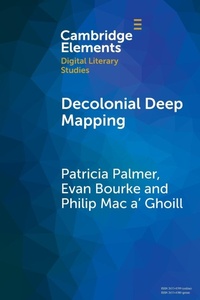
Decolonial Deep Mapping
Published on 14. August 2025
Book
Paperback/Softback
88 pages
978-1-009-49183-9 (ISBN)
Description
Deep maps capture complex relationships to place and help trace the relationship between the abstract spaces of traditional maps and the cultural and literary history of the places that they represent. Using early modern Ireland as a template, this Element explores how deep-mapping techniques and a decolonial data ethic can be used to assemble a more culturally and linguistically representative archive and create more inclusive literary histories. It shows how deep mapping can disrupt colonial teleology and counter the monophone (and, specifically, anglophone) colonial record by bringing the long-neglected voices of the colonised back into the conversation. In doing so, it recovers a pre-conquest cultural vibrancy which colonisation, the language shift from Irish to English, and scholarly inattention successively occluded. More broadly, it offers a model for engaging with decolonial literary deep maps by developing reading strategies for 'juxtapuntal' reading that has the potential to decolonise the canon.
More details
Series
Language
English
Place of publication
Cambridge
United Kingdom
Product notice
Paperback (trade)
Illustrations
Worked examples or Exercises
Dimensions
Height: 229 mm
Width: 152 mm
Thickness: 6 mm
Weight
142 gr
ISBN-13
978-1-009-49183-9 (9781009491839)
Copyright in bibliographic data and cover images is held by Nielsen Book Services Limited or by the publishers or by their respective licensors: all rights reserved.
Schweitzer Classification
Other editions
Additional editions
Patricia Palmer | Evan Bourke | Philip Mac a' Ghoill
Decolonial Deep Mapping
Book
08/2025
Cambridge University Press
€81.80
Shipment within 15-20 days
Persons
Content
1. Countering colonial cartography and coloniality; 2. Developing a decolonial literary deep map; 3. Decolonial reading strategies: archives, contiguity, and the juxtapuntal; 4. Juxtapuntal readings: mapping counter-discourses; 5. Coda; Bibliography.