

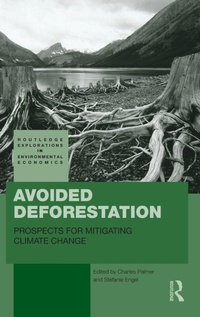
Avoided Deforestation
Prospects for Mitigating Climate Change
1st Edition
Published on 3. April 2009
Book
Hardback
258 pages
978-0-415-44712-6 (ISBN)
Description
Avoided deforestation can be characterized as the use of financial incentives to reduce rates of deforestation and forest degradation, with much of the focus on forests in tropical countries.
While avoided deforestation, as a policy issue, is not new, the current debate in academic and policy circles on including it in future climate change mitigation strategies such as the Clean Development Mechanism is gathering pace - and this debate is only likely to intensify as negotiations continue over what should be included in the successor agreement to the Kyoto Protocol, which is set to expire in 2012.
Up until now, however, the debate in terms of the scientific and economic implications of avoided deforestation has not been brought together. This book aims to bring together important research findings in the area along with their policy implications, whilst linking avoided deforestation to political economy as well as to the latest developments in environmental and natural resource economics.
While avoided deforestation, as a policy issue, is not new, the current debate in academic and policy circles on including it in future climate change mitigation strategies such as the Clean Development Mechanism is gathering pace - and this debate is only likely to intensify as negotiations continue over what should be included in the successor agreement to the Kyoto Protocol, which is set to expire in 2012.
Up until now, however, the debate in terms of the scientific and economic implications of avoided deforestation has not been brought together. This book aims to bring together important research findings in the area along with their policy implications, whilst linking avoided deforestation to political economy as well as to the latest developments in environmental and natural resource economics.
Reviews / Votes
'It's a publication of a high scientific level...a book I recommend highly!' - Jean-Pierre Sorg, Schweizerische Zeitschrift fuer Forstwesen'Overall I found this a useful, interesting, and readable introduction to the political and economic complexities surrounding the practice of avoided deforestation as a means to reduce climate change. The content is accessible to non-specialists with a general interest in the topic and basic background knowledge, so it ought to appeal to students and policy stakeholders who want to rapidly get up to speed on this important topic. In addition, scientists working in related fields should find it a valuable aid in putting their work in context and for suggesting areas that require more robust evidence or technical advances.' - Richard Betts, The Journal of Environmental Investing
More details
Series
Language
English
Place of publication
London
United Kingdom
Publishing group
Taylor & Francis Ltd
Target group
College/higher education
Illustrations
22 s/w Abbildungen, 22 s/w Zeichnungen, 32 s/w Tabellen
32 Tables, black and white; 22 Line drawings, black and white; 22 Illustrations, black and white
Dimensions
Height: 240 mm
Width: 161 mm
Thickness: 19 mm
Weight
578 gr
ISBN-13
978-0-415-44712-6 (9780415447126)
Copyright in bibliographic data and cover images is held by Nielsen Book Services Limited or by the publishers or by their respective licensors: all rights reserved.
Schweitzer Classification
Other editions
Additional editions
Book
12/2010
1st Edition
Routledge
€37.20
Shipment within 15-20 days
E-Book
04/2009
Routledge
€31.49
Available for download
E-Book
04/2009
Routledge
€31.49
Available for download
E-Book
04/2009
1st Edition
Routledge
€134.39
Available for download
Persons
Charles Palmer is currently a Senior Researcher at the Institute for Environmental Decisions at the ETH Zurich in Switzerland, specializing in environmental and development economics.
Stefanie Engel is Professor of Environmental Policy and Economics at the Institute for Environmental Decisions at the ETH Zurich in Switzerland.
Stefanie Engel is Professor of Environmental Policy and Economics at the Institute for Environmental Decisions at the ETH Zurich in Switzerland.
Content
1. Introduction: reducing CO2 emissions through avoided deforestation? Part 1: The Cost Effectiveness of Avoiding Deforestation 2. The costs of avoided deforestation as a climate change mitigation option 3. Economics of avoiding deforestation 4. Assessing the economic potential for reducing deforestation in developing countries Part 2: Policy and institutional barriers to avoided deforestation 5. International policy and institutional barriers to reducing emissions from deforestation and degradation in developing countries 6. Reducing carbon emissions by slowing deforestation: REDD initiatives in Brazil 7. Choosing avoided deforestation baselines in the context of government failure: the case of Indonesia's plantations policy 8. Will credits from avoided deforestation in developing countries jeopardize the balance of the carbon market? Part 3: Insights for Effective and Efficient Avoided Deforestation Policy 9. Leakage from avoided deforestation compensation policy: concepts, empirical evidence, and corrective policy options 10. A scalable approach for setting avoided deforestation baselines 11. Human choices and policies' impacts on ecosystem services: improving evaluations of payment and park effects on conservation and carbon 12. Increasing the efficiency of forest conservation: the case of payments for environmental services in Costa Rica 13. The Role of Risk in Targeting Payments for Environmental Services 14. Prospects for Mitigating Climate Change Through avoided deforestation: conclusions and outlook.