

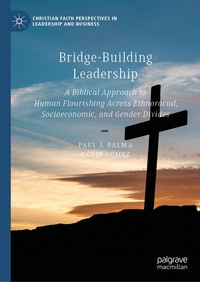
Bridge-Building Leadership
Description
This book examines the role of leadership in addressing ethno-racial, socio-economic, and gender divisions. Through an analysis of the Apostle Paul's writings, the authors investigate how leadership can bridge societal divides and facilitate human flourishing, conceptualized within a theistic framework of humanity's stewardship of God's creation.
Bridge-building leadership, rooted in the finished work of Jesus Christ-who through His death on the Cross and His Resurrection built the ultimate bridge between God and humanity-transcends differences of race, class, and gender, fostering relationality and inclusion. The authors propose a relational and cross-cultural model that embraces diversity to counteract division and misuse of power. The goal is to reconcile humanity first to the Creator and, flowing from that restored relationship, to one another, thereby achieving human flourishing.
Differentiating bridge-building leadership from other leadership models, this volume employs themes of reconciliation, social justice, and neighborly love to present a framework for overcoming societal differences. It will appeal to researchers and practitioners interested in the application of a Christ-centered model of leadership in contemporary contexts to promote human flourishing.
Reviews / Votes
"Palma and Gomez present a compelling argument that the Apostle Paul was addressing the complexities of intersectionality long before the term existed in modern sociology. They structure their analysis around the tripartite division of Galatians 3:28 with regards to race, class, and gender, thus demonstrating that these are not isolated silos of human experience but overlapping spheres of identity and oppression. Bridge-Building Leadership refuses to treat the 'Greek,' the 'Slave,' and the 'Female' as separate case studies; instead, it offers a holistic and theistic framework where the restoration of the
imago Dei
addresses the compounded nature of human marginalization." (Victor Counted, Director of the Office of Research and Sponsored Programs and Associate Professor, School of Psychology & Counseling, Regent University)
"Despite a seemingly endless proliferation of books on leadership, the quest to lead effectively in our deeply polarized world remains elusive.
Bridge-Building Leadership
charts a refreshing path forward. Starting from the foundation of Jesus as the personification of reconciliation, or Bridge (Gal. 3:28), the authors shepherd us through the theology and practice of a beautiful form of servant love that leads for the ultimate purpose of the flourishing of all. I highly recommend this wonderful guide to a life-changing-and world-healing-practice!" (Matthew T. Lee, Professor of the Social Sciences and Humanities and Associate Director at the Institute for Global Human Flourishing at Baylor University)
"This book captures the heart of what it means to lead as a follower of Christ, bringing people together across divides, listening with humility, and leading with love. In a fractured world, this bridge-building model of leadership is both prophetic and practical, offering a way forward for leaders who long to reflect the reconciling heart of Jesus in every relationship and decision. Leaders who want healthy flourishing and collaboration to flow from their leadership will be inspired and challenged by this work." (Jennifer Holloran, President/CEO, American Bible Society)
"
Bridge-Building Leadership
is both timely and valuable. Palma and Gomez offer a theologically grounded framework for reconciliation across the ethnoracial, socioeconomic, and gender divides that persistently undermine justice and human flourishing worldwide. Their biblical foundation, rooted in agapao love and the vision of Galatians 3:28, provides leaders in any context-from academia to human rights practice-with more than abstract ideals. The authors present actionable strategies for developing advocates who can navigate cultural and economic divisions with both conviction and competence. This book equips Christian leaders in this generation and the next to move beyond addressing symptoms of injustice toward building bridges that foster genuine, holistic flourishing in vulnerable communities globally." (Meg Kelsey, Director of the Center for Global Justice, Regent University School of Law)
"In a world that is becoming increasingly divided, where people are slipping through the widening gaps of socioeconomic and racial divides, we need courageous individuals now more than ever to lead and inspire others in building bridges across differences. Through their generous use of real-world and Scriptural examples, Palma and Gomez demonstrate bridge-building leadership that points beyond current, charged social narratives to the divine mandate for all who bear the
imago Dei
. As a female leader called to serve in racially and socioeconomically diverse settings, this book was both a call to action and a strong encouragement to persevere." (Rev. Vivian Hayes, Anglican Church of North America-Diocese of the Mid Atlantic)
"In a divided and polarizing world, church leaders need to acknowledge complicity in maintaining racial, ethnic and gender divisions where God intended to bridge them. This proposal for bridge-building leadership is direly needed as a call for leaders to act as bridge-builders. Taking their departure from the famous bridge-building passage of Galatians 3:28, the authors set an ambitious agenda for reconciling divisions in race, class and gender by leaders who are sensitive to fragmented and conflicted human lives in the 21st century. They root their agenda in a clear understanding of the
imago Dei
as well as the
missio Dei
, but most in the centrality of
agapao
love in all human relationships. Their proposal is well argued on the basis of a thorough biblical-theological study of race, class and gender, excellent insights from leadership studies, and a keen awareness of modern movements like Pentecostalism and the Lausanne conferences." (Jack Barentsen, Professor of Practical Theology emeritus, Evangelische Theologische Faculteit, Leuven, Institute of Leadership and Social Ethics)
"In their new book,
Bridge-Building Leadership
, Paul Palma and Doris Gomez provide a thorough, biblically-based remedy for the divisiveness that permeates our culture and our churches. This book is based on a solid exegetical treatment of the key distinctions identified by the Apostle Paul in Galatians 3:28, where he reminds us that in Christ, there are no distinctions based on nationalities, gender, or socio-economic class. The bridge-building model of leadership developed here is fueled by agapao love as its underlying ethical principle, the wellspring of unconditional love. However, Palma and Gomez do not stop there. In each chapter they provide contemporary examples and actionable recommendations that can be taken by each of us to practice the necessary bridge-building initiatives in our own lives. This message is urgently needed if we are to overcome the divisiveness that permeates our culture." (J. Lee Whittington, Dean & Professor of Management, Satish & Yasmin Gupta College of Business)
More details
Other editions
Additional editions
Persons
Paul J. Palma is on the Faculty of Regent University, USA, in the areas of Biblical Studies, Christian Ministry, and Leadership. His research and writing focus on Christianity in America, with particular attention to the intersection of faith, culture, and leadership.
Doris Gomez is Dean of the School of Business & Leadership at Regent University, USA. She has written and edited works on Christian leadership and business, with a particular emphasis on values-based leadership, and the integration of faith and leadership.
Content
Chapter 1: Introduction: Towards a Bridge-Building Vision of Human Flourishing.- Chapter 2: Biblical Foundations for Bridge-Building Leadership: Flourishing Through Reconciling Agapao Love.- Chapter 3: Ethnoracial Reconciliation: Realizing the One Multinational People of God.- Chapter 4 : Socioeconomic Reconciliation: Becoming Stewards Through Koinonia Fellowship.- Chapter 5: Gender Reconciliation: Rediscovering Humanity's Shared Image Bearing Identity.- Chapter 6: Bridge-Building, Human Flourishing, and the Future of Leadership Studies.- Chapter 7: Conclusion: Flourishing and Helping Others Flourish Through Bridge-Building Leadership.