

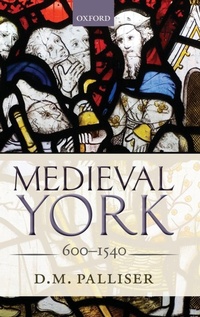
Medieval York
600-1540
Published on 23. January 2014
Book
Hardback
372 pages
978-0-19-925584-9 (ISBN)
Description
Medieval York provides a comprehensive history of what is now considered England's most famous surviving medieval city, covering nearly a thousand years. The volume examines York from its post-Roman revival as a town (c. 600) to the major changes of the 1530s and 1540s, which in many ways brought an end to the Middle Ages in England. York was one of the leading English towns after London, and in status almost always the 'second city'.
Much research and publication has been carried out on various aspects of medieval York, but this volume seeks to cover the field in its entirety. David Palliser offers an up-to-date and broad-based account of the city by employing the evidence of written documents, archaeology (especially on the rich results of recent city centre excavations), urban morphology, numismatics, art, architecture, and literature. Special attention is paid to the city's religious drama and its wealth of surviving stained glass.
The story of Medieval York is set in a wide context to make comparisons with other English and Continental towns, to establish how far York's story was distinctive or was typical of other English towns which have been less fortunate in the survival of their medieval fabric. It is essential reading for anyone interested in York's past and in its rich heritage of medieval churches, guildhalls, houses, streets, and city walls - the most complete medieval circuit in England.
Much research and publication has been carried out on various aspects of medieval York, but this volume seeks to cover the field in its entirety. David Palliser offers an up-to-date and broad-based account of the city by employing the evidence of written documents, archaeology (especially on the rich results of recent city centre excavations), urban morphology, numismatics, art, architecture, and literature. Special attention is paid to the city's religious drama and its wealth of surviving stained glass.
The story of Medieval York is set in a wide context to make comparisons with other English and Continental towns, to establish how far York's story was distinctive or was typical of other English towns which have been less fortunate in the survival of their medieval fabric. It is essential reading for anyone interested in York's past and in its rich heritage of medieval churches, guildhalls, houses, streets, and city walls - the most complete medieval circuit in England.
Reviews / Votes
This book is an outstanding achievement that will be warmly welcomed by historians in the North of England and by urban historians throughout the land. This book will remain the standard version of the history of medieval York for years to come * David Hey, Northern History * Palliser's masterful study reveals the richness and complexity of medieval urban life ... Recommended. * CHOICE * a very impressive synthesis of documentary records, archaeological evidence and the modern scholarship in a very accessible format ... Palliser's book should deservedly take its place in that list of 'new directions' and ... will play an important ongoing role in elucidating the history of medieval York for future generations. * Paul Oldfield, History * paints a vivid picture of a fascinating city * Current Archaeology * It is well written and nicely organised and exemplifies how to take new research and new ideas and present them in an important contribution to urban studies, which is most welcome. * Christian Steer, The Ricardian * masterly general survey * Nigel Tringham, Yorkshire Archaeological Journal * David Palliser has produced a book which is in almost every respect a masterwork of urban history, based on many years of reading and evaluating the mountain of texts which have been devoted to the study of medieval York ... an excellent book. * Tom Beaumont Jones, Medieval Archaeology *More details
Language
English
Place of publication
Oxford
United Kingdom
Illustrations
18 black and white illustrations
Dimensions
Height: 240 mm
Width: 161 mm
Thickness: 25 mm
Weight
722 gr
ISBN-13
978-0-19-925584-9 (9780199255849)
Copyright in bibliographic data and cover images is held by Nielsen Book Services Limited or by the publishers or by their respective licensors: all rights reserved.
Schweitzer Classification
Other editions
Additional editions
Person
D.M. Palliser, a native of York, taught at the universities of Keele, Birmingham, Hull, and Leeds, before retiring in 2004. He is now Honorary Visiting Professor in History at the University of York and Emeritus Professor of Medieval History at the University of Leeds. He has been researching and publishing on the city of York for nearly fifty years, and has also worked on the broader subject of medieval and early modern urban history. His publications include Tudor York (1979) and Volume I of the authoritative Cambridge Urban History of Britain, as well as numerous articles on the city.
Content
List of Illustrations ; Abbreviations ; 1. Origins and Myths: Eburacum and its Successors ; 2. One York or Several? The City Resettled ; 3. Anglo-Scandinavian York: 866-1066 ; 4. French Conquest and Lordship: 1066-1215 ; 5. Commune and Capital: c. 1215-1349 ; 6. A Golden Age? 1349-c. 1450 ; 7. 'Great ruin and extreme decay':c1450-c1540 ; Conclusion ; Bibliography ; Index