

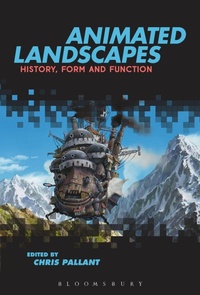
Animated Landscapes
History, Form and Function
Published on 23. February 2017
Book
Paperback/Softback
336 pages
978-1-5013-2011-8 (ISBN)
Description
Winner of the 2017 McLaren-Lambart Award for Best Book on the Subject of Animation
Studying landscape in cinema isn't quite new; it'd be hard to imagine Woody Allen without New York, or the French New Wave without Paris. But the focus on live-action cinema leaves a significant gap in studying animated films. With the almost total pervasiveness of animation today, this collection provides the reader with a greater sense of how the animated landscapes of the present relate to those of the past. Including essays from international perspectives, Animated Landscapes introduces an idea that has seemed, literally, to be in the background of animation studies.
The collection provides a timely counterpoint to the dominance of character (be that either animated characters such as Mickey Mouse or real world personalities such as Walt Disney) that exists within animation scholarship (and film studies more generally). Chapters address a wide range of topics including history, case studies in national contexts (including Australia, Japan, China and Latvia), the traversal of animated landscape, the animation of fantastical landscapes, and the animation of interactive landscapes. Animated Landscapes promises to be an invaluable addition to the existing literature, for the most overlooked aspect of animation.
Studying landscape in cinema isn't quite new; it'd be hard to imagine Woody Allen without New York, or the French New Wave without Paris. But the focus on live-action cinema leaves a significant gap in studying animated films. With the almost total pervasiveness of animation today, this collection provides the reader with a greater sense of how the animated landscapes of the present relate to those of the past. Including essays from international perspectives, Animated Landscapes introduces an idea that has seemed, literally, to be in the background of animation studies.
The collection provides a timely counterpoint to the dominance of character (be that either animated characters such as Mickey Mouse or real world personalities such as Walt Disney) that exists within animation scholarship (and film studies more generally). Chapters address a wide range of topics including history, case studies in national contexts (including Australia, Japan, China and Latvia), the traversal of animated landscape, the animation of fantastical landscapes, and the animation of interactive landscapes. Animated Landscapes promises to be an invaluable addition to the existing literature, for the most overlooked aspect of animation.
Reviews / Votes
This collection provides a rich and lively discussion on one of the most overlooked areas of animation-animated landscape, which, just as Pallant wants it to be, is to rebalance the long-term bias existing between character and landscape, which is related to the centrality of studies on character design and interpretation over reflections about landscapes. It ably explores the multivalent nature of animated landscape with an interdisciplinary and cross-disciplinary approach, which also deepens the reader's understanding of what animation is. * Alphaville: Journal of Film and Screen Media * For so long animation studies literature has focused mainly on animated characters-at last a book that examines the other part of the frame: backgrounds and environments. Through historical analysis and theoretical considerations, Animated Landscapes brings attention to a significant but largely overlooked realm of animation aesthetics. The broad scope of essays by leading scholars in the field reflect the diversity of animation today. * Maureen Furniss, Program Director of the Program in Experimental Animation, California Institute of the Arts, USA, and Founding Editor of Animation Journal * Animated landscapes: they're not just 'backgrounds' anymore. This collection by established and emerging scholars directs our attention to an aspect of animation that has long been treated as secondary, if it was considered at all. Far from being painting in motion, or even a depiction of nature, landscaping can be mindscaping, and an active, if not dominant element of the film, new media, or gaming experience. The book is a welcome addition to the growing body of work in animation studies. * Donald Crafton, The Joseph and Elizabeth Robbie Professor of Film, Television, and Theatre, University of Notre Dame, USA, and author of Shadow of a Mouse: Performance, Belief, and World-making in Animation * If Pallant's intention for his anthology was to question, interrogate and trace what it means for a landscape to become (and be considered) as 'animated', whilst shining the spotlight on an area that can at times appear to be 'virtually nothing' (p. 8), then the accomplishments of the included authors more than meet these goals. * Animation: An Interdisciplinary Journal *More details
Language
English
Place of publication
New York
United States
Publishing group
Bloomsbury Publishing Plc
Target group
College/higher education
Illustrations
30 bw illus
Dimensions
Height: 229 mm
Width: 152 mm
Thickness: 18 mm
Weight
485 gr
ISBN-13
978-1-5013-2011-8 (9781501320118)
Copyright in bibliographic data and cover images is held by Nielsen Book Services Limited or by the publishers or by their respective licensors: all rights reserved.
Schweitzer Classification
Other editions
Additional editions
E-Book
08/2015
1st Edition
Bloomsbury Academic USA
€43.49
Available for download
E-Book
08/2015
1st Edition
Bloomsbury Academic USA
€43.49
Available for download
Person
Chris Pallant is a Senior Lecturer at Canterbury Christ Church University, UK. His research includes animation, filmmaking production practices and technologies, and videogames. He has published on a range of topics, including Disney feature animation, the 'cartoonism' of Quentin Tarantino, performance capture, and Rockstar Games.
Content
List of Illustrations
Acknowledgements
Introduction
I - History: Formal Traditions
1. Seeing in Dreams - The Shifting Landscapes of Drawn Animation
Bryan Hawkins, Canterbury Christ Church University, UK
2. The Stop Motion Landscape
Chris Pallant, Canterbury Christ Church University, UK
3. Pixar, 'The Road to Point Reyes', and the long history of landscapes in new visual technologies
Malcolm Cook, Birkbeck, University of London, UK
II - History: National Perspectives
4. Australian Animation - Landscape, Isolation and Connections
Steven Allen, Winchester University, UK
5. Environmentalism and The Animated Landscape in Nausicaae of the Valley of the Wind (1984) and Princess Mononoke (1997)
Melanie Chan, York St John University, UK
6. Animating Shanshui: Chinese Landscapes in Animated Film, Art and Performance
Kiu-wai Chu, The University of Hong Kong
7. Latvian Animation: Landscapes of Resistance
Mihaela Mihailova, Yale University, USA
III - Form: Journeys Through Animated Space
8. The Landscape in the Memory: Animated Travel Diaries
Maria Lorenzo Hernandez, Universitat Politecnica de Valencia
9. Off the Rails: Animating Train Journeys
Birgitta Hosea, University of the Arts, London, UK
10. Between Setting and Character: A Taxonomy of Sentient Spaces in Fantasy Film
Fran Pheasant-Kelly, University of Wolverhampton, UK
IV - Form: Peripheral Perspectives
11. The Metamorphosis of Place: Projection-Mapped Animation
Dan Torre, RMIT, Australia
12. Plasmatic Pitches, Temporal Tracks and Conceptual Courts: The Landscapes of Animated Sport
Paul Wells, Loughborough University, UK
13. The Zombiefied Landscape: World War Z (2013), ParaNorman (2012), and the Politics of the Animated Corpse
James Newton, University of Kent, UK
V - Function: Interactivity
14. Evoking the Oracle: Visual Logic of Screen Worlds
Tom Klein, Loyola Marymount University, USA
15. Beyond the Animated Landscape: Videogame Glitches and the Sublime
Alan Meades, Canterbury Christ Church University, UK
List of Contributors
Bibliography
Animation/Filmography/Other Media
Index
Acknowledgements
Introduction
I - History: Formal Traditions
1. Seeing in Dreams - The Shifting Landscapes of Drawn Animation
Bryan Hawkins, Canterbury Christ Church University, UK
2. The Stop Motion Landscape
Chris Pallant, Canterbury Christ Church University, UK
3. Pixar, 'The Road to Point Reyes', and the long history of landscapes in new visual technologies
Malcolm Cook, Birkbeck, University of London, UK
II - History: National Perspectives
4. Australian Animation - Landscape, Isolation and Connections
Steven Allen, Winchester University, UK
5. Environmentalism and The Animated Landscape in Nausicaae of the Valley of the Wind (1984) and Princess Mononoke (1997)
Melanie Chan, York St John University, UK
6. Animating Shanshui: Chinese Landscapes in Animated Film, Art and Performance
Kiu-wai Chu, The University of Hong Kong
7. Latvian Animation: Landscapes of Resistance
Mihaela Mihailova, Yale University, USA
III - Form: Journeys Through Animated Space
8. The Landscape in the Memory: Animated Travel Diaries
Maria Lorenzo Hernandez, Universitat Politecnica de Valencia
9. Off the Rails: Animating Train Journeys
Birgitta Hosea, University of the Arts, London, UK
10. Between Setting and Character: A Taxonomy of Sentient Spaces in Fantasy Film
Fran Pheasant-Kelly, University of Wolverhampton, UK
IV - Form: Peripheral Perspectives
11. The Metamorphosis of Place: Projection-Mapped Animation
Dan Torre, RMIT, Australia
12. Plasmatic Pitches, Temporal Tracks and Conceptual Courts: The Landscapes of Animated Sport
Paul Wells, Loughborough University, UK
13. The Zombiefied Landscape: World War Z (2013), ParaNorman (2012), and the Politics of the Animated Corpse
James Newton, University of Kent, UK
V - Function: Interactivity
14. Evoking the Oracle: Visual Logic of Screen Worlds
Tom Klein, Loyola Marymount University, USA
15. Beyond the Animated Landscape: Videogame Glitches and the Sublime
Alan Meades, Canterbury Christ Church University, UK
List of Contributors
Bibliography
Animation/Filmography/Other Media
Index