

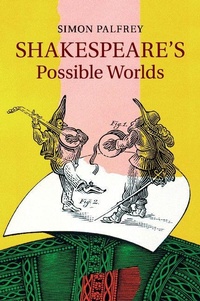
Shakespeare's Possible Worlds
Published on 1. June 2017
Book
Paperback/Softback
396 pages
978-1-107-64925-5 (ISBN)
Description
New methods are needed to do justice to Shakespeare. His work exceeds conventional models, past and present, for understanding playworlds. In this book, Simon Palfrey goes right to the heart of early modern popular drama, revealing both how it works and why it matters. Unlike his contemporaries, Shakespeare gives independent life to all his instruments, and to every fraction and fragment of the plays. Palfrey terms these particles 'formactions' - theatre-specific forms that move with their own action and passion. Palfrey's book is critically daring in both substance and format. Its unique mix of imaginative gusto, thought experiments, and virtuosic technique generates piercing close readings of the plays. There is far more to playlife than meets the eye. Influenced by Leibniz's visionary original model of possible worlds, Palfrey opens up the multiple worlds of Shakespeare's language, scenes, and characters as never before.
Reviews / Votes
'Shakespeare's Possible Worlds establishes Simon Palfrey as one of the great Shakespeare scholars of our age. On every page, Palfrey marshals his command of Renaissance theatrical technique and Baroque philosophy in order to float inventive readings that demonstrate the plenitude and plasticity of Shakespeare's dramatic imagining. Crafting both a philosophy of close reading and a dramaturgy of metaphor, Palfrey discovers a hermeneutics indigenous to theater. As Palfrey summons us to witness Shakespeare knitting shapes from the deep, we rediscover ourselves in the concatenation of worlds that drama assembles.' Julia Reinhard Lupton, University of California, Irvine, and author of Thinking with Shakespeare: Essays on Politics and Life '... unlike any other monograph in Shakespeare criticism published recently ... The intellectual labour that went into [this book] is dazzling. Ideas from literature, literary criticism, art history, fine arts, film, science, religion, rhetoric, philosophy, and new media abound, plunging the reader into an unexpected reading experience.' Goran Stanivukovic, Saint Mary's University, Nova ScotiaMore details
Language
English
Place of publication
Cambridge
United Kingdom
Target group
College/higher education
Product notice
Paperback (trade)
Dimensions
Height: 229 mm
Width: 152 mm
Thickness: 22 mm
Weight
572 gr
ISBN-13
978-1-107-64925-5 (9781107649255)
Copyright in bibliographic data and cover images is held by Nielsen Book Services Limited or by the publishers or by their respective licensors: all rights reserved.
Schweitzer Classification
Other editions
Additional editions
Simon Palfrey
Shakespeare's Possible Worlds
Book
05/2014
Cambridge University Press
€132.50
Shipment within 15-20 days
Person
Simon Palfrey is Professor of English Literature at the University of Oxford. He is the joint founding editor of Shakespeare Now! His books include Late Shakespeare: A New World of Words (1997), Doing Shakespeare (2004, 2011 - named a Times Literary Supplement International Book of the Year), Shakespeare in Parts (with Tiffany Stern, 2007 - winner of an Arts and Humanities Research Council Innovations Award and the Medieval and Renaissance Drama Society David Bevington Award for best new book on Medieval and Renaissance drama), and Poor Tom: Living 'King Lear' (2014).
Content
Part I: 1. Where is the life?; 2. Purposes; 3. Embryologies; 4. Shakespeare the impossible; 5. Popular theatre and possibility; 6. Shakespeare v. actor; 7. Formactions; 8. Playing to the plot; 9. Middleton; 10. Jacobean comi-tragedy; 11. Everyman tyrant; Part II: 12. The monadic playworld; 13. The truth of anachronism; 14. Possible history: Henry IV; 15. Anti-rhetoric; 16. Falstaff; 17. Scenes within scenes; 18. Strange mimesis; 19. How close should we get?; 20. Metaphysics and playworlds; 21. Pyramids of possible worlds; Part III: 22. Perdita's possible lives; 23. A life in scenes; 24. Scene as joke: Much Ado; 25. Buried lives: Macbeth; 26. The rape of Marina; 27. Life at the end of the line: Macbeth; 28. Dying for life: Desdemona; Epilogue: life on the line.