

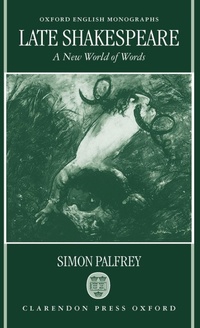
Late Shakespeare
A New World of Words
Published on 21. August 1997
Book
Hardback
312 pages
978-0-19-818619-9 (ISBN)
Description
Shakespeare's late plays are usually seen in terms of courtliness and escapism. But the critical tradition has been too decorous. Neither neo-Christian pieties nor high-political allegory can account for the works' audacity and surprise, or the popular investment in both their form and meaning. Post-structuralist and historicist approaches show the indeterminacy and materiality of language, but rarely identify how particular figures (words and characters) capture and energise contested history. Recent criticism tends to put a pre-emptive `master-paradigm' above all else; a more sinuous, minutely attentive critical vocabulary is needed to apprehend Shakespeare's turbulent, precise, teeming metaphorical discourse.
Late Shakespeare: A New World of Words reappraises the origins of authority, language, and decorum, and the prospects for each. Through his portrayal of `popular' desire---in his rustics, clowns, rogues, slaves, women---Shakespeare presents worlds which explore the meaning of the `subject', and the potential for effective transformatory agency. Rather than a Jonsonian (or perhaps earlier Shakespearian) verisimilitude, with each person discrete and verifiable, Shakespeare's characters embody metaphor-in-process; like the revamped romance genre itself, they `take on' surrounding turbulence.
The plays show the stormy consequences of hegemonic violence. The subsequent exile to wilderness allows for contingent novelty: new liberties are tested amid the wreckage or recapitulation of old forms. The plays pit possible sources of regeneration (romantic pastoral, semi-populist humanism) against more primal violence and rebelliousness. Finally, the book argues against a conventional sense of the plays' movement towards divinely sanctioned closure; mischief, irony, polysemy remain; romance's political problems are competitive, multiple, and tumescently unpredictable.
Late Shakespeare: A New World of Words reappraises the origins of authority, language, and decorum, and the prospects for each. Through his portrayal of `popular' desire---in his rustics, clowns, rogues, slaves, women---Shakespeare presents worlds which explore the meaning of the `subject', and the potential for effective transformatory agency. Rather than a Jonsonian (or perhaps earlier Shakespearian) verisimilitude, with each person discrete and verifiable, Shakespeare's characters embody metaphor-in-process; like the revamped romance genre itself, they `take on' surrounding turbulence.
The plays show the stormy consequences of hegemonic violence. The subsequent exile to wilderness allows for contingent novelty: new liberties are tested amid the wreckage or recapitulation of old forms. The plays pit possible sources of regeneration (romantic pastoral, semi-populist humanism) against more primal violence and rebelliousness. Finally, the book argues against a conventional sense of the plays' movement towards divinely sanctioned closure; mischief, irony, polysemy remain; romance's political problems are competitive, multiple, and tumescently unpredictable.
Reviews / Votes
presents valuable insights into the undercurrent of turbulence and discord that informs these romantic plays - R.H. Peake, formerly of the University of Virginia, Choice, Vol 35, No. 10, June '98More details
Series
Language
English
Place of publication
Oxford
United Kingdom
Publishing group
Oxford University Press
Target group
Professional and scholarly
Dimensions
Height: 222 mm
Width: 145 mm
Thickness: 22 mm
Weight
573 gr
ISBN-13
978-0-19-818619-9 (9780198186199)
Copyright in bibliographic data and cover images is held by Nielsen Book Services Limited or by the publishers or by their respective licensors: all rights reserved.
Schweitzer Classification
Other editions
Additional editions
Book
01/2000
Oxford University Press
€88.10
Shipment within 15-20 days
Person
Simon Palfrey is Lecturer in English and the History of Ideas at the University of Melbourne.
Content
Introduction ; 1. Romance, irony, and humanism ; 2. Pericles and the idea of the hero ; 3. Court ; 4. Country ; 5. Magnetic Island and Islander in The Tempest ; 6. Violence and Freedom ; 7. Women and Romance ; 8. Endings ; Abbreviations ; Selected Primary References ; Selected Secondary References