

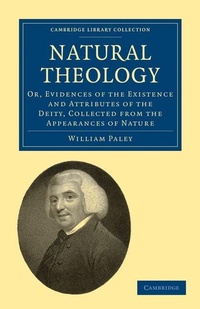
Natural Theology
Or, Evidences of the Existence and Attributes of the Deity, Collected from the Appearances of Nature
6th Edition
Published on 20. July 2009
Book
Paperback/Softback
604 pages
978-1-108-00355-1 (ISBN)
Description
William Paley (1743-1805) argues for the existence of God as the intelligent creator of the world in this, his last book, published in 1802. He builds on early modern natural theology including the works of John Ray, William Derham, and Bernard Nieuwentyt, and most of his examples are taken from medicine and natural history. Paley uses analogy and metaphors, including a particularly well-written version of the 'watchmaker analogy', to prove that the world is designed and sustained by God. This sixth edition also contains a detailed bibliography, appendices on Paley's courses, and background notes on key figures. It was an influential best-seller throughout the nineteenth century, read by theologians and scientists alike, and reprinted in cheap editions for the middle classes. It inspired many nineteenth-century works on natural theology, including the Bridgewater Treatises (which also appear in this series), and is a landmark of Western thought.
More details
Series
Edition
6th Revised edition
Language
English
Place of publication
Cambridge
United Kingdom
Target group
Professional and scholarly
Edition type
Revised edition
Product notice
Paperback (trade)
Illustrations
Worked examples or Exercises
Dimensions
Height: 216 mm
Width: 140 mm
Thickness: 35 mm
Weight
841 gr
ISBN-13
978-1-108-00355-1 (9781108003551)
Copyright in bibliographic data and cover images is held by Nielsen Book Services Limited or by the publishers or by their respective licensors: all rights reserved.
Schweitzer Classification
Content
1. State of the argument; 2. State of the argument continued; 3. Application of the argument; 4. Of the succession of plants and animals; 5. Application of the argument continued; 6. The argument cumulative; 7. Of the mechanical and immechanical functions of animals and vegetables; 8. Of mechanical arrangement in the human frame-of the bones; 9. Of the muscles; 10. Of the vessels of animal bodies; 11. Of the animal structure regarded as a mass; 12. Comparative anatomy; 13. Peculiar organisations; 14. Prospective contrivances; 15. Relations; 16. Compensations; 17. The relation of animated bodies to inanimate nature; 18. Instincts; 19. Of insects; 20. Of plants; 21. Of the elements; 22. Astronomy; 23. Personality of the Deity; 24. Of the natural attributes of the Deity; 25. Of the unity of the Deity; 26. The goodness of the Deity; 27. Conclusions.