

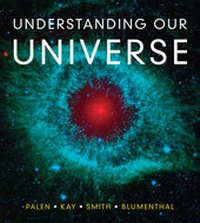
Understanding Our Universe
Published on 23. December 2011
Book
Paperback/Softback
560 pages
978-0-393-91210-4 (ISBN)
Description
Understanding Our Universe was constructed with the latest astronomy education research in mind: students learn by doing. The learning system allows students to immediately apply what they learn, gain a deeper understanding of the science, build confidence, and make meaningful connections to their everyday lives.
More details
Language
English
Place of publication
New York
United States
Dimensions
Height: 272 mm
Width: 246 mm
Thickness: 20 mm
Weight
1273 gr
ISBN-13
978-0-393-91210-4 (9780393912104)
Copyright in bibliographic data and cover images is held by Nielsen Book Services Limited or by the publishers or by their respective licensors: all rights reserved.
Schweitzer Classification
Other editions
New editions
Stacy Palen | Laura Kay | Bradford Smith
Understanding Our Universe
Book
10/2014
2nd Edition
WW Norton & Co
€126.48
Article exhausted; check for reprint
Persons
Stacy Palen is an award-winning professor in the physics department at Weber State University. She received her BS in physics from Rutgers University and her PhD in physics from the University of Iowa. As a lecturer and postdoc at the University of Washington, she taught Introductory Astronomy more than 20 times over 4 years. Since joining Weber State, she has been very active in science outreach activities ranging from star parties to running the state Science Olympiad. Stacy does research in formal and informal astronomy education and the death of Sun-like stars. She spends much of her time thinking, teaching, and writing about the applications of science in everyday life. She then puts that science to use on her small farm in Ogden, Utah.
Laura Kay is Ann Whitney Olin professor and Chair of the Department of Physics and Astronomy at Barnard College, where she has taught since 1991. She received a BS degree in physics and an AB degree in feminist studies from Stanford University, and MS and PhD degrees in astronomy and astrophysics from the University of California-Santa Cruz. As a graduate student she spent 13 months at the Amundsen Scott station at the South Pole in Antarctica, and has had fellowships in Chile and Brazil. She studies active galactic nuclei using optical and X-ray telescopes. At Barnard she teaches courses on astronomy, astrobiology, women and science, and polar exploration.
Brad Smith is a retired professor of planetary science. He has served as an associate professor of astronomy at New Mexico State University, a professor of planetary sciences and astronomy at the University of Arizona, and as a research astronomer at the University of Hawaii. Through his interest in Solar System astronomy, he has participated as a team member or imaging team leader on several U.S. and international space missions, including Mars Mariners 6, 7, and 9; Viking; Voyagers 1 and 2; and the Soviet Vega and Phobos missions. He later turned his interest to extrasolar planetary systems, investigating circumstellar debris disks as a member of the Hubble Space Telescope NICMOS experiment team. Brad has four times been awarded the NASA Medal for Exceptional Scientific Achievement. He is a member of the IAU Working Group for Planetary System Nomenclature and is Chair of the Task Group for Mars Nomenclature. George Blumenthal is the director of the Center for Studies in Higher Education at the University of California, Berkeley. From 2006 to 2019 he was chancellor at the University of California, Santa Cruz. He joined the UC Santa Cruz faculty as a professor of astronomy and astrophysics in 1972. Chancellor Blumenthal received his BS degree from the University of Wisconsin-Milwaukee and his PhD in physics from the University of California, San Diego. As a theoretical astrophysicist, Blumenthal's research encompasses several broad areas, including the nature of the dark matter that constitutes most of the mass in the universe, the origin of galaxies and other large structures in the universe, the earliest moments in the universe, astrophysical radiation processes, and the structure of active galactic nuclei such as quasars.
Laura Kay is Ann Whitney Olin professor and Chair of the Department of Physics and Astronomy at Barnard College, where she has taught since 1991. She received a BS degree in physics and an AB degree in feminist studies from Stanford University, and MS and PhD degrees in astronomy and astrophysics from the University of California-Santa Cruz. As a graduate student she spent 13 months at the Amundsen Scott station at the South Pole in Antarctica, and has had fellowships in Chile and Brazil. She studies active galactic nuclei using optical and X-ray telescopes. At Barnard she teaches courses on astronomy, astrobiology, women and science, and polar exploration.
Brad Smith is a retired professor of planetary science. He has served as an associate professor of astronomy at New Mexico State University, a professor of planetary sciences and astronomy at the University of Arizona, and as a research astronomer at the University of Hawaii. Through his interest in Solar System astronomy, he has participated as a team member or imaging team leader on several U.S. and international space missions, including Mars Mariners 6, 7, and 9; Viking; Voyagers 1 and 2; and the Soviet Vega and Phobos missions. He later turned his interest to extrasolar planetary systems, investigating circumstellar debris disks as a member of the Hubble Space Telescope NICMOS experiment team. Brad has four times been awarded the NASA Medal for Exceptional Scientific Achievement. He is a member of the IAU Working Group for Planetary System Nomenclature and is Chair of the Task Group for Mars Nomenclature. George Blumenthal is the director of the Center for Studies in Higher Education at the University of California, Berkeley. From 2006 to 2019 he was chancellor at the University of California, Santa Cruz. He joined the UC Santa Cruz faculty as a professor of astronomy and astrophysics in 1972. Chancellor Blumenthal received his BS degree from the University of Wisconsin-Milwaukee and his PhD in physics from the University of California, San Diego. As a theoretical astrophysicist, Blumenthal's research encompasses several broad areas, including the nature of the dark matter that constitutes most of the mass in the universe, the origin of galaxies and other large structures in the universe, the earliest moments in the universe, astrophysical radiation processes, and the structure of active galactic nuclei such as quasars.
Content
Part I
Chapter 1: Our Place in the Universe
Chapter 2: Patterns in the Sky-Motions of Earth
Chapter 3: Laws of Motion
Chapter 4: Light and Telescopes
Part II
Chapter 5: The Formation of Stellar Systems
Chapter 6: Terrestrial Worlds in the Inner Solar System
Chapter 7: Atmospheres of Venus, Earth, and Mars
Chapter 8: The Giant Planets
Chapter 9: Small Bodies of the Solar System
Part III
Chapter 10: Measuring the Stars
Chapter 11: Our Star: The Sun
Chapter 12: Evolution of Low-Mass Stars
Chapter 13: Evolution of High-Mass Stars
Part IV
Chapter 14: The Expansion of Space
Chapter 15: The Realm of the Galaxies
Chapter 16: Our Galaxy: The Milky Way
Chapter 17: Modern Cosmology and the Origin of Structure
Chapter 18: Life in the Universe
Chapter 1: Our Place in the Universe
Chapter 2: Patterns in the Sky-Motions of Earth
Chapter 3: Laws of Motion
Chapter 4: Light and Telescopes
Part II
Chapter 5: The Formation of Stellar Systems
Chapter 6: Terrestrial Worlds in the Inner Solar System
Chapter 7: Atmospheres of Venus, Earth, and Mars
Chapter 8: The Giant Planets
Chapter 9: Small Bodies of the Solar System
Part III
Chapter 10: Measuring the Stars
Chapter 11: Our Star: The Sun
Chapter 12: Evolution of Low-Mass Stars
Chapter 13: Evolution of High-Mass Stars
Part IV
Chapter 14: The Expansion of Space
Chapter 15: The Realm of the Galaxies
Chapter 16: Our Galaxy: The Milky Way
Chapter 17: Modern Cosmology and the Origin of Structure
Chapter 18: Life in the Universe