

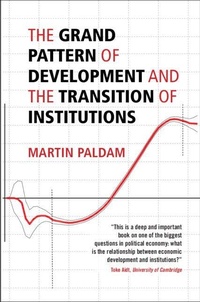
The Grand Pattern of Development and the Transition of Institutions
Will be published approx. on 19. August 2021
Book
Hardback
286 pages
978-1-316-51550-1 (ISBN)
Description
The culmination of a long-lasting and impressive research program, this book summarizes the relationship between economic development with income on the one hand and the evolution of institutions on the other; the transition of countries from one economic and social system to another. The author considers the transitions of two types of institutions: The first is external; it is legal-administrative systems with staff and buildings. The political system and the economic system are considered. The second consists of traditions and beliefs. Here corruption and religiosity are considered. Contrary to the claim that institutions are causal to development, this book demonstrates that the main direction of causality is from income to institutions. As countries get wealthy, they become secular democracies with low corruption and a mixed economic system. In this impressive coda, Paldam shows that the evolution of institutions is not causal to the economic growth process but rather follows it.
Reviews / Votes
'Martin Paldam has for a long time made major contributions to help us understand the relationship between economic growth and political institutions. His uses a large number of data skillfully and in an extraordinary way; his focus always is on the questions and issues involved. It is most welcome that his immense knowledge is now presented in this book.' Bruno S. Frey, University of Basel 'This is a 'big think' book, examining the interrelationship of social, political and economic variables in countries' transition from low to high incomes. Paldam painstakingly identifies the best available data and with appropriate qualifications and concludes that the level of income was the major driver of these variables. This is an important contribution to our understanding of the relationship between key variables in the development process.' Anne O. Krueger, John Hopkins University 'This is a deep and important book on one of the biggest questions in political economy: what is the relationship between economic development and institutions? Paldam's central thesis is that economic development causes democratization and eliminates corruption in the long run. His arguments are persuasive, the result of years of thoughtful scholarship. The book is a must read for anyone who wants to understand the connection between development and institutions.' Toke Aidt, University of Cambridge 'Martin Paldam investigates the grand pattern of development. No small puzzles for him. His answers are most sensible, and they can differ from the pronouncements heralded from the towers of privileged domains. He does not equivocate to avoid what some people prefer he not say. He is a careful thinker and cautious empiricist who weighs his conclusions carefully. In this book he addresses the societal transitions that are so important for economic development.' Arye Hillman, Bar-Ilan UniversityMore details
Language
English
Place of publication
Cambridge
United Kingdom
Target group
Professional and scholarly
Illustrations
Worked examples or Exercises
Dimensions
Height: 235 mm
Width: 157 mm
Thickness: 20 mm
Weight
571 gr
ISBN-13
978-1-316-51550-1 (9781316515501)
Copyright in bibliographic data and cover images is held by Nielsen Book Services Limited or by the publishers or by their respective licensors: all rights reserved.
Schweitzer Classification
Other editions
Additional editions
E-Book
08/2021
Cambridge University Press
€31.49
Available for download
Person
Martin Paldam is Professor Emeritus in the Department of Economics and Management at Aarhus University.
Content
Foreword; Part I. Main Ideas: 1. Introduction; 2. Some technical points; 3. The largest historical event: the end of Soviet socialism; Part II. The Transitions of Institutions: Part IIA. The Democratic Transition: 4. Literature, data, transition path and causality; 5. The jumps model for the short run, 1960-2016; 6. Events are practically random; 7. Three pillars model for the long run, 1800-2016; Part IIB. The Transition of the Economic System: 8. Ownership preferences: the B-index; 9. Economic freedom: the F-index; Part IIC. The Transitions in Traditions and Beliefs: 10. The transition of corruption; 11. The religious transition; Part III. The Grand Transition: 12. The hump-shaped transition path for the growth rate; 13. Do improvements of institutions harm development?; 14. Conclusions.