

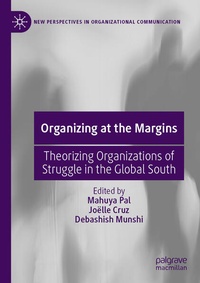
Organizing at the Margins
Description
This edited volume presents complex issues surrounding economic and cultural injustices in the global South and the social imaginaries articulated by vulnerable communities in these extractive zones. These organizations of struggle by disenfranchised members in the global South bring forth a collective of knowledge to decolonize organizational theory and think of organizing a more just world.
The essays in this volume critique and connect meanings of "organizations" in relation to neoliberalism, coloniality, and social justice. More specifically, scholars engage with ideas of resistance such as invisible histories in management theory, hybrid collective action, self-determination and indigenous sovereignty, and decolonizing institutions. The chapters also cover a wide range of locations including feminist movements in Latin America, the struggles of Palestinians in self-exile to connect with their homeland, and reproductive labor in Sri Lanka to the decolonial potential of Black Lives Matter in the US and insights into organizing resistance in parts of Asia and Africa.
For scholars and policymakers, this book presents emancipatory essays that interrogate the cultural, social, political, and historical issues pertaining to organizations in the context of the neoliberal economy.
Reviews / Votes
Organizing at the Margins Theorizing: Organizations of Struggle in the Global South is a revolutionary book that disrupts the dominance of Eurocentric epistemology by demonstrating the power and value of alternative modes of organizing in the Global South. It is a must read for those who want to move beyond calls for decolonization to realizing the otherwise.Stella Nkomo , University of Pretoria, South Africa
The global insights and interventions in this groundbreaking collection contribute to both the knowledge and practices that circulate across political economies and the felt-sensing affects of contested borders, social democracy, distributions of labor, race futures, and international progressive action. The essays are profoundly aspirational and a testament to the beautiful hard-won labor of deep thinking and commitment to intellectual theory and communions of praxis. Read on and experience the purpose and joy across these pages.
D. Soyini Madison , Professor Emeritus, Northwestern University, Acts of Activism: Human Rights as Radical Performance (Cambridge UP), USA
More details
Other editions
Additional editions
Persons
Mahuya Pal is Associate Professor in the Department of Communication at the University of South Florida. Her critical organizational communication research explores decolonial politics anchored in organizing of resistance by underprivileged communities against institutional power. She contextualizes her research within the twenty-first century concerns about unbridled growth of transnational corporations.
Joëlle Cruz is Associate Professor in the Department of Communication at the University of Colorado Boulder, USA. Her research focuses on intersections of alternative organizing (e.g., grassroots, community-based organizing, and social movements) and culture. A postcolonial and decolonial feminist scholar, Joëlle is interested in rethinking and expanding what constitutes the "margins" in organizational communication.
Debashish Munshi is Professor of Management Communication at the University of Waikato, Aotearoa New Zealand. His scholarly interests weave through critical communication studies, critical management studies, and subaltern historiography. His research explores alternative cultural (especially Indigenous, feminist, and postcolonial) models of building relationships with and among marginalised publics and working towards sustainable futures.
Content
CHAPTER 1 - Organizing away from the gaze: Local knowledges, new futures, Mahuya Pal, Joëlle Cruz, and Debashish Munshi.- Part I: Decolonizing dominant epistemologies.- CHAPTER 2 - Decolonizing knowledge: Cultural aspirations, political self-determination, and social rights in knowledge making , Linda Tuhiwai Smith in conversation with Debashish Munshi.- CHAPTER 3 - For another democratic language: Feminist action in Latin America and the reconstruction of the political, Lara Martim Rodrigues Selis and Natalia Maria Felix de Souza.- CHAPTER 4 - Hybrid collective action, Silvio Waisbord .- CHAPTER 5 - Alternative economic discourses from the margins: Kenyan migrant women's informal childcare organizing as an alternative economic discourse in the contemporary U.S. context, Nancy Maingi Ngwu.- CHAPTER 6 - Bound(less): Re-storying entrepreneurship , Chigozirim Utah Sodeke.- Part II: Dismantling borders.- CHAPTER 7 - Reflexivity and solidarity in culture-centered research with marginalized populations, Jaime Robb.- CHAPTER 8 - The imagined freedom: Borders and exile in the global South, Abdalhadi Alijla.- CHAPTER 9 - Border struggle: Invisible [hi]story of the other in management/organization studies, J. Miguel Imas.- Part III: Deconstructing structures.- CHAPTER 10 - Culture-centered organizing at the "margins of the margins:" Dismantling structures, decolonizing futures, Mohan J. Dutta.- CHAPTER 11- Emotional communities in the economy of emotions: A study of discursive muscularity in networked mobilization of fan groups in China, Zhuo Ban.- CHAPTER 12 - Black Lives Matter as postcolonial organizing, Angela N. Gist-Mackey and Hannah Oliha-Donaldson.- CHAPTER 13 - Producing and (re) producing? An ethnographic narrative of female estate and apparel workers of Sri Lanka, Prajna Seneviratne