

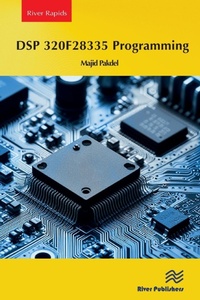
DSP 320F28335 Programming
1st Edition
Published on 24. June 2024
Book
Paperback/Softback
134 pages
978-87-7004-197-3 (ISBN)
Description
This book provides a comprehensive, practical approach to understanding and implementing the programming concepts of the DSP 320F28335 microcontroller. It is an indispensable guide for both seasoned professionals and beginners interested in mastering the complexities of programmable digital signal processors (DSPs).
Inside, you will embark on a journey through the world of DSPs, exploring various programming techniques and strategies tailored specifically for the 320F28335 microcontroller. From the fundamentals of DSP programming to advanced signal processing algorithms, this book covers it all. Each chapter is carefully crafted, offering clear explanations, step-by-step examples, and hands-on exercises to reinforce your learning. You will learn how to harness the power of the 320F28335 microcontroller to develop real-time applications.
Whether you are a seasoned programmer looking to expand your knowledge or a beginner ready to dive into the world of DSPs, "DSP 320F28335 Programming"" will be your ultimate companion. With its comprehensive coverage, insightful explanations, and practical examples, this book is a must-have resource for anyone aiming to excel in the realm of digital signal processing programming.
Inside, you will embark on a journey through the world of DSPs, exploring various programming techniques and strategies tailored specifically for the 320F28335 microcontroller. From the fundamentals of DSP programming to advanced signal processing algorithms, this book covers it all. Each chapter is carefully crafted, offering clear explanations, step-by-step examples, and hands-on exercises to reinforce your learning. You will learn how to harness the power of the 320F28335 microcontroller to develop real-time applications.
Whether you are a seasoned programmer looking to expand your knowledge or a beginner ready to dive into the world of DSPs, "DSP 320F28335 Programming"" will be your ultimate companion. With its comprehensive coverage, insightful explanations, and practical examples, this book is a must-have resource for anyone aiming to excel in the realm of digital signal processing programming.
More details
Language
English
Place of publication
Gistrup
Denmark
Target group
College/higher education
Professional and scholarly
Postgraduate and Professional Practice & Development
Illustrations
22 s/w Abbildungen, 112 farbige Abbildungen
112 Illustrations, color; 22 Illustrations, black and white
Dimensions
Height: 234 mm
Width: 156 mm
Thickness: 8 mm
Weight
231 gr
ISBN-13
978-87-7004-197-3 (9788770041973)
Copyright in bibliographic data and cover images is held by Nielsen Book Services Limited or by the publishers or by their respective licensors: all rights reserved.
Schweitzer Classification
Other editions
Additional editions
Majid Pakdel
DSP 320F28335 Programming
E-Book
06/2024
1st Edition
Taylor & Francis
€74.99
Available for download
Majid Pakdel
DSP 320F28335 Programming
E-Book
06/2024
1st Edition
River Publishers
€74.99
Available for download
Person
Majid Pakdel received his Bachelor's degree in Electrical-Telecommunications Engineering from Amirkabir University of Technology, Tehran in 2004, his Master's degree in Electrical power Engineering from Isfahan University of Technology in 2007, his Ph.D. in Electrical power Engineering from University of Zanjan in 2018, and his Master's degree in Computer Engineering-Artificial Intelligence and Robotics from Malek Ashtar University of Technology, Tehran in 2023. He has published over 20 papers and 3 books in the fields of electrical engineering and computer science. He was a visiting Ph.D. student in the Department of Energy Technology at Aalborg University between 2015 and 2016.
Content
1. Introduction to Microprocessors 2. Memory Organization and I/O Ports 3. System Interrupts and Timers 4. Digital to Analog Conversion 5. Analog to Digital Conversion 6. Code Generation Using Simulink, PSIM, and PLECS