

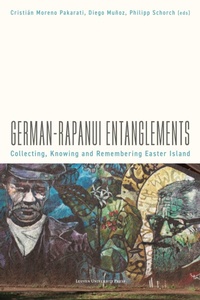
German-Rapanui Entanglements
Collecting, Knowing and Remembering Easter Island
Will be published approx. on 1. September 2026
Book
Paperback/Softback
250 pages
978-94-6270-526-5 (ISBN)
Description
Groundbreaking material-visual history and ethnography of German-Rapanui entanglements.
This book traces German-Rapanui entanglements from past to present through encounters between scholars, missionaries, institutions and Indigenous actors, and through the material and visual traces-objects, photographs, and texts-that continue to shape knowledge and memory of Rapa Nui (Easter Island). Moving beyond limiting Eurocentric frames, it highlights how Rapanui people have actively engaged with German and German-speaking individuals and institutions to (re)shape different practices and discourses of 'Rapanuiness'.
The chapters bring these dynamics to life: from Bavarian Capuchin activities that reached far beyond conversion, to collecting and exhibiting networks linking Altoetting in Bavaria to Rapa Nui; from German efforts to record oral traditions and the 1957 German-Chilean expedition, to long-term archaeological collaborations at Ava Ranga Uka A Toroke Hau.
Written by scholars based in Rapa Nui, Germany, Chile, France, and the United States, the volume shows how Rapanui communities have shifted from being marginalised in the management of their heritage to becoming key agents in its interpretation and future. Together, these studies illuminate three centuries of entanglement-and their powerful resonance today.
This book traces German-Rapanui entanglements from past to present through encounters between scholars, missionaries, institutions and Indigenous actors, and through the material and visual traces-objects, photographs, and texts-that continue to shape knowledge and memory of Rapa Nui (Easter Island). Moving beyond limiting Eurocentric frames, it highlights how Rapanui people have actively engaged with German and German-speaking individuals and institutions to (re)shape different practices and discourses of 'Rapanuiness'.
The chapters bring these dynamics to life: from Bavarian Capuchin activities that reached far beyond conversion, to collecting and exhibiting networks linking Altoetting in Bavaria to Rapa Nui; from German efforts to record oral traditions and the 1957 German-Chilean expedition, to long-term archaeological collaborations at Ava Ranga Uka A Toroke Hau.
Written by scholars based in Rapa Nui, Germany, Chile, France, and the United States, the volume shows how Rapanui communities have shifted from being marginalised in the management of their heritage to becoming key agents in its interpretation and future. Together, these studies illuminate three centuries of entanglement-and their powerful resonance today.
Reviews / Votes
From the introduction and throughout its vibrant contributing chapters, the book never loses focus. Its emphasis on how the Indigenous community of Rapa Nui (Easter Island) entered and, in many ways, regained its standing in discussing the collection, curation, and interpretation of its cultural heritage is unique. The edited volume could very much redefine anthropology and the museums associated with this discipline for years to come. - Rainer Buschmann, California State University Channel IslandsMore details
Language
English
Place of publication
Leuven
Belgium
Target group
US School Grade: College Graduate Student and over
Product notice
Paperback (trade)
Illustrations
Not illustrated
Dimensions
Height: 233 mm
Width: 155 mm
Weight
454 gr
ISBN-13
978-94-6270-526-5 (9789462705265)
Copyright in bibliographic data and cover images is held by Nielsen Book Services Limited or by the publishers or by their respective licensors: all rights reserved.
Schweitzer Classification
Persons
Cristian Moreno Pakarati is a historian, independent researcher and founder of Rapanui Pioneers Society in Hanga Roa, Rapa Nui.
Diego Munoz is an anthropologist and affiliated researcher in the ERC project 'IndiGen' at LMU Munich, Germany, and at the Centre de Recherche et de Documentation sur l'Oceanie, France.
Philipp Schorch is Professor of Museum Anthropology at LMU Munich, Germany, and an Honorary Senior Research Associate at the Museum of Archaeology and Anthropology at the University of Cambridge, UK.
Diego Munoz is an anthropologist and affiliated researcher in the ERC project 'IndiGen' at LMU Munich, Germany, and at the Centre de Recherche et de Documentation sur l'Oceanie, France.
Philipp Schorch is Professor of Museum Anthropology at LMU Munich, Germany, and an Honorary Senior Research Associate at the Museum of Archaeology and Anthropology at the University of Cambridge, UK.