

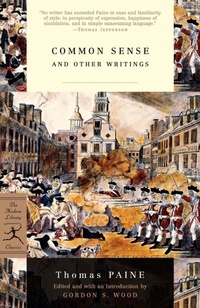
Common Sense
and Other Writings
Published on 11. February 2003
Book
Paperback/Softback
352 pages
978-0-375-76011-2 (ISBN)
Description
Includes the complete texts of Common Sense; Rights of Man, Part the Second; The Age of Reason (part one); Four Letters on Interesting Subjects, published anonymously and just discovered to be Paine's work; and Letter to the Abbé Raynal, Paine's first examination of world events; as well as selections from The American Crises
In 1776, America was a hotbed of enlightenment and revolution. Thomas Paine not only spurred his fellow Americans to action but soon came to symbolize the spirit of the Revolution. His elegantly persuasive pieces spoke to the hearts and minds of those fighting for freedom. He was later outlawed in Britain, jailed in France, and finally labeled an atheist upon his return to America.
In 1776, America was a hotbed of enlightenment and revolution. Thomas Paine not only spurred his fellow Americans to action but soon came to symbolize the spirit of the Revolution. His elegantly persuasive pieces spoke to the hearts and minds of those fighting for freedom. He was later outlawed in Britain, jailed in France, and finally labeled an atheist upon his return to America.
More details
Series
Language
English
Place of publication
United States
Publishing group
Random House USA Inc
Product notice
Paperback (trade)
Dimensions
Height: 203 mm
Width: 132 mm
Thickness: 19 mm
Weight
393 gr
ISBN-13
978-0-375-76011-2 (9780375760112)
Copyright in bibliographic data and cover images is held by Nielsen Book Services Limited or by the publishers or by their respective licensors: all rights reserved.
Schweitzer Classification
Other editions
Additional editions
Persons
Thomas Paine (1737-1809) was an English-born political philosopher and writer whose works significantly influenced the American and French revolutions. In 1774, he emigrated to the American colonies with the assistance of Benjamin Franklin, arriving just in time to participate in the burgeoning revolutionary movement. His pamphlet Common Sense (1776) was instrumental in galvanizing public support for American independence from Britain.Following the American Revolution, Paine returned to Europe and became involved in the French Revolution. He authored Rights of Man (1791-1792), a defense of the French Revolution and a call for political rights and social reforms. During this period, he was elected to the French National Convention but was later imprisoned due to his opposition to the execution of King Louis XVI.Paine's later work, The Age of Reason (1794-1807), critiqued organized religion and promoted deism, leading to widespread controversy. He returned to the United States in 1802 but faced ostracism for his religious views. Despite his significant contributions to revolutionary thought, Paine died in relative obscurity in 1809.