

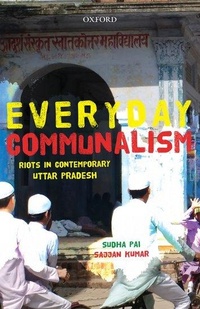
Everyday Communalism
Riots in Contemporary Uttar Pradesh
Published on 25. October 2018
Book
Hardback
368 pages
978-0-19-946629-0 (ISBN)
Description
With the demolition of the Babri Masjid and subsequent riots of the late 1980s and 1990s in Uttar Pradesh, the period that followed appeared relatively peaceful. Only at the turn of the century, India witnessed a strong wave of communalism in early 2000s. After the Godhra riots of Gujarat in 2002, Uttar Pradesh saw a series of them--in Mau in 2005, Lucknow in 2006, Gorakhpur in 2007, and Muzaffarnagar in 2013--announcing the return of fundamentalism in the Bharatiya Janta Party's core agenda of Hindutva politics.
Everyday Communalism not only attempts to explore the anatomy of a Hindu-Muslim riot and its aftermath, but also examines the inner workings that enable deep-seated polarization between communities. Pai and Kumar show that frequent, low-intensity communal clashes pegged on routine everyday issues and resources help establish a permanent anti-Muslim prejudice among Hindus legitimizing majoritarian rule in the eyes of an increasingly polarized, intolerant, and entitled majority community of Hindus. Uttar Pradesh's rising cultural aspirations; economic anxieties to move away from its traditionally backward status; a deep caste-marked agrarian crisis; and sharp inequalities and acute poverty further play into the making a new post-Ayodhya phase of Hindutva politics.
Everyday Communalism not only attempts to explore the anatomy of a Hindu-Muslim riot and its aftermath, but also examines the inner workings that enable deep-seated polarization between communities. Pai and Kumar show that frequent, low-intensity communal clashes pegged on routine everyday issues and resources help establish a permanent anti-Muslim prejudice among Hindus legitimizing majoritarian rule in the eyes of an increasingly polarized, intolerant, and entitled majority community of Hindus. Uttar Pradesh's rising cultural aspirations; economic anxieties to move away from its traditionally backward status; a deep caste-marked agrarian crisis; and sharp inequalities and acute poverty further play into the making a new post-Ayodhya phase of Hindutva politics.
More details
Language
English
Place of publication
New Delhi
India
Product notice
sewn/stitched
Cloth over boards
Dimensions
Height: 221 mm
Width: 142 mm
Thickness: 28 mm
Weight
476 gr
ISBN-13
978-0-19-946629-0 (9780199466290)
Copyright in bibliographic data and cover images is held by Nielsen Book Services Limited or by the publishers or by their respective licensors: all rights reserved.
Schweitzer Classification
Persons
Sudha Pai was professor at the Centre for Political Studies, School of Social Sciences, and rector (pro vice-chancellor) at Jawaharlal Nehru University, New Delhi, India. Sajjan Kumar is an independent researcher based in New Delhi, India.
Content
- List of Figures and Tables
- Preface
- List of Abbreviations
- Introduction: Everyday Communalism in Uttar Pradesh
- 1. Communal Politics in Uttar Pradesh from Independence to the 1990s: A Background
- Part I Eastern Uttar Pradesh: Culture, Political Economy, and the New Discourse of Everyday Communalism
- 2. Politics, Culture, and the Political Economy of Everyday Communalism in Eastern UP
- 3. Communal Mobilization and Riots in Eastern Uttar Pradesh: Mau and Gorakhpur Districts
- Part II Western Uttar Pradesh: Political Economy of Agrarian Crisis and the Construction of Everyday Communalism
- 4. Agrarian Crisis, Changing Jat-Muslim Relations, and Everyday Communalism in Western UP
- 5. Communal Mobilization and Riots in Western Uttar Pradesh: Muzaffarnagar and Shamli Districts
- Conclusion
- Epilogue
- Glossary
- Bibliography
- Index
- About the Authors