

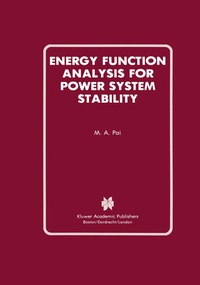
Energy Function Analysis for Power System Stability
Published on 22. January 2012
Book
Paperback/Softback
XII, 240 pages
978-1-4612-8903-6 (ISBN)
Description
This research monograph is in some sense a sequel to the author's earlier one (Power System Stability, North Holland, New York 1981) which devoted cons- erable attention to Lyapunov stability theory, construction of Lyapunov fu- tions and vector Lyapunov functions as applied to power systems. This field of research has rapidly grown since 1981 and the more general concept of energy funct ion has found wide spread application in power systems. There have been advances in five distinct areas (i) Developing energy functions for structure preserving models which can incorporate non-linear load models (ii) Energy fu- tions to include detailed model of the generating unit i. e. , the synchronous machine and the excitation system (iii) Reduced order energy functions for large scale power systems, the simplest being the single machine infinite bus system (iv) Characterization of the stability boundary of the post-fault stable eQui- brium point (v) Applications for large power networks as a tool for dynamic security assessment. It was therefore felt appropriate to capture the essential features of these advances and put them in a somewhat cohesive framework. The chapters in the book rough ly fo llow this sequence. It is interesting to note how different research groups come to the same conclusion via different reas- ings.
More details
Series
Edition
Softcover reprint of the original 1st ed. 1989
Language
English
Place of publication
New York
United States
Target group
Professional and scholarly
Research
Illustrations
XII, 240 p.
Dimensions
Height: 254 mm
Width: 178 mm
Thickness: 15 mm
Weight
489 gr
ISBN-13
978-1-4612-8903-6 (9781461289036)
DOI
10.1007/978-1-4613-1635-0
Schweitzer Classification
Other editions
Additional editions
E-Book
12/2012
Springer
€287.83
Available for download
Book
08/1989
Kluwer Academic Publishers
€299.59
Shipment within 15-20 days
Content
1 Power System Stability in Single Machine System.- 1.1 Introduction.- 1.2 Statement of the Stability Problem.- 1.3 Mathematical Formulation of the Problem.- 1.4 Modeling Issues.- 1.5 Motivation Through Single Machine Infinite Bus System.- 1.6 Chapter Outline.- 2 Energy Functions for Classical Models.- 2.1 Introduction.- 2.2 Internal Node Representation.- 2.3 Energy Functions for Internal Node Models.- 2.4 Individual Machine and other Energy Functions.- 2.5 Structure Preserving Energy Functions.- 2.6 Alternative Form of the Structure Preserving Energy Function.- 2.7 Positive Definiteness of the Energy Integral.- 2.8 Tsolas-Araposthasis-Varaiya Model.- 3 Reduced Order Energy Functions.- 3.1 Introduction.- 3.2 Individual Machine and Group Energy Function.- 3.3 Simplified Form of the Individual Machine Energy Function.- 3.4 Cutset Energy Function.- 3.5 Example of Cutset Energy Function.- 3.6 Extended Equal Area Criterion (EEAC).- 3.7 The Quasi Unstable Equilibrium Point (QUEP) Method.- 3.8 Decomposition-Aggregation Method.- 3.9 Time Scale Energies.- 4 Energy Functions with Detailed Models of Synchronous Machines and Its Control.- 4.1 Introduction.- 4.2 Single Machine System With Flux Decay Model.- 4.3 Multi-Machine Systems With Flux Decay Model (Method of Parameter Variations).- 4.4 Lyapunov Functions for Multi-Machine Systems With Flux Decay Model.- 4.5 Multi-Machine Systems With Flux Decay Models and AVR.- 4.6 Energy Functions With Detailed Models.- 4.7 Lyapunov Function for Multi-Machine Systems With Flux Decay and Nonlinear Voltage Dependent Loads.- 5 Region of Stability in Power Systems.- 5.1 Introduction.- 5.2 Characterization of the Stability Boundary.- 5.3 Region of Stability.- 5.4 Method of Hyperplanes and Hypersurfaces.- 5.5 Potential Energy Boundary Surface (PEBS) Method.- 5.6 Hybrid Method Using the Gradient System.- 6 Practical Applications of the Energy Function Method.- 6.1 Introduction.- 6.2 The Controlling u.e.p. Method.- 6.3 Modifications to the Controlling u.e.p. Method.- 6.4 Potential Energy Boundary Surface (PEBS) Method.- 6.5 Mode of Instability (MOI) Method.- 6.6 Dynamic Security Assessment.- 7 Future Research Issues.- Appendix A 10 Machine 39 Bus System Data.- References.