

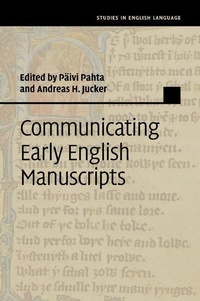
Communicating Early English Manuscripts
Published on 29. January 2015
Book
Paperback/Softback
314 pages
978-1-107-64650-6 (ISBN)
Description
In an obvious way, manuscripts communicate. This is the first book to focus on the communicative aspects of English manuscripts from the fourteenth to the nineteenth century. It investigates how the authors and scribes of these manuscripts communicated with their audiences, how the characters depicted in these manuscripts communicate with each other, and how the manuscripts communicate with scholars and audiences in the 21st century. It covers a wide variety of genres, such as stories, scientific writing, witchcraft records, personal letters, war correspondence, courtroom records, and plays. The volume demonstrates how these handwritten texts can be used to analyse the history of language as communication between individuals and groups, and discusses the challenges these documents present to present-day scholars. It is unique in bringing together studies by distinguished international experts examining primary handwritten sources from the perspectives of several fields, including historical pragmatics, historical sociolinguistics, corpus linguistics and literary scholarship.
More details
Series
Language
English
Place of publication
Cambridge
United Kingdom
Target group
College/higher education
Product notice
Paperback (trade)
Illustrations
17 Tables, black and white; 7 Halftones, unspecified; 10 Line drawings, unspecified
Dimensions
Height: 229 mm
Width: 152 mm
Thickness: 17 mm
Weight
457 gr
ISBN-13
978-1-107-64650-6 (9781107646506)
Copyright in bibliographic data and cover images is held by Nielsen Book Services Limited or by the publishers or by their respective licensors: all rights reserved.
Schweitzer Classification
Other editions
Additional editions
Paeivi Pahta | Andreas H. Jucker
Communicating Early English Manuscripts
Book
01/2011
Cambridge University Press
€89.00
Shipment within 15-20 days
Persons
Paeivi Pahta is Professor of English Philology in the School of Modern Languages and Translation Studies at the University of Tampere. Andreas H. Jucker is Professor of English Linguistics at the University of Zurich.
Content
Introduction; 1. Communicating manuscripts: authors, scribes, readers, listeners and communicating characters Andreas H. Jucker and Paeivi Pahta; Part I. Authors, Scribes and their Audiences: 2. Commonplace-book communication: role shifts and text functions in Robert Reynes's notes contained in MS Tanner 407 Thomas Kohnen; 3. Textuality in late medieval England: two case studies Gabriella Del Lungo Camiciotti; 4. The significance of now-dispersed Bute 13: a mixed-language scientific manuscript Patricia Deery Kurtz and Linda Ehrsam Voigts; 5. Communicating attitudes and values through language choices: diatopic and diastratic variation in Mary Magdalene in MS Digby 133 Maurizio Gotti and Stefania Maci; 6. Constructing the audiences of the Old Bailey Trials 1674-1834 Elizabeth Closs Traugott; Part II. Communicating through Handwritten Correspondence: 7. A defiant gentleman or 'the strengest thiefe of Wales': reinterpreting the politics in a medieval correspondence Merja Stenroos and Martti Maekinen; 8. Sociopragmatic aspects of person reference in Nathaniel Bacon's letters Minna Palander-Collin and Minna Nevala; 9. Poetic collaboration and competition in the late seventeenth century: George Stepney's letters to Jacob Tonson and Matthew Prior Susan Fitzmaurice; 10. Handwritten communication in nineteenth-century business correspondence Marina Dossena; Part III. From Manuscript to Print: 11. The relationship between MS Hunter 409 and the 1532 edition of Chaucer's works edited by William Thynne Graham D. Caie; 12. The development of play-texts: from manuscript to print Jonathan Culpeper and Jane Demmen; 13. Communicating Galen's Methodus medendi in Middle and Early Modern English Paeivi Pahta, Turo Hiltunen, Ville Marttila, Maura Ratia, Carla Suhr and Jukka Tyrkkoe; 14. Prepositional modifiers in early English medical prose: a study ON their historical development IN noun phrases Douglas Biber, Bethany Gray, Alpo Honkapohja and Paeivi Pahta; 15. The pragmatics of punctuation in Older Scots Jeremy Smith and Christian Kay; Part IV. Manuscripts and their Communicating Characters: 16. Greetings and farewells in Chaucer's Canterbury Tales Andreas H. Jucker; 17. Attitudes of the accused in the Salem witchcraft trials Leena Kahlas-Tarkka and Matti Rissanen.