


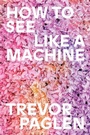
How to See Like a Machine
Images After AI
Will be published approx. on 11. May 2027
Book
Paperback/Softback
192 pages
978-1-83674-217-3 (ISBN)
Description
Today our world is under the watchful and tireless eye of computer vision, with cam-eras and monitors tracing our every move. Furthermore, generative AI is now able to render a synthetic world indistinguishable from reality for us to explore. Trevor Paglen goes in search of the ways and means of understanding this new visual universe. Instead of asking what these technologies "say" about the world, he teaches us to ask what they "do" and where such images come from.
Exploring the esoteric worlds of psyops, UFO imagery, magicians, and public relation gurus, Paglen shows that this appar-ently alien realm is more human, but much stranger, than we imagine.
Exploring the esoteric worlds of psyops, UFO imagery, magicians, and public relation gurus, Paglen shows that this appar-ently alien realm is more human, but much stranger, than we imagine.
Reviews / Votes
Paglen's ideas are smart and suggestive, with the added virtue of being expressed in prose so clear it makes the opacity of other theoretical writing feel like a psyop. This lucidity not only makes his work readable but also staves off the perception that discourse about UFOs and the CIA must be riddled with conspiratorial paranoia... even as Paglen demonstrates how machine vision is shifting our media paradigms, he also demonstrates how human vision can help us navigate the shifts. -- Louis Bury * Art in America * Paglen moves through psyops, UFO imagery, adtech, and recommendation algorithms to argue that the shift underway isn't just about fake images, but about images that require no human eye at all. For anyone trying to make sense of what's happening in the current digital and A.I. age, this is an equally readable and rigorous guide. -- Books Our Editors Can't Wait to Read This Summer * Cultured * How will people choose to interact with art in a world where AI can spit out any image desired? When digital platforms value hyperpersonalization over discovery and learn through user surveillance? AI is altering visual culture more insidiously than it even seems, far beyond slop and plagiarism, and we need to understand it. * Lit Hub, Most Anticipated Books of 2026 * To be literate today means to come to terms with how the twin technical transformations of our time, computer vision and generative AI, work, and how they work on us: how they have reformatted our perception and cognition, our labor and leisure, our representations and realities, and will continue to do so with ever greater intensity. There is no better guide than Trevor Paglen, our most exploratory of artists, who, for two decades, has cracked open each new version of this black box, exposing proprietary abuses, inventing critical terms, devising counter uses, and imagining alternative futures. How to See Like a Machine is the toolkit we need. -- Hal Foster, author of <i>What Comes After Farce? Art and Criticism at a Time of Debacle</i> In this indispensable compilation, Trevor Paglen traces the fate of photographic images in the age of cognitive warfare, AI slop and pictorial conditioning. Decades of propaganda, psyops and photoshop have successively rid images of reality. Generative AI automates this process to create statistical renderings in a state of superposition; neither true nor false, but optimized to mess with human minds. When seeing becomes acting, thinking and theory need to involve actual visual practice, too. Paglens invaluable hands-on method of inquiry documents a shift in focus from images of reality to the reality of images. Required reading. -- Hito Steyerl, author of <i>Medium Hot</i> Paglen is an extraordinary artist and thinker. In these succinct, entertaining essays he broadens our understanding of vision, and shows how image-making is leaving the human eye behind -- Hari Kunzru, author of <i>Blue Ruin</i> A profoundly uncompromising, ambitious, and imaginative read -- Kate Crawford, author of <i>Atlas of AI</i> Paglen's work makes the invisible visible. In his new book he looks at images and shows how images look at us. What emerges is a new space for thinking between humans and media. This book is urgent. -- Hans Ulrich Obrist Paglen's essays are impressively cogent, engaging, and relevant ... [due to] the importance of this book's subject and the valuable arguments Paglen makes, [we] recommend this title for all art and politics collections. * Library Journal * Paglen confronts, with clear prose and a level head, everything from UFOs to psyops, offering a revealing look behind the curtain that you can't unsee. * Art in America, 7 Books We're Looking Forward to in May * Paglen is well-placed to bring news from the more obscure, unexpected sites and sources of present technological predicaments. For the past twenty years, his wide-ranging practice-which includes sculpture, installation, photography, and a prodigious amount of text and talk-has explored the hinterland between secret military technology and the more or less subtle distortions of everyday life that technology eventually wreaks. * 4 Columns *More details
Language
English
Place of publication
London
United Kingdom
Illustrations
55 integrated images
Dimensions
Height: 198 mm
Width: 129 mm
Weight
250 gr
ISBN-13
978-1-83674-217-3 (9781836742173)
Copyright in bibliographic data is held by Nielsen Book Services Limited or its licensors: all rights reserved.
Schweitzer Classification
Other editions
Previous edition
Book
05/2026
Verso Books
€22.50
Available immediately
Person
Trevor Paglen is an artist whose work has had one-person exhibitions at the Smithsonian American Art Museum, Washington, DC; Fondazione Prada, Milan; and the Barbican Centre, London. He has participated in group exhibitions at the Metropolitan Museum of Art, the San Francisco Museum of Modern Art, the Tate Modern, and numerous other venues. His work has been profiled in the New York Times, the New Yorker, the Wall Street Journal, Wired, the Financial Times, Artforum, and Aperture. In 2014, he received the Electronic Frontier Foundation's Pioneer Award and, in 2016, he won the Deutsche Boerse Photography Prize. Paglen was named a MacArthur Fellow in 2017.
Content
1. Introduction
2. Invisible Images: Your Pictures are looking at you
3. Excavating AI
4. Machine Realism
5. Neural Activations
6. Society of PSYOPS
7. Archives of the Future
8. Conclusion
9. Acknowledgements
2. Invisible Images: Your Pictures are looking at you
3. Excavating AI
4. Machine Realism
5. Neural Activations
6. Society of PSYOPS
7. Archives of the Future
8. Conclusion
9. Acknowledgements