

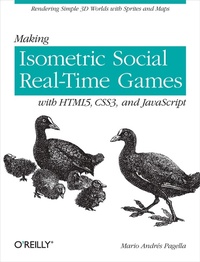
Making Isometric Social Real-Time Games with HTML5
Rendering Simple 3D Worlds with Sprites and Maps
Published on 4. October 2011
Book
Paperback/Softback
70 pages
978-1-4493-0475-1 (ISBN)
Description
Walk through the process of designing and implementing from scratch an isometric real time game such as some of the most succesful Facebook Games. Applying HTML5, CSS3, and JavaScript, this piece shows how to build games using isometric map making, sprite animations, networking, social network integration, high performance rendering and game design.
More details
Language
English
Place of publication
Sebastopol
United States
Target group
Professional and scholarly
Product notice
Paperback (trade)
Unsewn / adhesive bound
Dimensions
Height: 233 mm
Width: 177 mm
Thickness: 15 mm
Weight
265 gr
ISBN-13
978-1-4493-0475-1 (9781449304751)
Copyright in bibliographic data and cover images is held by Nielsen Book Services Limited or by the publishers or by their respective licensors: all rights reserved.
Schweitzer Classification
Other editions
Additional editions
Mario Andres Pagella
Making Isometric Social Real-Time Games with HTML5, CSS3, and JavaScript
Rendering Simple 3D Worlds with Sprites and Maps
E-Book
08/2011
1st Edition
O'Reilly
€12.49
Available for download
Mario Andres Pagella
Making Isometric Social Real-Time Games with HTML5, CSS3, and JavaScript
Rendering Simple 3D Worlds with Sprites and Maps
E-Book
08/2011
1st Edition
O'Reilly
€16.99
Available for download
Person
Andres Pagella is an accomplished software developer with more than 10 years of professional experience living in Capital Federal, Argentina. He has worked on the design and the implementation of several high traffic websites in Argentina. He currently works as the Chief Technical Officer of Minor Studios Argentina S.R.L. developing a social game design tool called Atmosphir.
Content
- Preface
- Chapter 1: Graphics Foundations: Canvas and Sprites
- Chapter 2: Making It Isometric
- Chapter 3: Interface Considerations
- Chapter 4: HTML5 Sound and Processing Optimization
- Chapter 5: Connecting the Game to People