

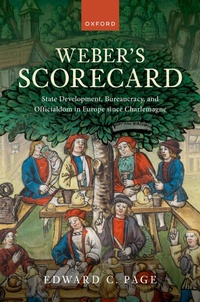
Weber's Scorecard
State Development, Bureaucracy, and Officialdom in Europe since Charlemagne
Published on 30. September 2024
Book
Hardback
320 pages
978-0-19-890427-4 (ISBN)
Description
This book examines Max Weber's understanding of bureaucracy by applying his ideas to the development of officialdom from the ninth century to the present in six territories: England, Sweden, France, Germany, Spain, and Hungary. Edward Page takes a broad view of bureaucracy that includes not only officials in important central or national institutions but also those providing goods and services locally. The 'scorecard' is based on expected developments in four key areas of Weber's analysis: the functional differentiation of tasks within government, professionalism, formalism, and monocracy. After discussing the character of officialdom in the ninth, twelfth, fifteenth, eighteenth, and twenty-first centuries, the book reveals that Weber's scorecard has a mixed record, especially weak in its account of the development of monocracy and formalism. A final chapter discusses alternative conceptions of bureaucratic development and sets out an account based on understanding processes of routinization, institutional integration, and the instrumentalization of law.
More details
Language
English
Place of publication
Oxford
United Kingdom
Target group
Professional and scholarly
Product notice
sewn/stitched
Cloth over boards
Dimensions
Height: 235 mm
Width: 159 mm
Thickness: 24 mm
Weight
642 gr
ISBN-13
978-0-19-890427-4 (9780198904274)
Copyright in bibliographic data and cover images is held by Nielsen Book Services Limited or by the publishers or by their respective licensors: all rights reserved.
Schweitzer Classification
Other editions
Additional editions
Edward C. Page
Weber's Scorecard
State Development, Bureaucracy, and Officialdom in Europe since Charlemagne
E-Book
11/2024
OUP eBook
€90.99
Available for download
Person
Edward C. Page is Sidney and Beatrice Webb Professor of Public Policy at the London School of Economics and Political Science, having previously held positions at the University of Strathclyde and the University of Hull. He is the co-editor, with Steven J. Balla and Martin Lodge, of The Oxford Handbook of Classics in Public Policy and Administration (OUP 2015) and author of Policy Without Politicians: Bureaucratic Influence in Comparative Perspective (OUP 2012).
Content
1: Introduction
2: Patrimonialism and ninth-century government
3: Twelfth-century feudal officialdom
4: Growing intensity in the fifteenth century
5: Absolutism, bureaucracy, and eighteenth-century fiscal-military states
6: Constitutional officialdom: The 1950s and after
7: Weber's scorecard
8: If not Weber, then what?
2: Patrimonialism and ninth-century government
3: Twelfth-century feudal officialdom
4: Growing intensity in the fifteenth century
5: Absolutism, bureaucracy, and eighteenth-century fiscal-military states
6: Constitutional officialdom: The 1950s and after
7: Weber's scorecard
8: If not Weber, then what?