

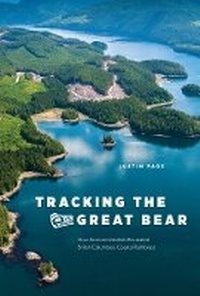
Tracking the Great Bear
How Environmentalists Recreated British Columbia's Coastal Rainforest
Will be published approx. on 15. January 2015
Book
Paperback/Softback
176 pages
978-0-7748-2672-3 (ISBN)
Description
Encompassing millions of hectares of globally rare coastal rainforest, the Great Bear Rainforest in coastal British Columbia is home to ancient trees, rich runs of salmon, and abundant species, including the elusive white "spirit bear." The area also supports small human communities, particularly First Nations. Once slated for clear-cut logging, large areas were protected in 2006 by the signing of one of the world's most significant and innovative conservation agreements.
Tracking the Great Bear traces environmentalists' efforts to save the area from status quo industrial forestry, while at the same time respecting First Nations' right to economic development. Adopting a novel theoretical approach from science and technology studies, the book explains environmentalists' success as a result of their deployment of a powerful actor-network within British Columbia's land-use decision-making process.
This book makes a significant contribution to social scientific analyses of natural resource management. Bridging the gap between interpretivist and social structural analyses, it demonstrates how the Great Bear Rainforest was made - or, rather, recreated - out of uncertain and contested links among an improbable assemblage of actors and elements.
Tracking the Great Bear traces environmentalists' efforts to save the area from status quo industrial forestry, while at the same time respecting First Nations' right to economic development. Adopting a novel theoretical approach from science and technology studies, the book explains environmentalists' success as a result of their deployment of a powerful actor-network within British Columbia's land-use decision-making process.
This book makes a significant contribution to social scientific analyses of natural resource management. Bridging the gap between interpretivist and social structural analyses, it demonstrates how the Great Bear Rainforest was made - or, rather, recreated - out of uncertain and contested links among an improbable assemblage of actors and elements.
Reviews / Votes
This is an extremely important book, not only for explaining how collaboration has been achieved at a regional scale in mid- and north BC, but also as a symbol and example of what is possible in seemingly intractable conservation "stand-offs." It will repay study by students of environmental history and by all involved in that wide-reaching, all-encompassing field of environmental politics. - Ken Atkinson, University of York St John (British Journal of Canadian Studies, Vol. 29 No. 1, Spring 2016)More details
Series
Language
English
Place of publication
Vancouver
Canada
Target group
Professional and scholarly
Product notice
Paperback (trade)
Dimensions
Height: 229 mm
Width: 152 mm
Weight
300 gr
ISBN-13
978-0-7748-2672-3 (9780774826723)
Copyright in bibliographic data and cover images is held by Nielsen Book Services Limited or by the publishers or by their respective licensors: all rights reserved.
Schweitzer Classification
Person
Justin Page is an environmental social scientist at ERM Rescan, an environmental consulting company based in Vancouver. He has over ten years of environmental social sciences research experience in the academic and private sectors.
Content
Foreword: Rethinking Environmentalism / Graeme Wynn
Introduction
1 Where in the World Is the Great Bear? Problematizing British Columbia's Coastal Forests
2 Grizzlies Growl at the International Market: Circulating a Panorama of the Great Bear Rainforest
3 Negotiating with the Enemy: Articulating a Common Matter of Concern
4 Mobilizing Allies and Reconciling Interests
Conclusion
Notes
References
Index
Introduction
1 Where in the World Is the Great Bear? Problematizing British Columbia's Coastal Forests
2 Grizzlies Growl at the International Market: Circulating a Panorama of the Great Bear Rainforest
3 Negotiating with the Enemy: Articulating a Common Matter of Concern
4 Mobilizing Allies and Reconciling Interests
Conclusion
Notes
References
Index