

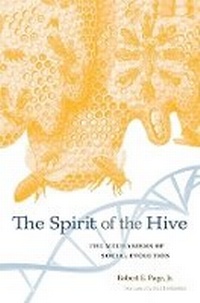
The Spirit of the Hive
The Mechanisms of Social Evolution
Published on 17. June 2013
Book
Hardback
240 pages
978-0-674-07302-9 (ISBN)
Description
Charles Darwin struggled to explain how forty thousand bees working in the dark, seemingly by instinct alone, could organize themselves to construct something as perfect as a honey comb. How do bees accomplish such incredible tasks? Synthesizing the findings of decades of experiments, The Spirit of the Hive presents a comprehensive picture of the genetic and physiological mechanisms underlying the division of labor in honey bee colonies and explains how bees' complex social behavior has evolved over millions of years.
Robert Page, one of the foremost honey bee geneticists in the world, sheds light on how the coordinated activity of hives arises naturally when worker bees respond to stimuli in their environment. The actions they take in turn alter the environment and so change the stimuli for their nestmates. For example, a bee detecting ample stores of pollen in the hive is inhibited from foraging for more, whereas detecting the presence of hungry young larvae will stimulate pollen gathering. Division of labor, Page shows, is an inevitable product of group living, because individual bees vary genetically and physiologically in their sensitivities to stimuli and have different probabilities of encountering and responding to them.
A fascinating window into self-organizing regulatory networks of honey bees, The Spirit of the Hive applies genomics, evolution, and behavior to elucidate the details of social structure and advance our understanding of complex adaptive systems in nature.
Robert Page, one of the foremost honey bee geneticists in the world, sheds light on how the coordinated activity of hives arises naturally when worker bees respond to stimuli in their environment. The actions they take in turn alter the environment and so change the stimuli for their nestmates. For example, a bee detecting ample stores of pollen in the hive is inhibited from foraging for more, whereas detecting the presence of hungry young larvae will stimulate pollen gathering. Division of labor, Page shows, is an inevitable product of group living, because individual bees vary genetically and physiologically in their sensitivities to stimuli and have different probabilities of encountering and responding to them.
A fascinating window into self-organizing regulatory networks of honey bees, The Spirit of the Hive applies genomics, evolution, and behavior to elucidate the details of social structure and advance our understanding of complex adaptive systems in nature.
Reviews / Votes
Fascinating... Page's book is a delightful example of how one dedicated career in science can dramatically deepen and broaden our perceptions of the world around us. -- Mark L. Winston * Nature * This book is a useful and timely resource as scientists try to understand and solve problems related to colony collapse disorder affecting honeybees worldwide... The Spirit of the Hive takes a novel approach to the study of honeybees and their social order... It is a very interesting read. -- J. M. Gonzalez * Choice *More details
Language
English
Place of publication
Cambridge, Mass
United States
Target group
Professional and scholarly
Illustrations
39 halftones, 30 line illustrations, 4 tables
Dimensions
Height: 235 mm
Width: 156 mm
Thickness: 22 mm
Weight
499 gr
ISBN-13
978-0-674-07302-9 (9780674073029)
Copyright in bibliographic data and cover images is held by Nielsen Book Services Limited or by the publishers or by their respective licensors: all rights reserved.
Schweitzer Classification
Other editions
Additional editions
E-Book
06/2013
1st Edition
Harvard University Press
€66.59
Available for download
Robert E. Page Jr.
Spirit of the Hive
E-Book
06/2013
1st Edition
Harvard University Press
€44.59
Available for download
Persons
Robert E. Page, Jr., is University Provost and Foundation Chair of Life Sciences at Arizona State University. Bert Hoelldobler is the Robert A. Johnson Professor in Social Insect Research at Arizona State University. He was previously Professor of Biology and Alexander Agassiz Professor of Zoology at Harvard University and subsequently held the chair for Behavioral Physiology and Sociobiology at the University of Wuerzburg, Germany. He is an elected member of many academies, including the American Academy of Arts and Sciences, the US National Academy of Sciences, and the German National Academy of Sciences, Leopoldina. He has received many awards, among them the Pulitzer Prize for The Ants, coauthored with E. O. Wilson.