

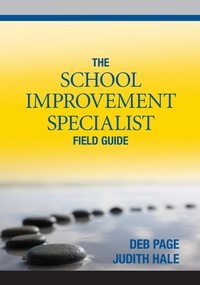
The School Improvement Specialist Field Guide
Description
As a current or transitioning school improvement specialist, you are entrusted with helping schools turn around their performance. Now there is a proven process that can strengthen your effectiveness as well. Deb Page and Judith Hale, SIS authorities, guide new and transitioning SIS professionals in applying high-leverage practices that result in systemic, sustainable, school-wide improvement. The School Improvement Specialist Field Guide offers the voice and counsel of a trusted coach while addressing how to:
Establish enduring interventions with viable tools and methods
Use time-tested processes to teach 21st century skills to educators and students alike
Seamlessly align improvement practices to the updated Institute for Performance Improvement Standards
Transition smoothly into the school improvement specialist role
With easy-to-use tools and protocols-both in the guide and online-you'll have the support you need to facilitate improvement. Follow the improvement process that leads to success for you, your students, and your school!
"Purposeful, intentional facilitation of the school improvement process builds a school staff's capacity and skills for continuous improvement that lasts beyond the consultant or leader. This book provides a framework, tools, and strategies for effective facilitation."
-Bess Scott, Director of Elementary Education
Lincoln Public Schools, NE
"There is an abundance of ideas from which an improvement specialist could develop and implement a successful school improvement process. It was great to see facilitation strategies as part of the resources provided."
-Gayle Wahlin, Educational Consultant
DuPage Regional Office of Education
Reviews / Votes
"Purposeful, intentional facilitation of the school improvement process builds a school staff's capacity and skills for continuous improvement that lasts beyond the consultant or leader. The School Improvement Specialist Field Guide provides a framework, tools and strategies for effective facilitation." -- Bess Scott, Director of Elementary Education "In The School Improvement Specialist Field Guide, there is an abundance of ideas from which an Improvement Specialist could develop and implement a successful school improvement process. It was great to see facilitation strategies as part of the resources provided." -- Gayle Wahlin, Educational ConsultantMore details
Persons
Deb Page is a leading independent voice, strategy consultant, and thought leader in the areas of systemic improvement of Education Leadership and Human Capital Management. Throughout her career, Deb has established a reputation as an innovator and problem-solver that inspires and attains outstanding results. She is a former K-12 educator who spent over 20 years in corporate human capital management. She began her career as a high school teacher after graduating from the University of Georgia with a B.S. in Language Education. Her corporate career was spent in retail, service, and financial services, in Human Resources, Quality and Performance Improvement, Training, Executive Development and Coaching, and Business Development. The majority of her career she worked in subsidiaries of Citigroup, and launched and led a corporate university. In 2001 she left her position as Sr. Vice President for Instruction and Business Development for Citibank, N.A. to form Willing Learner. Training Magazine has honored Deb as one of the "new guard in training and development".
In 2002, Deb led the start up of the Georgia Leadership Institute for School Improvement, a public/private initiative to improve education leadership, supported by the Bill & Melinda Gates Foundation, the Woodruff and Whitehead Foundations and the Wallace Foundation. Under her leadership GLISI developed a solid track record for helping school systems improve student achievement and organizational effectiveness through improved practices in talent management, performance management, and team-based improvement. She led development of over $15 million in external funding and provided grant-makers with proof of the stewardship and impact of their investment. Deb works in partnership with Dr. Judy Hale, of Hale Associates (www.HaleAssociates.com) to design, develop and deliver training and performance solutions for leaders across all sectors through a collaborative arrangement with the International Society for Performance Improvement (www.ISPI.org).
As a Senior Practice Leader on behalf of the Georgia Leadership Institute for School Improvement, Deb continues to help state education agencies, school districts, universities and other stakeholders in education leadership build Signature Leadership Systems tailored to their local contexts, strategic intentions and performance goals. Through her private consulting practice, Deb supports the ongoing work of GLISI through social entrepreneurial action, sharing a portion of Willing Learner¿s profits to sustain GLISI initiatives.
Judith A. Hale¿s (Ph.D., CPT, and ibstpi Fellow) firm, Hale Associates, has worked with clients in all industries in the private and public sectors for over 25 years. Judy is the president of the International Society of Performance and Improvement (ISPI). She serves on the Institute for Credentialing Excellence (formerly NOCA) taskforce for accrediting assessment-based certificate programs. She has served on the ISPI President¿s Advisory Council, on the Illinois Occupational Skills Standards Credentialing Council, and was a commercial arbitrator with the American Arbitration Association.
Judith speaks regularly at international and national conferences on subjects related to competencies, credentialing, evaluation, implementation, needs assessment, and performance improvement.
Judy is the author of the best-selling Performance Consultant¿s Fieldbook: tools and techniques for improving organizations and people, 2nd Ed (2007); Outsourcing Training and Development (2006); Performance-based Management: What every manager should do to get results (2003); Performance-Based Evaluation: tools and techniques for measuring the impact of training (2002); Performance-Based Certification: How to Design a Valid, Defensible, Cost-effective Program (2000); The Training Manager¿s Competencies (1989); and co-author of Achieving a Leadership Role for Training (1995).
Judy was awarded a B.A. from Ohio State University in communications, a M.A. from Miami University in communications, and a Ph.D. from Purdue University in instructional design. Her doctoral research was on how to control bias in competency studies.
Content
Audience for this Book
Acknowledgments
Acknowledgments
About the Authors
Introduction
Applying Human Performance Technology to the Certification of School Improvement Specialists
How the Certification for School Improvement Specialists Evolved
How this Field Guide is Organized
The Ten Standards
Standard 1: Analyze and Apply Critical Judgment
Standard 2: Facilitate Deriving Meaning and Engagement
Standard 3: Focus on Systemic Factors
Standard 4: Plan and Record
Standard 5: Organize and Manage Efforts and Resources
Standard 6: Guide and Focus Collaborative Improvement
Standard 7: Build Capacity
Standard 8: Demonstrate Organizational Sensitivity
Standard 9: Monitor Accountability and Adoption
Standard 10: Implement for Sustainability
Application for Certification
CSIS Performance Foundations
Mission
Vision
Values
Performance Criteria
1. Analyze and Apply Critical Judgment
Real World Challenge -- Bailey's Story Part 1
Standard 1: Analyze and Apply Critical Judgment
Facilitating the Collection and Interpretation of Data
Demonstrating Deep Knowledge
Presenting Evidence That Supports Conclusions
An Example of an Effective Application of Standard 1
An Example of a Less Effective Application of Standard 1
Reflection
Power Points
Summary
2. Facilitate Deriving Meaning and Engagement
Real World Challenge -- Bailey's Story Part 2
Standard 2: Facilitate Deriving Meaning and Engagement
Creating Meaning
Identifying Systemic Performance Factors
Categorizing Performance Factors
Comprehending Implications
Building Supportive Relationships
Establishing Norms
Developing Agendas
Facilitating Group Communication
Building Commitment
Using Stories
Gaining Commitments
An Example of an Effective Application of Standard 2
An Example of a Less Effective Application of Standard 2
Reflection
Power Points
Summary
3. Focus on Systemic Factors
Real World Challenge -- Bailey's Story Part 3
Standard 3: Focus on Systemic Factors
Identifying Systemic and Interdependent Factors
Selecting a Suite of Aligned Interventions
Building Higher Order Skills
An Example of an Effective Application of Standard 3
An Example of a Less Effective Application of Standard 3
Reflection
Power Points
Summary
4. Plan and Record
Real World Challenge -- Bailey's Story Part 4
Standard 4: Plan and Record
Recommending What Works
Developing the Plan
Communicating the Work Ahead
Documenting the Decisions
An Example of an Effective Application of Standard 4
An Example of a Less Effective Application of Standard 4
Reflection
Power Points
Summary
5. Organize and Manage Efforts and Resources
Real World Challenge -- Bailey's Story Part 5
Standard 5: Organize and Manage Efforts and Resources
Chunking the Work into Manageable Steps
Distributing the Work
Coordinating and Orchestrating
An Example of an Effective Application of Standard 5
An Example of a Less Effective Application of Standard 5
Reflection
Power Points
Summary
6. Guide and Focus Collaborative Improvement
Real World Challenge -- Bailey's Story Part 6
Standard 6: Guide and Focus Collaborative Improvement
Starting with Your Inner Circle
Reaching out to a Wider Circle
Aligning Performance Foundations and Targets
Providing Relevant Information
Modeling the Right Behaviors
Taking on the Hard Decisions
An Example of an Effective Application of Standard 6
An Example of a Less Effective Application of Standard 6
Reflection
Power Points
Summary
7. Build Capacity
Real World Challenge -- Bailey's Story Part 7
Standard 7: Build Capacity
Using Effective Adult Interventions
Coaching and Giving Feedback
Asking Questions
Facilitating Study
Facilitating Sharing
Facilitating Adoption
An Example of an Effective Application of Standard 7
An Example of a Less Effective Application of Standard 7
Reflection
Power Points
Summary
8. Demonstrate Organizational Sensitivity
Real World Challenge -- Bailey's Story Part 8
Standard 8: Demonstrate Organizational Sensitivity
Establishing Credibility
Following Accepted Rules
Demonstrating Professionalism
Valuing Others' Positions and Views
Keeping People Engaged
An Example of an Effective Application of Standard 8
An Example of a Less Effective Application of Standard 8
Reflection
Power Points
Summary
9. Monitor Accountability and Adoption
Real World Challenge -- Bailey's Story Part 9
Standard 9: Monitor Accountability and Adoption
Paying Attention Purposely
Taking Corrective Action
Addressing Underperformance
Recognizing and Communicating
Aligning
An Example of an Effective Application of Standard 9
An Example of a Less Effective Application of Standard 9
Reflection
Power Points
Summary
10. Implement for Sustainability
Real World Challenge -- Bailey's Story Part 10
Standard 10: Implement for Sustainability
Ensuring Continuity
Transferring Ownership
Facilitating Evaluation
Gaining Commitment
Improving Continuously
An Example of an Effective Application of Standard 10
An Example of a Less Effective Application of Standard 10
Reflection
Power Points
Summary
Appendix
Readiness Assessment
References
Resources
Index