

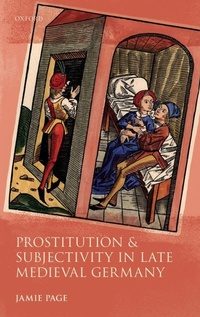
Prostitution and Subjectivity in Late Medieval Germany
Published on 12. April 2021
Book
Hardback
178 pages
978-0-19-886278-9 (ISBN)
Description
Prostitution played an important part in structuring gender relations in medieval Germany. Prostitutes were often viewed as an example of the extreme female sinfulness which all women risked falling into, yet their social role was also seen as vital to the unmarried men for whom they provided a sexual outlet. Prostitution and Subjectivity in Late Medieval Germany is the first full-length study of medieval prostitution to focus primarily on how gender discourse shaped the lives of prostitutes themselves.
Based on three legal case studies from the late medieval Empire, Prostitutes and Subjectivity in Late Medieval Germany examines constructions of subjectivity between 1400 and 1500. This period saw the rapid rise of tolerated prostitution across much of western Europe and the emergence of the public brothel as a central institution in the regulation of social order, followed by its equally rapid suppression from the early 1500s. By analysing how individuals interacted with cultural discourses surrounding the body, sexuality, and sin, the book explores how the concepts which defined prostitution in the Middle Ages shaped individual lives, and how individuals were able - or not - to exert agency, both within the circumstances of their own lives, and in response to official attempts to regulate sexual behaviour.
Based on three legal case studies from the late medieval Empire, Prostitutes and Subjectivity in Late Medieval Germany examines constructions of subjectivity between 1400 and 1500. This period saw the rapid rise of tolerated prostitution across much of western Europe and the emergence of the public brothel as a central institution in the regulation of social order, followed by its equally rapid suppression from the early 1500s. By analysing how individuals interacted with cultural discourses surrounding the body, sexuality, and sin, the book explores how the concepts which defined prostitution in the Middle Ages shaped individual lives, and how individuals were able - or not - to exert agency, both within the circumstances of their own lives, and in response to official attempts to regulate sexual behaviour.
Reviews / Votes
A masterful and enjoyable book. * Eleanor Janega, The Journal of the Social History Society * This elegantly structured and lucidly written study exploring surviving legal records from late medieval cities in the German-speaking lands invites the reader to examine and reflect on the interpretive categories, medieval and modern, through which we seek to understand the lives of female sex workers in the past. * Ann Marie Rasmussen, German History * ...the study offers a profound and very nuanced insight into the world of late medieval prostitution and convincingly shows the freedoms enjoyed by prostitutes, along with the constraints placed upon them, in the misogynistic world of the late Middle Ages. * Oliver Landolt, German Historical Institute London Bulletin * "Occasionally, a book merits the description 'must read.' To my mind,Prostitution and Subjectivity in late Medieval Germanyqualifies. Students of women's and gender history, the history of sexuality, medieval history, and urban history will surely benefit from delving into this study's engrossing argument, deft contextualization, and informed discussion of the extant historiography as well as the individual cases; this volume is a veritable milestone in the history of prostitution." * Helmut Puff, University of Michigan, German Quarterly * Jamie Page's Prostitution and Subjectivity uses three case studies from different areas of Germany across the fifteenth century to recover the subjectivity of women involved in prostitution in the late medieval period. The result is compelling, surprising, and engaging. * Clare Burgess, University of Oxford, Oxford, UK * Jamie Page's Prostitution and Subjectivity has advanced the field of medieval sex work studies in leaps and bounds, providing an excellent analysis of sex workers, subjectivity and agency. * Lucia Akard, English Historical Review * This book is recommended to anyone interested in microhistorical analysis, late medieval court records, and thorough methodological discussions. * Paul Schweitzer-Martin, Speculum 99/2 *More details
Series
Language
English
Place of publication
Oxford
United Kingdom
Target group
Professional and scholarly
Dimensions
Height: 240 mm
Width: 161 mm
Thickness: 14 mm
Weight
438 gr
ISBN-13
978-0-19-886278-9 (9780198862789)
Copyright in bibliographic data and cover images is held by Nielsen Book Services Limited or by the publishers or by their respective licensors: all rights reserved.
Schweitzer Classification
Other editions
Additional editions
E-Book
01/2021
1st Edition
OUP eBook
€54.49
Available for download
E-Book
01/2021
1st Edition
OUP eBook
€54.49
Available for download
Person
Jamie Page received his PhD in Medieval History and German at the University of St Andrews and has held research posts at Durham University and the Eberhard Karls Universitaet Tuebingen. His research addresses themes of gender and sexuality in the late medieval urban world, focusing specifically on the southern German-speaking Empire.
Content
Introduction: Prostitution and Subjectivity in Late Medieval Germany
1: Secret women: clandestine prostitution in fourteenth-century Zurich
2: Municipal prostitution and subjectivity: the women of Noerdlingen's brothel
3: '...this miserable, shameful life'. Prostitution and subjectification in late medieval Augsburg
Conclusion
1: Secret women: clandestine prostitution in fourteenth-century Zurich
2: Municipal prostitution and subjectivity: the women of Noerdlingen's brothel
3: '...this miserable, shameful life'. Prostitution and subjectification in late medieval Augsburg
Conclusion