

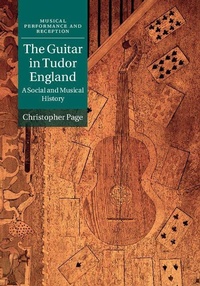
The Guitar in Tudor England
A Social and Musical History
Published on 30. July 2015
Book
Hardback
270 pages
978-1-107-10836-3 (ISBN)
Description
Few now remember that the guitar was popular in England during the age of Queen Elizabeth and Shakespeare, and yet it was played everywhere from the royal court to the common tavern. This groundbreaking book, the first entirely devoted to the renaissance guitar in England, deploys new literary and archival material, together with depictions in contemporary art, to explore the social and musical world of the four-course guitar among courtiers, government servants and gentlemen. Christopher Page reconstructs the trade in imported guitars coming to the wharves of London, and pieces together the printed tutor for the instrument (probably of 1569) which ranks as the only method book for the guitar to survive from the sixteenth century. Two chapters discuss the remains of music for the instrument in tablature, both the instrumental repertoire and the traditions of accompanied song, which must often be assembled from scattered fragments of information.
Reviews / Votes
'The book is especially valuable because the author examines both the social and musical history of the guitar. Studies that focus just on one instrument can be sincere but dull, their pages filled with tables, measurements, stringing lists, and pretty pictures. Important information, to be sure, but missing a crucial point: these instruments were held in human hands and used for very human purposes. Here, Mr Page's book shines brightly ... Readers who want to learn all things about the guitar in Tudor England could do no better than to read this superb book.' Mark Kroll, Early Music America 'Christopher Page's study of the Tudor gittern presents the reviewer with a challenge, since it is impeccably conceived, comprehensively researched and exquisitely written; so what can one add beyond words of praise?' John Milsom, Early MusicMore details
Series
Language
English
Place of publication
Cambridge
United Kingdom
Target group
Professional and scholarly
Illustrations
26 Halftones, unspecified; 26 Halftones, black and white
Dimensions
Height: 250 mm
Width: 175 mm
Thickness: 19 mm
Weight
650 gr
ISBN-13
978-1-107-10836-3 (9781107108363)
Copyright in bibliographic data and cover images is held by Nielsen Book Services Limited or by the publishers or by their respective licensors: all rights reserved.
Schweitzer Classification
Other editions
Additional editions
Book
03/2018
Cambridge University Press
€49.00
Shipment within 15-20 days
E-Book
03/2017
Cambridge University Press
€26.49
Available for download
E-Book
07/2015
Cambridge University Press
€21.99
Available for download
Person
Christopher Page is a Fellow of the British Academy, Professor of Medieval Music and Literature at the University of Cambridge, and from October 2014 Gresham Professor of Music at Gresham College, London for three years. He holds the Dent Medal of the Royal Musical Association awarded for outstanding services to musicology. In 1981 he founded the professional vocal ensemble Gothic Voices, which now has twenty-five CDs in the catalogue, three of which won the coveted Gramophone Early Music Record of the Year award. In 2012, he was a founder member of the Consortium for Guitar Research at Sidney Sussex College, an affiliate of the Royal Musical Association. He has published many books and articles on early music, most recently a major study, The Christian West and its Singers: The First Thousand Years (2010).
Content
Introduction; 1. Imagery; 2. Who owned a gittern?; 3. The gittern trade; 4. 'An instruction to the Gitterne'; 5. Sounding strings; 6. The gittern and Tudor song; 7. Thomas Whythorne: the autobiography of a Tudor guitarist; Conclusion; Appendices: Appendix A. The terms 'gittern' and 'cittern'; Appendix B. References to gitterns from 1542-1605; Appendix C. The probate inventory of Dennys Bucke (1584); Appendix D. Octave strings on the fourth and third course; Appendix E. The fiddle tunings of Jerome of Moravia, swept strings and the guitar; Appendix F. The mandore and the wire-strung gittern; Appendix G. The ethos of the guitar in sixteenth-century France; Appendix H. Raphe Bowle.