

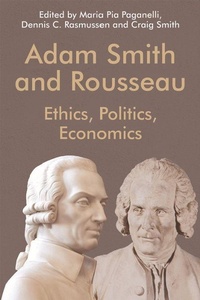
Adam Smith and Rousseau
Ethics, Politics, Economics
Published on 18. February 2018
Book
Hardback
336 pages
978-1-4744-2285-7 (ISBN)
Description
Looks at all aspects of the pivotal intellectual relationship between two key figures of the Enlightenment
Jean-Jacques Rousseau (1712-78) and Adam Smith (1723-90) are two of the foremost thinkers of the European Enlightenment. They who made seminal contributions to moral and political philosophy and shaped some of the key concepts of modern political economy. Though we have no solid evidence that they met in person, we do know that they shared many friends and interlocutors. In particular, David Hume was Smith's closest intellectual associate and was also the one who arranged for Rousseau's stay in England in 1766.
This collection brings together an international and interdisciplinary group of Adam Smith and Rousseau scholars to explore the key shared concerns of these two great thinkers in politics, philosophy, economics, history and literature
Jean-Jacques Rousseau (1712-78) and Adam Smith (1723-90) are two of the foremost thinkers of the European Enlightenment. They who made seminal contributions to moral and political philosophy and shaped some of the key concepts of modern political economy. Though we have no solid evidence that they met in person, we do know that they shared many friends and interlocutors. In particular, David Hume was Smith's closest intellectual associate and was also the one who arranged for Rousseau's stay in England in 1766.
This collection brings together an international and interdisciplinary group of Adam Smith and Rousseau scholars to explore the key shared concerns of these two great thinkers in politics, philosophy, economics, history and literature
Reviews / Votes
This volume is nicely done ... Smith and Rousseau studies are both in robust health right now, but with only a few scholars who are capable of writing well about both philosophers. This volume will assist with the on-going work of cross-fertilisation, and make it much easier in future for more to follow suit. -- Christopher Brooke, University of Cambridge * Journal of Scottish Philosophy * This excellent volume deepens our understanding of the relationship between the ideas and arguments of Smith and Rousseau, and succeeds in making it clear that our understanding of each of these hugely important philosophers depends to a significant extent on our understanding of the other. * Professor James Harris, University of St.Andrews *More details
Series
Language
English
Place of publication
Edinburgh
United Kingdom
Target group
College/higher education
Product notice
sewn/stitched
Cloth over boards
Dimensions
Height: 236 mm
Width: 152 mm
Thickness: 23 mm
Weight
612 gr
ISBN-13
978-1-4744-2285-7 (9781474422857)
Copyright in bibliographic data and cover images is held by Nielsen Book Services Limited or by the publishers or by their respective licensors: all rights reserved.
Schweitzer Classification
Other editions
Additional editions
Maria Pia Paganelli | Dennis C. Rasmussen | Craig Smith
Adam Smith and Rousseau
Ethics, Politics, Economics
E-Book
01/2018
1st Edition
Edinburgh University Press
€29.49
Available for download
Maria Pia Paganelli | Dennis C. Rasmussen | Craig Smith
Adam Smith and Rousseau
Ethics, Politics, Economics
E-Book
01/2018
1st Edition
Edinburgh University Press
€29.49
Available for download
Persons
Maria Pia Paganelli is Associate Professor in the Department of Economics at Trinity University, San Antonio, Texas. She is the co-editor of The Oxford Handbook on Adam Smith (OUP, 2013) along with Christopher Berry and Craig Smith. She has written extensively in journals on David Hume and Adam Smith. Dennis C. Rasmussen is Associate Professor in the Department of Political Science at Tufts University. He is the author of The Pragmatic Enlightenment: Recovering the Liberalism of Hume, Smith, Montesquieu and Voltaire (Cambridge University Press, 2014), The Problems and Promise of Commercial Society: Adam Smith's Response to Rousseau (Penn State University Press, 2008). Craig Smith is Professor of the History of Political Thought in the School of Social and Political Sciences at The University of Glasgow.
Content
Acknowledgments
Citations and Abbreviations
Series Editor's Introduction
Part I: Adam Smith and Jean-Jacques Rousseau
1. IntroductionMaria Pia Paganelli, Dennis C. Rasmussen and Craig Smith
2. On the Place of Politics in Commercial SocietyRyan Patrick Hanley
3. Rousseau and the Scottish Enlightenment: Connections and DisconnectionsMark Hulliung
Part II: Self-interest and Sympathy
4. The Role of Interpersonal Comparisons in Moral Learning and the Sources of Recognition Respect: Jean-Jacques Rousseau's amour-propre and Adam Smith's sympathyChristel Fricke
5. Actors and Spectators: Rousseau's response to eighteenth-century debates on self-interestMark Hill
6. Pursuing Sympathy without Vanity: Interpreting Smith's Critique of Rousseau through Smith's Critique of MandevilleJohn McHugh
Part III: Moral Sentiments and Spectatorship
7. Adam Smith and Jean-Jacques Rousseau on the Vices of the MarketplaceMichael Schleeter
8. Julie's Garden and the Impartial Spectator: an examination of Smithean themes in Rousseau's La Nouvelle HeloiseTabitha Baker
9. Sentimental Conviction: Rousseau's Apologia and the Impartial SpectatorAdam Schoene
Part IV: Commercial Society and Justice
10. Being and Appearing: self-falsification, exchange and freedom in Rousseau and Adam SmithCharles L. Griswold
11. Citizens, Markets and Social Order: An Aristotelian Reading of Smith and Rousseau on JusticeJimena Hurtado
Part V: Politics and Freedom
12. Smith, Rousseau and the True Spirit of a RepublicanDennis C. Rasmussen
13. Left to Their Own Devices: Smith and Rousseau on Public Opinion and the Role of the StateJason Neidleman
14. Rousseau and Smith: Sympathy, Justice and CosmopoliticsNeil Saccamano
Notes on Contributors
Index
Citations and Abbreviations
Series Editor's Introduction
Part I: Adam Smith and Jean-Jacques Rousseau
1. IntroductionMaria Pia Paganelli, Dennis C. Rasmussen and Craig Smith
2. On the Place of Politics in Commercial SocietyRyan Patrick Hanley
3. Rousseau and the Scottish Enlightenment: Connections and DisconnectionsMark Hulliung
Part II: Self-interest and Sympathy
4. The Role of Interpersonal Comparisons in Moral Learning and the Sources of Recognition Respect: Jean-Jacques Rousseau's amour-propre and Adam Smith's sympathyChristel Fricke
5. Actors and Spectators: Rousseau's response to eighteenth-century debates on self-interestMark Hill
6. Pursuing Sympathy without Vanity: Interpreting Smith's Critique of Rousseau through Smith's Critique of MandevilleJohn McHugh
Part III: Moral Sentiments and Spectatorship
7. Adam Smith and Jean-Jacques Rousseau on the Vices of the MarketplaceMichael Schleeter
8. Julie's Garden and the Impartial Spectator: an examination of Smithean themes in Rousseau's La Nouvelle HeloiseTabitha Baker
9. Sentimental Conviction: Rousseau's Apologia and the Impartial SpectatorAdam Schoene
Part IV: Commercial Society and Justice
10. Being and Appearing: self-falsification, exchange and freedom in Rousseau and Adam SmithCharles L. Griswold
11. Citizens, Markets and Social Order: An Aristotelian Reading of Smith and Rousseau on JusticeJimena Hurtado
Part V: Politics and Freedom
12. Smith, Rousseau and the True Spirit of a RepublicanDennis C. Rasmussen
13. Left to Their Own Devices: Smith and Rousseau on Public Opinion and the Role of the StateJason Neidleman
14. Rousseau and Smith: Sympathy, Justice and CosmopoliticsNeil Saccamano
Notes on Contributors
Index