

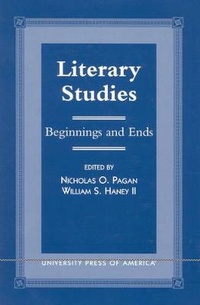
Literary Studies
Beginnings and Ends
Published on 16. May 2001
Book
Paperback/Softback
200 pages
978-0-7618-1935-6 (ISBN)
Description
The essays in this collection raise questions about the end of literature, with the word end taken in its varied meanings. Literary study begins with a commitment to the new; it has an end but does not end because the beginning is always renewed. The beginning is the end; the end is the beginning. Literary study directs our attention to a world changing through time, but even though our thinking is ineluctably historical and therefore new, it also points beyond time and the very opposition between beginning and end. Literature helps us to see the world anew, with fresh eyes, alert to the strange and its inseparable other, the familiar, but in the process it also suggests something more beyond the boundaries of thought. What is it about literature that helps us to see beyond our mental constructions? How does literature bridge the present, past and future in its move toward the inexpressible? The first group of essays address these questions in theory and through the example of specific works, and the final essays present diverse views on humanism and culture. The collection thus begins with essays that address specifically literary issues and ends with speculations on the relationship between literature and painting, the cultural context of model airplane building, and the future of the humanities in the age of mechanical reproduction. Each of these chapters show that beginnings and ends are culturally relative, and to be met in unexpected places. They suggest that today, literary studies must acknowledge the influence of the opacity of the signifier, but also that in the interpretation of texts and the strangeness of language enables us to glimpse a corresponding strangeness in the world and in the subject itself. Despite our postmodern condition, literary and cultural studies like no other field can bring the subject into confrontation with the relativity of its own existence, while at the same time allowing it to distance itself through reflection from the social forces that exist.
More details
Language
English
Place of publication
Lanham, MD
United States
Dimensions
Height: 231 mm
Width: 146 mm
Thickness: 10 mm
Weight
272 gr
ISBN-13
978-0-7618-1935-6 (9780761819356)
Copyright in bibliographic data and cover images is held by Nielsen Book Services Limited or by the publishers or by their respective licensors: all rights reserved.
Schweitzer Classification
Persons
Nicholas O. Pagan is an Associate Professor of English Literature and Humanities at Eastern Mediterranean University. William S. Haney II is a Professor of Literature and Humanities at Eastern Mediterranean University.
Content
Chapter 1 Preface Chapter 2 Introduction Chapter 3 Nipping Bloom in the Bud Chapter 4 Reckoning with Time Chapter 5 The End of the American Frontier? Chapter 6 The Problem of Studying Postmodernist Literature at the End of the Millennium Chapter 7 William Carlos Williams and the American Idiom Chapter 8 Beginnings and Ends Chapter 9 Nazim Hikmet Chapter 10 Integral Phenomenology and Performance Chapter 11 Modeling and Postmodernism Chapter 12 The Dialogue between Modern Art and Modern Literature Chapter 13 The Alchemy of Time Chapter 14 Index