

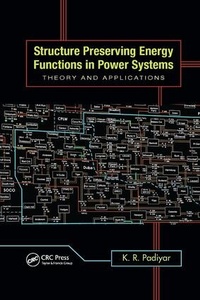
Structure Preserving Energy Functions in Power Systems
Theory and Applications
1st Edition
Published on 27. October 2017
Book
Paperback/Softback
380 pages
978-1-138-07771-3 (ISBN)
Description
A guide for software development of the dynamic security assessment and control of power systems, Structure Preserving Energy Functions in Power Systems: Theory and Applications takes an approach that is more general than previous works on Transient Energy Functions defined using Reduced Network Models. A comprehensive presentation of theory and applications, this book:
Describes the analytics of monitoring and predicting dynamic security and emergency control through the illustration of theory and applications of energy functions defined on structure preserving models
Covers different facets of dynamic analysis of large bulk power systems such as system stability evaluation, dynamic security assessment, and control, among others
Supports illustration of SPEFs using examples and case studies, including descriptions of applications in real-time monitoring, adaptive protection, and emergency control
Presents a novel network analogy based on accurate generator models that enables an accurate, yet simplified approach to computing total energy as the aggregate of energy in individual components
The book presents analytical tools for online detection of loss of synchronism and suggests adaptive system protection. It covers the design of effective linear damping controllers using FACTS, for damping small oscillations during normal operation to prevent transition to emergency states, and emergency control based on FACTS, to improve first swing stability and also provide rapid damping of nonlinear oscillations that threaten system security during major disturbances. The author includes detection and control algorithms derived from theoretical considerations and illustrated through several examples and case studies on text systems.
Describes the analytics of monitoring and predicting dynamic security and emergency control through the illustration of theory and applications of energy functions defined on structure preserving models
Covers different facets of dynamic analysis of large bulk power systems such as system stability evaluation, dynamic security assessment, and control, among others
Supports illustration of SPEFs using examples and case studies, including descriptions of applications in real-time monitoring, adaptive protection, and emergency control
Presents a novel network analogy based on accurate generator models that enables an accurate, yet simplified approach to computing total energy as the aggregate of energy in individual components
The book presents analytical tools for online detection of loss of synchronism and suggests adaptive system protection. It covers the design of effective linear damping controllers using FACTS, for damping small oscillations during normal operation to prevent transition to emergency states, and emergency control based on FACTS, to improve first swing stability and also provide rapid damping of nonlinear oscillations that threaten system security during major disturbances. The author includes detection and control algorithms derived from theoretical considerations and illustrated through several examples and case studies on text systems.
Reviews / Votes
"The main strength of the book seems to be its entirety. .... One really has a feeling that there's everything one may need from this field. As the subject of energy functions is not always easy to understand, it is also important that the theoretical considerations are supported by examples and case studies. ... The book represents the state of the art in the field of structure preserving energy functions for power systems."-Rafael Mihalic, Full Professor, Faculty of Electrical Engineering, Ljubljana, Slovenia
"This book is an excellent reference for the power system community, as it provides thorough coverage of technical aspects such as power system stability, security, direct methods for transient stability, and the application of HVDC and FACTS for stability improvements."
-Dr. Ram Adapa, Technical Leader, EPRI, Palo Alto, California, USA
More details
Language
English
Place of publication
London
United Kingdom
Publishing group
Taylor & Francis Ltd
Target group
College/higher education
Illustrations
148 s/w Abbildungen, 30 s/w Tabellen
30 Tables, black and white; 148 Illustrations, black and white
Dimensions
Height: 234 mm
Width: 156 mm
Weight
453 gr
ISBN-13
978-1-138-07771-3 (9781138077713)
Copyright in bibliographic data and cover images is held by Nielsen Book Services Limited or by the publishers or by their respective licensors: all rights reserved.
Schweitzer Classification
Other editions
Additional editions
E-Book
09/2018
1st Edition
CRC Press
€114.99
Available for download
E-Book
09/2018
1st Edition
CRC Press
€115.99
Available for download
Book
03/2013
1st Edition
CRC Press
€272.36
Shipment within 15-20 days
Person
Prof. K.R. Padiyar is with Indian Institute of Science, Bangalore since 1987, where he is presently an Emeritus Professor in the department of Electrical Engineering. Previously he was with Indian Institute of Technology, Kanpur from 1976 to 1987 where he became a Professor in 1980. He obtained B.E. degree from Poona University in 1962, M.E. degree form Indian Institute of Science in 1964 and PhD degree from University of Waterloo, Canada in 1972.
Prof. Padiyar is an internationally recognized expert in the areas of HVDC and FACTS, Power System Stability and Control. He has authored over 200 papers and five books including "HVDC Power Transmission Systems", "Power System Dynamics", "Analysis of Subsynchronous Resonance in Power Systems "and recently, "FACTS Controllers in Power Transmission and Distribution". He is a Fellow of Indian National Academy of Engineering and Life Senior Member of IEEE. He was awarded the Dept. of Power Prize twice by Institution of Engineers (India). He is the recipient of 1999 Prof. Rustom Choksi Award for Excellence in Research for Science/Engineering. He was ABB Chair Professor during 2001-03.
He has published several papers on the subject of power system stability, Structure Preserving Energy Functions(SPEF) and their applications. Some of these are listed below.
Prof. Padiyar is an internationally recognized expert in the areas of HVDC and FACTS, Power System Stability and Control. He has authored over 200 papers and five books including "HVDC Power Transmission Systems", "Power System Dynamics", "Analysis of Subsynchronous Resonance in Power Systems "and recently, "FACTS Controllers in Power Transmission and Distribution". He is a Fellow of Indian National Academy of Engineering and Life Senior Member of IEEE. He was awarded the Dept. of Power Prize twice by Institution of Engineers (India). He is the recipient of 1999 Prof. Rustom Choksi Award for Excellence in Research for Science/Engineering. He was ABB Chair Professor during 2001-03.
He has published several papers on the subject of power system stability, Structure Preserving Energy Functions(SPEF) and their applications. Some of these are listed below.
Content
Detection of Instability Based on Identification of Critical Cutsets. Sensitivity Analysis for Dynamic Security and Preventive Control Using Damping Controllers. Application of FACTS Controllers for Emergency Control - I. Application of FACTS Controllers for Emergency Control - II. Appendices.