

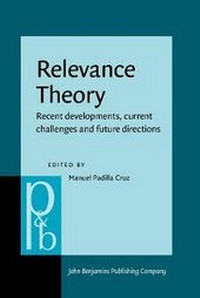
Relevance Theory
Recent developments, current challenges and future directions
Published on 20. October 2016
Book
Hardback
327 pages
978-90-272-5673-7 (ISBN)
Description
How hearers arrive at intended meaning, which elements encode processing instructions in certain languages, how procedural meaning and prosody interact, how diverse types of utterances are interpreted, how epistemic vigilance mechanisms work, which linguistic elements assist those mechanisms, how a critical attitude to information and informers develops when a second language is learnt, or why some perlocutionary effects originate are some of the varied issues that have intrigued pragmatists, and relevance theorists in particular, and continue to fuel research. In this collection readers will discover new proposals based on the cognitive framework put forward by Dan Sperber and Deirdre Wilson three decades ago. Their gripping, insightful and stimulating discussions, combined in some cases with meticulous and in-depth analyses, show the directions relevance theory has recently followed. Moreover, this collection also unveils fruitful and promising interactions with areas like morphology, prosody, language typology, interlanguage pragmatics, machine translation, or rhetoric and argumentation, and avenues for future research.
More details
Series
Language
English
Place of publication
Amsterdam
Netherlands
Target group
Professional and scholarly
Weight
740 gr
ISBN-13
978-90-272-5673-7 (9789027256737)
Copyright in bibliographic data and cover images is held by Nielsen Book Services Limited or by the publishers or by their respective licensors: all rights reserved.
Schweitzer Classification
Other editions
Additional editions
E-Book
10/2016
1st Edition
John Benjamins Publishing Company
€118.99
Available for download
Person
Content
1. Introduction; 2. Three decades of relevance theory (by Padilla Cruz, Manuel); 3. Part I: Issues on procedural meaning and procedural analyses; 4. The speaker's derivational intention (by Fretheim, Thorstein); 5. Cracking the chestnut: How intonation interacts with procedural meaning in Colloquial Singapore English Lah (by Lee, Junwen); 6. Reference assignment in pronominal argument languages: A relevance-theoretic perspective (by Schroder, Helga); 7. Conceptual and procedural information for verb tense disambiguation: The English Simple Past (by Grisot, Cristina); 8. Part II: Discourse issues; 9. Relevance theory and contextual sources-centred analysis of irony: Current research and compatibility (by Yus, Francisco); 10. Distinguishing rhetorical from ironical questions: A relevance-theoretic account (by Raeber, Thierry); 11. Part III: Interpretive processes; 12. Relevance theory, epistemic vigilance and pragmatic competence (by Ifantidou, Elly); 13. Evidentials, genre and epistemic vigilance (by Unger, Christoph); 14. Part IV: Rhetorical and perlocutionary effects of communication; 15. Rhetoric and cognition: Pragmatic constraints on argument processing (by Oswald, Steve); 16. Perlocutionary effects and relevance theory (by Piskorska, Agnieszka); 17. Conclusion; 18. Some directions for future research in relevance-theoretic pragmatics (by Padilla Cruz, Manuel); 19. Contributors; 20. Index