

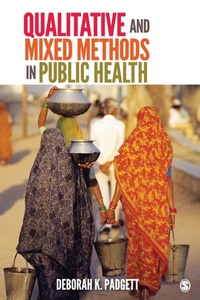
Qualitative and Mixed Methods in Public Health
1st Edition
Published on 3. November 2011
Book
Paperback/Softback
312 pages
978-1-4129-9033-2 (ISBN)
Description
Public health research methods for the 21st century
Designed to meet the needs of public health students, practitioners, and researchers, this exciting and contemporary new text from the author of Qualitative Methods in Social Work Research, Second Edition offers a firm grounding in qualitative and mixed methods, including their social science roots and public health applications. It uniquely addresses two profound changes taking place in public health in the 21st century: the explosion of interest in global public health, and the growing reliance on community-engaged research methods. The author brings public health to life through the use of real-world case studies drawn from the author's funded research projects in breast cancer screening as well as homelessness and mental illness.
Designed to meet the needs of public health students, practitioners, and researchers, this exciting and contemporary new text from the author of Qualitative Methods in Social Work Research, Second Edition offers a firm grounding in qualitative and mixed methods, including their social science roots and public health applications. It uniquely addresses two profound changes taking place in public health in the 21st century: the explosion of interest in global public health, and the growing reliance on community-engaged research methods. The author brings public health to life through the use of real-world case studies drawn from the author's funded research projects in breast cancer screening as well as homelessness and mental illness.
Reviews / Votes
"There is a lack of quality qualitative texts specifically tailored for public health and I think this text could fill that gap. The emphasis on global health is a very attractive feature for this book as it would lend itself to a wide variety of professionals and students. The "start to finish" overview that the book attempts is very accessible for students who are just learning about how to go about conducting qualitative research." -- Michael Reece "...the data collection and analysis are all in one text, the examples given are great, and it provides a chapter on mixed-methods research which would be a natural segue into talking about quantitative data collection and analysis." -- Stephanie B. Jilcott "The three greatest strengths are the breadth of topics covered, the connection between classroom teaching and real world practical experience and classroom exercises, resources, practical examples - offering lots of opportunities to practice what is learned in the classroom." -- Rosemary M. Caron "Those of us who teach and use qualitative methods have been waiting fora book like this for a long time. Deborah Padgett successfully conveys
the reasons for using qualitative methods, epistemological orientations,
methodological traditions, and the nuts and bolt of how to do and report
rigorous and relevant qualitative and mixed methods research. This
well-balanced book is the perfect fit for those of us who teach and
conduct applied health research." -- Geoffrey Nelson, Ph.D., Professor of Psychology
More details
Language
English
Place of publication
Thousand Oaks
United States
Target group
College/higher education
Dimensions
Height: 229 mm
Width: 152 mm
Thickness: 17 mm
Weight
457 gr
ISBN-13
978-1-4129-9033-2 (9781412990332)
Copyright in bibliographic data and cover images is held by Nielsen Book Services Limited or by the publishers or by their respective licensors: all rights reserved.
Schweitzer Classification
Person
Dr. Deborah K. Padgett is widely known for her expertise in qualitative and mixed methods including this third edition and a companion text Qualitative and Mixed Methods in Public Health (Sage, 2012). She is first author of Housing First: Ending Homelessness, Transforming Systems and Changing Lives (Oxford University Press, 2015) and has published extensively on mental health needs and service use of homeless adults and other underserved populations. Dr. Padgett was Principal Investigator on two NIMH-funded R01 grants, both qualitative studies of engagement and recovery among formerly homeless adults in supportive housing in New York City. She served as President of the Society for Social Work and Research (SSWR), culminating in the establishment of the SSWR "Deborah K. Padgett Early Career Award" in recognition of her contributions. She is a member of the American Academy of Social Work and Social Welfare (AASWSW) and serves on its Board. In 2013, Dr. Padgett received New York University's Distinguished Teaching Award.
Content
Preface
1. Introduction
2. Choosing the Right Qualitative Approach(es)
3. Mixed Methods
4. Getting Started: Study Design and Sampling
5. Ethical Issues in Qualitative Research
6. Entering the Field and Conducting Observation
7. Interviewing and Use of Documents
8. Data Analysis and Interpretation
9. Strategies for Rigor
10. Telling the Story: Writing Up the Qualitative Study
Appendix
References
Index
About the Author
1. Introduction
2. Choosing the Right Qualitative Approach(es)
3. Mixed Methods
4. Getting Started: Study Design and Sampling
5. Ethical Issues in Qualitative Research
6. Entering the Field and Conducting Observation
7. Interviewing and Use of Documents
8. Data Analysis and Interpretation
9. Strategies for Rigor
10. Telling the Story: Writing Up the Qualitative Study
Appendix
References
Index
About the Author