

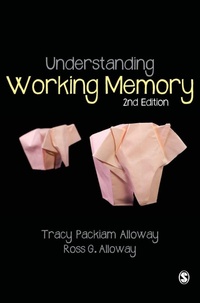
Understanding Working Memory
2nd Edition
Published on 10. November 2014
Book
Hardback
168 pages
978-1-4462-7420-0 (ISBN)
Description
It is hard to conceive of a classroom activity that does not involve working memory - our ability to work with information. In fact, it would be impossible for students to learn without working memory. From following instructions to reading a sentence, from sounding out an unfamiliar word to calculating a math problem, nearly everything a student does in the classroom requires working with information. Even when a student is asked to do something simple, like take out their science book and open it to page 289, they have to use their working memory.
Most children have a working memory that is strong enough to quickly find the book and open to the correct page, but some don't - approximately 10% in any classroom. A student who loses focus and often daydreams may fall in this 10%. A student who isn't living up to their potential may fall in this 10%. A student who may seem unmotivated may fall in this 10%. In the past, many of these students would have languished at the bottom of the class, because their problems seemed insurmountable and a standard remedy like extra tuition didn't solve them. But emerging evidence shows that many of these children can improve their performance by focusing on their working memory. Working memory is a foundational skill in the classroom and when properly supported it can often turn around a struggling student's prospects.
This book will make sure you are able to spot problems early, work with children to improve their working memory and ensure they reach their full potential.
How does the book work?
Each of the following chapters includes a description of the learning difficulty (WHAT), followed by an inside look into the brain of a student with the disorder (WHERE), their unique working memory profile (WHY), and classroom strategies to support working memory (HOW). There are two types of strategies: general working memory strategies that can be applied to all students in your class, and specific working memory strategies for each learning difficulty. The final chapter (Chapter 9) provides the student with tools to empower them along their learning journey.
The aim in supporting students with learning difficulties is not just to help them survive in the classroom, but to thrive as well. The strategies in the book can provide scaffolding and support that will unlock their working memory potential to boost learning. They are designed to be easily integrated within the classroom setting as a dimension of an inclusive curriculum and used in developing an individualized education program (IEP) for the student.
The strategies recommended here can also complement existing programs that support a core deficit, such as a social skills program for a student with autistic spectrum disorder, or behavior modification for those with ADHD. Each chapter also includes:
Try It box: Provides the reader with an opportunity to have a hands-on understanding of the material
Science Flash box: Gives the reader a snapshot of current and interesting research related to each chapter
Current Debate box: Discusses a controversial issue pertaining to the disorder
Tracy Packiam Alloway is an award-winning psychologist based at the University of North Florida
Ross Alloway is the CEO of Memosyne Ltd, a company that brings cutting-edge scientific research to parents.
Most children have a working memory that is strong enough to quickly find the book and open to the correct page, but some don't - approximately 10% in any classroom. A student who loses focus and often daydreams may fall in this 10%. A student who isn't living up to their potential may fall in this 10%. A student who may seem unmotivated may fall in this 10%. In the past, many of these students would have languished at the bottom of the class, because their problems seemed insurmountable and a standard remedy like extra tuition didn't solve them. But emerging evidence shows that many of these children can improve their performance by focusing on their working memory. Working memory is a foundational skill in the classroom and when properly supported it can often turn around a struggling student's prospects.
This book will make sure you are able to spot problems early, work with children to improve their working memory and ensure they reach their full potential.
How does the book work?
Each of the following chapters includes a description of the learning difficulty (WHAT), followed by an inside look into the brain of a student with the disorder (WHERE), their unique working memory profile (WHY), and classroom strategies to support working memory (HOW). There are two types of strategies: general working memory strategies that can be applied to all students in your class, and specific working memory strategies for each learning difficulty. The final chapter (Chapter 9) provides the student with tools to empower them along their learning journey.
The aim in supporting students with learning difficulties is not just to help them survive in the classroom, but to thrive as well. The strategies in the book can provide scaffolding and support that will unlock their working memory potential to boost learning. They are designed to be easily integrated within the classroom setting as a dimension of an inclusive curriculum and used in developing an individualized education program (IEP) for the student.
The strategies recommended here can also complement existing programs that support a core deficit, such as a social skills program for a student with autistic spectrum disorder, or behavior modification for those with ADHD. Each chapter also includes:
Try It box: Provides the reader with an opportunity to have a hands-on understanding of the material
Science Flash box: Gives the reader a snapshot of current and interesting research related to each chapter
Current Debate box: Discusses a controversial issue pertaining to the disorder
Tracy Packiam Alloway is an award-winning psychologist based at the University of North Florida
Ross Alloway is the CEO of Memosyne Ltd, a company that brings cutting-edge scientific research to parents.
Reviews / Votes
This is a clearly written and well-organised book, providing valuable information about working memory and how it can affect individuals' learning and progress in an educational context. It is a 'must read' for all teachers and support assistants in primary and secondary schools. Many parents are likely to find the book of interest to them if they have a child with any of the disorders discussed in the book. Undergraduate psychology students would also benefit from reading this book as background understanding to working memory in context - the references and further reading offering opportunity to extend their knowledge. -- Jenny Moody, Postgraduate Psychology Tutor, Dyslexia Action The clear structure and lack of jargon make the book accessible to a wide range of readers... I was especially impressed that anxiety disorders were included because these can have a debilitating effect on a student, and yet they are often missed out of books on special needs. The case studies are helpful and provide examples of how students can be affected, together with specific strategies that can be used to help them. -- Amanda Swannell It is a very handy, "go to" reference for students, teachers and parents about the nature of working memory difficulties and how these can manifest themselves within the areas of Dyslexia, Dyscalculia, DCD, ADHD, ASD and Anxiety disorders. -- Janet Oostendorp The book is a refreshing welcome addition to the field of special education, and promises to be a great success among educators. -- Naveen Kashyap, Department of Humanities and Social Sciences, Indian Institute of TechnologyMore details
Edition
2nd Revised edition
Language
English
Place of publication
London
United Kingdom
Target group
College/higher education
Professional and scholarly
Edition type
Revised edition
Dimensions
Height: 250 mm
Width: 175 mm
Thickness: 14 mm
Weight
484 gr
ISBN-13
978-1-4462-7420-0 (9781446274200)
Copyright in bibliographic data and cover images is held by Nielsen Book Services Limited or by the publishers or by their respective licensors: all rights reserved.
Schweitzer Classification
Other editions
Additional editions
Tracy Packiam Alloway | Ross G. Alloway
Understanding Working Memory
Book
11/2014
2nd Edition
SAGE Publications Ltd
€69.00
Shipment within 15-20 days
Tracy Packiam Alloway | Ross G. Alloway
Understanding Working Memory
E-Book
10/2014
2nd Edition
SAGE Publications Ltd
€61.49
Available for download
Tracy Packiam Alloway | Ross G. Alloway
Understanding Working Memory
E-Book
10/2014
2nd Edition
SAGE Publications Ltd
€61.49
Available for download
Previous edition
Book
11/2010
1st Edition
SAGE Publications Ltd
€116.56
Article exhausted; check for reprint
Persons
Tracy Packiam Alloway, PhD, is a professor of Psychology at the University of North Florida. Formerly, she was the Director of the Center for Memory and Learning in the Lifespan in the UK. She is an expert on working memory and education, and has published over 75 journal articles and books on this topic. She developed the internationally recognized Alloway Working Memory Assessment (Pearson Assessment, translated into 20 languages). She writes a blog for Psychology Today and Huffington Post. She has also provided advice to Fortune 500 companies, like Prudential, as well as the World Bank and BBC.
www.tracyalloway.com
Ross Alloway, PhD, CEO of Memosyne Ltd., brings working memory training to educators and parents. Ross developed Jungle Memory, used by thousands of students in over twenty countries. Together with Tracy Alloway, Ross edited an academic book on working memory (Psychology Press) and co-authored a popular science book (Simon & Schuster, translated into 17 languages). He has also has published research with Tracy Alloway on working memory in a variety of contexts, from education to aging, from happiness to lying, from barefoot running to Facebook. Their research has been featured on BBC, ABC News, Huffington Post, Salon, The Washington Post, and Newsweek. He writes a blog for Huffington Post.
www.docsalloway.com
www.tracyalloway.com
Ross Alloway, PhD, CEO of Memosyne Ltd., brings working memory training to educators and parents. Ross developed Jungle Memory, used by thousands of students in over twenty countries. Together with Tracy Alloway, Ross edited an academic book on working memory (Psychology Press) and co-authored a popular science book (Simon & Schuster, translated into 17 languages). He has also has published research with Tracy Alloway on working memory in a variety of contexts, from education to aging, from happiness to lying, from barefoot running to Facebook. Their research has been featured on BBC, ABC News, Huffington Post, Salon, The Washington Post, and Newsweek. He writes a blog for Huffington Post.
www.docsalloway.com
Content
Epilogue by Kim Grant
Chapter 1: Our Brain's Post-it-note
Chapter 2: Diagnosing Working Memory
Chapter 3: Specific Learning Disorder: Reading Difficulties (Dyslexia)
Chapter 4: Specific Learning Disorder: Maths Difficulties (Dyscalculia)
Chapter 5: Developmental Coordination
Chapter 6: Attention Deficit Hyperactivity Disorder (ADHD)
Chapter 7: Autistic Spectrum Disorder
Chapter 8: Anxiety Disorders (by Evan Copello)
Chapter 9: Student Strategies and Training
Appendix: Working Memory strategies table
Epilogue by Kim Grant
Chapter 1: Our Brain's Post-it-note
Chapter 2: Diagnosing Working Memory
Chapter 3: Specific Learning Disorder: Reading Difficulties (Dyslexia)
Chapter 4: Specific Learning Disorder: Maths Difficulties (Dyscalculia)
Chapter 5: Developmental Coordination
Chapter 6: Attention Deficit Hyperactivity Disorder (ADHD)
Chapter 7: Autistic Spectrum Disorder
Chapter 8: Anxiety Disorders (by Evan Copello)
Chapter 9: Student Strategies and Training
Appendix: Working Memory strategies table
Epilogue by Kim Grant