

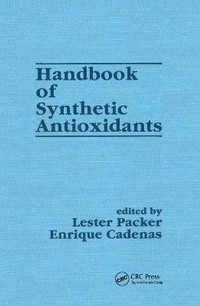
Handbook of Synthetic Antioxidants
Will be published approx. on 14. February 1997
Book
Hardback
464 pages
978-0-8247-9810-9 (ISBN)
Description
Emphasizes the efficacy of synthetically occurring compounds in the management of free radical-mediated illnesses. The text details the design, development and delivery of therapeutic antioxidants used in the treatment of pathophysiological disorders, from amylotrophic lateral sclerosis (ALS) and multiple sclerosis (MS) to Alzheimer's disease.
More details
Series
Edition
1997 edition
Language
English
Place of publication
Bosa Roca
United States
Publishing group
Taylor & Francis Inc
Target group
College/higher education
Professional and scholarly
Academic and Professional Practice & Development
Product notice
sewn/stitched
Cloth over boards
Dimensions
Height: 234 mm
Width: 159 mm
Thickness: 27 mm
Weight
771 gr
ISBN-13
978-0-8247-9810-9 (9780824798109)
Copyright in bibliographic data and cover images is held by Nielsen Book Services Limited or by the publishers or by their respective licensors: all rights reserved.
Schweitzer Classification
Other editions
Additional editions
Lester Packer
Handbook of Synthetic Antioxidants
Book
12/2019
1st Edition
CRC Press
€69.90
Shipment within 15-20 days
Lester Packer
Handbook of Synthetic Antioxidants
E-Book
08/2019
1st Edition
CRC Press
€61.99
Available for download
Lester Packer
Handbook of Synthetic Antioxidants
E-Book
08/2019
1st Edition
CRC Press
€61.99
Available for download
Person
LESTER PACKER is Professor of Molecular and Cell Biology, Division of Cell and Developmental Biology, University of California, Berkeley. Dr. Packer is the author of over 500 published articles and coeditor of the Handbook of Antioxidants, Oxidative Stress in Dermatology, Vitamin E in Health and Disease, Retinoids: Progress in Research and Clinical Applications, and Biothiols in Health and Disease (all tides, Marcel Dekker, Ine.). He is President of the Oxygen Club of California, President of the International Society of Free Radical Research, and a member of the Oxygen Society, the American Society of Biochemistry and Molecular Biology, and the American Institute of Nutrition, among others. Dr. Packer received the B.S. (1951) and M.S. (1952) degrees in biologyand chemistry from Brooklyn College, Brooklyn, New York, and the Ph.D. degree (1956) in microbiology and biochemistry from Yale University, New Haven, Connecticut., ENRIQUE CADENAS is a Professor in and Chairman of the Department of Molecular Pharmaeology and Toxicology in the School of Pharmacy and a Professor of Biochemistry in the School of Medicine, University of Southern California, Los Angeles. The author of over 160 professionai publications and coeditor of the Handbook of Antioxidants and Biothiols in Health and Disease (both titles, Marcel Dekker, Inc.), Dr. Cadenas is a member of the American Chemical Society, the American Society of Photobiology, the Biochemical Society (United Kingdom), and the European Society for Photobiology, among others. Dr. Cadenas received the M.D. degree (1973) and the Ph.D. degree (1977) in biochemistry from the University of Buenos Aires School of Medicine, Argentina.
Content
General concepts: approach and rationale for the design of synthetic derivatives of natural antioxidants as therapeutic agents. Synthetic derivatives of natural antioxidants: design and biological evaluation of tissue-directed alpha-tocopherol analogs; physical and chemical mechanisms of the antioxidant action of tirilazad mesylate; anionic tocopherol esters as antioxidants and cytoprotectants. Phenolic antioxidants: phenolic antioxidants - physiological and toxicological aspects; antioxidant properties of probucol; antioxidant properties of the catechol derivative nitecapone. Twenty-one aminosteroids or lazaroids: neuroprotective efficacy and mechanisms of the lazaroids. Sulfhydryl and selenium-containing compounds: antioxidant properties of ebselen; the development of diaryl chalcogenides and alpha-(phenylselenenyl) ketones with antioxidant and glutathione peroxidase-mimetic properties; modulation of glutathione. Nitrones and nitroxides: nitrones radical traps as protectors of oxidative damage in the central nervous system; antioxidant properties of nitroxides and nitroxide SOD mimics. SOD mimics: mimics of superoxide dismutase. Metal chelators: antioxidant properties of synthetic iron chelators.