

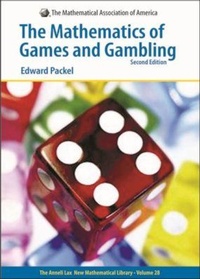
Mathematics of Games and Gambling
2nd Edition
Published on 14. December 2006
Book
Hardback
188 pages
978-0-88385-646-8 (ISBN)
Description
The new edition of a favourite which introduces and develops some of the important and beautiful elementary mathematics needed for rational analysis of various gambling and game activities. Most of the standard casino games (roulette, craps, blackjack, keno), some social games (backgammon, poker, bridge) and various other activities (state lotteries, horse racing) are treated in ways that bring out their mathematical aspects. The mathematics developed ranges from the predictable concepts of probability, expectation, and binomial coefficients to some less well-known ideas of elementary game theory. The second edition includes new material on: Sports betting and the mathematics behind it Game theory applied to bluffing in poker and related to the 'Texas Holdem phenomenon' The Nash equilibrium concept and its emergence in popular culture Internet links to games and Java applets for practice and classroom use. Game-related exercises are included and solutions to some appear at the end of the book.
More details
Edition
2nd Revised edition
Language
English
Place of publication
Washington DC
United States
Edition type
New edition
Product notice
sewn/stitched
Cloth over boards
Dimensions
Height: 233 mm
Width: 161 mm
Thickness: 17 mm
Weight
401 gr
ISBN-13
978-0-88385-646-8 (9780883856468)
Schweitzer Classification
Other editions
Previous edition

Edward Packel
The Mathematics of Games and Gambling
Book
09/1996
Mathematical Association of America
€34.91
Article exhausted; check for reprint
Person
Edward Packel is Volwiler Professor of Mathematics at Lake Forest College.
Content
Preface to the first edition; Preface to the second edition; 1. The phenomenon of gambling; 2. Finite probabilities and great expectations; 3. Backgammon and other dice diversions; 4. Permutations, combinations and applications; 5. Play it again Sam: the binomial distribution; 6. Elementary game theory; 7. Odds and ends; Answers/Hints for selected exercises; Bibliography; Index.