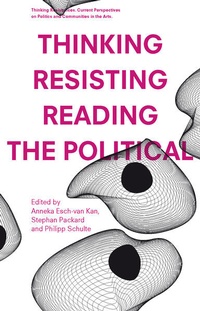
This volume contrasts a number of recently suggested concepts of the political - each of which connects to certain instances of art and literature in its discourse - with questions concerning the rigidity of those connections: How strongly do such claims to politics depend on their specific examples, what is the scope of their validity to understand art with regard to politics, and how can they help us grasp the political within other pieces of art? In each case, manners of thinking concepts of the political, the mutual resistance of such concepts and their academic treatment, and the turn towards specific readings informed by those concepts converge.
The essays collected in "Thinking Resistances. Current Perspectives on Politics, Community, and Art" engage with political phenomena in their interrelations with arts as well as with recent theoretical and philosophical perspectives on the very meaning of politics, the political, and community.
With contributions by Armen Avanessian, Friedrich Balke, Judith Butler, Simon Critchley, Anneka Esch-van Kan, Josef Früchtl, Andreas Hetzel, Jon McKenzie, Dieter Mersch, Chantal Mouffe, Maria Muhle, Nikolaus Müller-Schöll, Stephan Packard, Wim Peeters, Jacques Rancière, Juliane Rebentisch, Gabriel Rockhill, Frank Ruda and Philipp Schulte.
Series
Language
Place of publication
Dimensions
Height: 21 cm
Width: 13.5 cm
Weight
ISBN-13
978-3-03734-217-6 (9783037342176)
Schweitzer Classification
Editor
Stephan Packard ist Juniorprofessor am Institut für Medienkulturwissenschaft der Albert-Ludwigs-Universität in Freiburg, nachdem er als Dozent am Institut für Allgemeine und Vergleichende Literaturwissenschaft an der Ludwig-Maximilians-Universität in München tätig war. Seine Forschungsschwerpunkte sind Semiotik und Psychoanalyse in neuen und alten Medienwissenschaften, Affektsemiotik, Zensur und Medienkontrolle, Comicstudien.
Anneka Esch-van Kan hat kürzlich ihre Doktorarbeit am Graduate Centre for the Study of Culture (JLU Gießen) zum zeitgenössischen politischen Theater in den USA abgeschlossen. Ihre Forschungsschwerpunkte sind Performance Studies, Postdramatische Theaterformen, politisches Theater und neuere Politiken des Ästhetischen sowie Berührungspunkte von Kulturwissenschaft und Disability Studies.
Philipp Schulte arbeitet als Referent für die Hessische Theaterakademie in Frankfurt am Main sowie als freier Autor und Dramaturg u. a. für das Performancekollektiv Monster Truck. Er ist außerdem wissenschaftlicher Mitarbeiter am Institut für Angewandte Theaterwissenschaft in Gießen.
9
-
16
Politics and Aesthetics: Introduction
(Anneka Esch-van Kan, Stephan Packard, Philipp Schulte)
19
-
24
Thinking - Introduction
(Stephan Packard)
25
-
41
From the Plebs to the Demos: Two Notions of Political Subjectification
(Maria Muhle)
43
-
51
Democratic Politics in the Age of Post-Fordism
(Chantal Mouffe)
53
-
63
As If We Could Trust: Fiction and Aesthetics of the Political
(Josef Früchtl)
65
-
88
The Political and the Violent: On Resistances
(Dieter Mersch)
89
-
100
All in Good Time? Fiction and the Possibility of Historic Events
(Friedrich Balke)
101
-
118
Doing or Not Doing: Politics, Aesthetics, Performance
(Jacques Rancière)
121
-
126
Resisting - Introduction
(Anneka Esch-van Kan)
127
-
136
Ethical Ambivalence
(Judith Butler)
137
-
154
Thinking Politics Concretely: Negation, Affirmation, and the Dialectics of Dialectics and Non-Dialectics
(Frank Ruda)
155
-
162
Is Utopianism Dead?
(Simon Critchley)
163
-
183
Abu Ghraib and the Society of the Spectacle of the Scaffold
(Jon McKenzie)
185
-
199
"Torture Chicks" - Resistance and the Political in Coco Fusco's "A Room of One's Own" and "A Field Guide for Female Interrogators"
(Anneka Esch-van Kan)
201
-
212
"Prendre la parole": Voices of Resistance in Contemporary Theory
(Andreas Hetzel)
215
-
220
Reading - Introduction
(Anneka Esch-van Kan, Philipp Schulte)
221
-
230
Reading Political Theories (not) Reading: Towards a Contemporary Realism of Reference
(Armen Avanessian)
231
-
243
Contesting "the Democratic Chattering of the Letter": Politics of Commentary in 20th Century Literature
(Wim Peeters)
245
-
261
Realism Today: Art, Politics, and the Critique of Representation
(Juliane Rebentisch)
263
-
274
"Plus d'un rôle": Playing Together in Contemporary Dance, Theatre, and Performance
(Nikolaus Müller-Schöll)
275
-
290
Alternative Genealogies - Critique and Style in Contemporary Performance Art:
(Philipp Schulte)
291
-
310
Why are Story Arcs Dark and Gritty? On the Metaphysics of Seriality in "Dexter" and Kammerer
(Stephen Packard)
311
-
323
Critical Reflections on the Ontological Illusion: Rethinking the Relation between Art and Politics
(Gabriel Rockhill)