

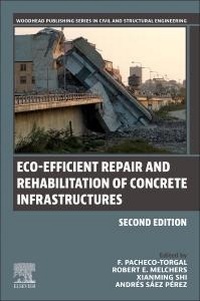
Eco-efficient Repair and Rehabilitation of Concrete Infrastructures
2nd Edition
Published on 18. March 2024
Book
Paperback/Softback
456 pages
978-0-443-13470-8 (ISBN)
Description
Eco-efficient Repair and Rehabilitation of Concrete Infrastructures, Second Edition provides an updated, state-of-the-art review of the latest advances in this important research field. The first section is brought fully up-to-date and focuses on deterioration assessment methods. The second section contains brand new chapters on innovative concrete repair and rehabilitation materials, including fly ash-based alkali-activated repair materials for concrete exposed to aggressive environments, retrofitting of concrete structures with biomaterials, and the assessment of concrete after repair operations and durability of concrete repair.
The final section has been revised to include new chapters on climate change's influence and life cycle assessment (LCA). These chapters include deterioration of concrete infrastructure due to climate change, influence of climate change on bridge deterioration, probabilistic modeling of chloride diffusion in repaired reinforced concrete structures, and LCA of concrete repaired with recycled aggregates.
The final section has been revised to include new chapters on climate change's influence and life cycle assessment (LCA). These chapters include deterioration of concrete infrastructure due to climate change, influence of climate change on bridge deterioration, probabilistic modeling of chloride diffusion in repaired reinforced concrete structures, and LCA of concrete repaired with recycled aggregates.
More details
Series
Edition
2nd edition
Language
English
Place of publication
United States
Publishing group
Elsevier - Health Sciences Division
Target group
Professional and scholarly
Product notice
Paperback (trade)
Unsewn / adhesive bound
Dimensions
Height: 228 mm
Width: 152 mm
Thickness: 22 mm
Weight
703 gr
ISBN-13
978-0-443-13470-8 (9780443134708)
Copyright in bibliographic data and cover images is held by Nielsen Book Services Limited or by the publishers or by their respective licensors: all rights reserved.
Schweitzer Classification
Other editions
Additional editions
Fernando Pacheco-Torgal | Robert E. Melchers | Xianming Shi
Eco-efficient Repair and Rehabilitation of Concrete Infrastructures
E-Book
03/2024
2nd Edition
Woodhead Publishing
€270.00
Available for download
Previous edition
Fernando Pacheco-Torgal | Robert E. Melchers | Xianming Shi
Eco-efficient Repair and Rehabilitation of Concrete Infrastructures
Book
11/2017
Woodhead Publishing Ltd
€303.50
Shipment within 15-20 days
Persons
Fernando Pacheco Torgal is a Principal Investigator at C-TAC, University of Minho. He holds the title of Counsellor (Top 0.5%) from the Portuguese Engineers Association and has been consistently recognized as a Scopus Highly Cited Scientist in the global rankings by Stanford University. With over 300 publications to his name, he has carried out in-depth peer reviews of more than one thousand scientific papers and assessed nearly one hundred research grant proposals across 15 countries. He serves on the editorial boards of nine international journals and has been involved in editorial decisions for several hundred manuscripts. In addition, he has edited 33 international books, many of which are available in the libraries of prestigious institutions such as Harvard, MIT, and Stanford. Robert Melchers is a Full Professor of Civil Engineering at the University of Newcastle in Australia. He was the founding editor of the Australian Journal of Structural Engineering. Professor Melchers' research contributes to creating a better understanding of the corrosion of steel in marine environments. Professor Melchers' research into structural reliability and corrosion modelling of steel and concrete structures has won him many international awards and invitations to contribute to international research projects. In 2013 he was awarded the Engineers Australia John Connell Medal, presented annually to a structural engineer who has made a significant national and international contribution to the profession. Xianming Shi is a professor in Civil and Environmental Engineering at the Washington State University, USA, He is the Founding Director of new USDOT National University Transportation Center, National Center for Transportation Infrastructure Durability & Life-Extension (TriDurLE). He also serves as Editor-in-Chief for the Springer Nature Journal, Journal of Infrastructure Preservation & Resilience, and an Associate Editor for the Journal of Nondestructive Evaluation. His research contributions include more than 150 scholarly journal articles, several books, an international patent, and numerous other publications, with more than 7,000 citations by peers. His research has led to better understanding of how both nanoscience and nano-engineering can benefit infrastructure durability and enable sustainability. Andres Saez Perez has been a Full Professor in the Department of Continuum Mechanics and Structural Analysis at the University of Seville (Spain) since 2007. He received his B. Eng. degree from the School of Engineering at the University of Seville in 1992, his M Sc degree from the Civil Engineering Department at Northwestern University (USA) in 1994, and his Ph. D. degree from the University of Seville in 1997.
Content
1. Introduction to the second edition of eco-efficient repair and rehabilitation of concrete infrastructures
Part I - Deterioration assessment
2. Service life estimation of concrete infrastructure
3. Impact of climate change on the service life of concrete structures
4. Online monitoring of reinforced concrete corrosion using sensors
5. Monitoring the health of reinforced concrete beam repaired with epoxy injection and carbon fiber-reinforced polymer using acoustic emission technique
6. Field assessment of a concrete bridge: case study
7. Updated physics-based models for the deterioration assessment of concrete structures
8. Durability problems of concrete structures rehabilitated with fiber-reinforced polymer
Part II - Innovative concrete repair and rehabilitation materials
9. Fly ash-based alkali-activated repair material for concrete exposed to aggressive environment
10. Repairing concrete structures with textile-reinforced concrete
11. Seismic retrofitting of concrete structures with biomaterials
12. Modern assessment techniques to evaluate concrete repairs
Part III - Design, LCC, LCA and case studies
13. Deterioration of concrete infrastructure due to climate change
14. Influence of climate change on the deterioration of reinforced concrete bridges and possible adaptation strategies
15. Life cycle assessment and cost-effective design of retrofitting concrete columns with steel-jacketed recycled aggregate concrete
16. Probabilistic modeling of chloride diffusion in repaired reinforced concrete structures
Part I - Deterioration assessment
2. Service life estimation of concrete infrastructure
3. Impact of climate change on the service life of concrete structures
4. Online monitoring of reinforced concrete corrosion using sensors
5. Monitoring the health of reinforced concrete beam repaired with epoxy injection and carbon fiber-reinforced polymer using acoustic emission technique
6. Field assessment of a concrete bridge: case study
7. Updated physics-based models for the deterioration assessment of concrete structures
8. Durability problems of concrete structures rehabilitated with fiber-reinforced polymer
Part II - Innovative concrete repair and rehabilitation materials
9. Fly ash-based alkali-activated repair material for concrete exposed to aggressive environment
10. Repairing concrete structures with textile-reinforced concrete
11. Seismic retrofitting of concrete structures with biomaterials
12. Modern assessment techniques to evaluate concrete repairs
Part III - Design, LCC, LCA and case studies
13. Deterioration of concrete infrastructure due to climate change
14. Influence of climate change on the deterioration of reinforced concrete bridges and possible adaptation strategies
15. Life cycle assessment and cost-effective design of retrofitting concrete columns with steel-jacketed recycled aggregate concrete
16. Probabilistic modeling of chloride diffusion in repaired reinforced concrete structures