

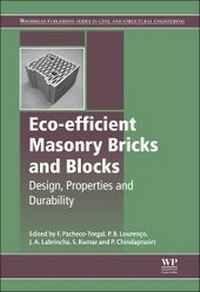
Eco-efficient Masonry Bricks and Blocks
Design, Properties and Durability
Published on 4. December 2014
Book
Hardback
548 pages
978-1-78242-305-8 (ISBN)
Description
Masonry walls constitute the interface between the building's interior and the outdoor environment. Masonry walls are traditionally composed of fired-clay bricks (solid or perforated) or blocks (concrete or earth-based), but in the past (and even in the present) they were often associated as needing an extra special thermal and acoustical insulation layer. However, over more recent years investigations on thermal and acoustical features has led to the development of new improved bricks and blocks that no longer need these insulation layers. Traditional masonry units (fired-clay bricks, concrete or earth-based blocks) that don't offer improved performance in terms of thermal and acoustical insulation are a symbol of a low-technology past, that are far removed from the demands of sustainable construction.
This book provides an up-to-date state-of-the-art review on the eco-efficiency of masonry units, particular emphasis is placed on the design, properties, performance, durability and LCA of these materials. Since masonry units are also an excellent way to reuse bulk industrial waste the book will be important in the context of the Revised Waste Framework Directive 2008/98/EC which states that the minimum reuse and recycling targets for construction and demolition waste (CDW) should be at least 70% by 2020. On the 9th of March 2011 the European Union approved the Regulation (EU) 305/2011, known as the Construction Products Regulation (CPR) and it will be enforced after the 1st of July 2013. The future commercialization of construction materials in Europe makes their environmental assessment mandatory meaning that more information related to the environmental performance of building materials is much needed.
This book provides an up-to-date state-of-the-art review on the eco-efficiency of masonry units, particular emphasis is placed on the design, properties, performance, durability and LCA of these materials. Since masonry units are also an excellent way to reuse bulk industrial waste the book will be important in the context of the Revised Waste Framework Directive 2008/98/EC which states that the minimum reuse and recycling targets for construction and demolition waste (CDW) should be at least 70% by 2020. On the 9th of March 2011 the European Union approved the Regulation (EU) 305/2011, known as the Construction Products Regulation (CPR) and it will be enforced after the 1st of July 2013. The future commercialization of construction materials in Europe makes their environmental assessment mandatory meaning that more information related to the environmental performance of building materials is much needed.
Reviews / Votes
"This book fulfils an important gap in building knowledge and provides the designers, architects and engineers with important up-to-date information to re-establish masonry as a suitable system for eco-efficient buildings." --Professor Vahan Agopyan, Vice-President of the University of S.Paulo (From the foreword)More details
Series
Language
English
Place of publication
Cambridge
United Kingdom
Publishing group
Elsevier Science & Technology
Target group
Professional and scholarly
Dimensions
Height: 229 mm
Width: 152 mm
Weight
900 gr
ISBN-13
978-1-78242-305-8 (9781782423058)
Copyright in bibliographic data and cover images is held by Nielsen Book Services Limited or by the publishers or by their respective licensors: all rights reserved.
Schweitzer Classification
Other editions
Additional editions
Fernando Pacheco-Torgal | Paulo B. Lourenco | Joao Labrincha
Eco-efficient Masonry Bricks and Blocks
Design, Properties and Durability
Book
10/2018
Woodhead Publishing Ltd
€235.22
The article will not be published
Fernando Pacheco-Torgal | Paulo B. Lourenco | Joao Labrincha
Eco-Efficient Masonry Bricks and Blocks: Design, Properties and Durability
Design, Properties and Durability
E-Book
12/2014
Woodhead Publishing
€240.00
Available for download
Persons
Fernando Pacheco Torgal is a Principal Investigator at C-TAC, University of Minho. He holds the title of Counsellor (Top 0.5%) from the Portuguese Engineers Association and has been consistently recognized as a Scopus Highly Cited Scientist in the global rankings by Stanford University. With over 300 publications to his name, he has carried out in-depth peer reviews of more than one thousand scientific papers and assessed nearly one hundred research grant proposals across 15 countries. He serves on the editorial boards of nine international journals and has been involved in editorial decisions for several hundred manuscripts. In addition, he has edited 33 international books, many of which are available in the libraries of prestigious institutions such as Harvard, MIT, and Stanford. Paulo B. Lourenco is Full Professor of Structural Engineering, Co-head of the Institute for Sustainability and Innovation in Structural Engineering and head of the Masonry and Historical Constructions Division at the University of Minho. He is also the coordinator of the International Master's on Structural Analysis of Historical Construction (SAHC). He is the editor of the International Journal of Architectural heritage, associate editor of several international journals, and author of more than 230 ISI peer-reviewed technical papers. He also serves on several international codes and standards committees (e.g. RILEM TC 250-CSM). Professor Prinya Chindaprasirt is the Director of the Sustainable Infrastructure Research and Development Center (SIRDC), a research unit in Khon Kaen University. He is now also the head of Advanced Functional Materials research cluster of Khon Kaen University. He was appointed a full professor in 2007. In 2009 he was the first person in civil engineering who was appointed the highest rank professor in Thailand. He has set up the Thai Geopolymer Network in 2005 to promote the research and collaboration among Thai researchers in this field.
Editor
Principal Investigator, CTAC Research Centre, University of Minho, Guimaraes, Portugal
Professor of Structural Engineering, Co-head of the Institute for Sustainability and Innovation in Structural Engineering and head of the Masonry and Historical Constructions Division, University of Minho
Associate Professor, University of Aveiro, Portugal
Director, Sustainable Infrastructure Research and Development Center (SIRDC), Khon Kaen University, Khon Kaen, Thailand
Petroleum Engineering Department, University of Southern California,
Los Angeles, CA 90089-1 21 1, U.S.A.
Los Angeles, CA 90089-1 21 1, U.S.A.
Content
1. Introductionto eco-efficient masonry bricks and blocks
PART I - DESIGN, PROPERTIES AND THERMAL PERFORMANCE OF LARGE AND HIGHLY PERFORATED FIRED-CLAY MASONRY BRICKS
2. The design and mechanical performance of large and highly perforated fired masonry bricks
3. Influence of large and highly perforated fired clay bricks in the improvement of the equivalent thermal transmittance of single-leaf masonry walls
4. Traditional fired clay bricks versus large and highly perforated fired clay bricks masonry: Influence on buildings thermal performance
PART II - THE DESIGN, PROPERTIES AND DURABILITY OF FIRED-CLAY MASONRY BRICKS CONTAINING INDUSTRIAL WASTES
5. The properties and durability of clay-fly ash-based fired masonry bricks
6. Types of waste, properties and durability of pore forming waste-based fired masonry bricks
7. Types of waste, properties and durability of toxic waste-based fired masonry bricks
PART III - THE DESIGN, PROPERTIES AND DURABILITY OF PORTLAND CEMENT CONCRETE MASONRY BLOCKS
8. The properties and durability of high pozzolanic industrial by-produts content concrete masonry blocks
9. The properties and durability of autoclaved aerated concrete masonry blocks
10. The design, properties and performance of concrete masonry blocks with PCMs
11. The design, properties and performance of shape optimized masonry blocks
PART IV - THE DESIGN, PROPERTIES AND DURABILITY OF GEOPOLYMERIC MASONRY BLOCKS
12. The properties and durability of fly-ash based geopolymeric masonry blocks
13. The properties and durability of mine tailings-based geopolymeric masonry blocks
14. The properties and performance of red-mud based geopolymeric masonry blocks
15. Design and properties of fly ash, ground granulated blast furnace slag, silica fume and metakaolin geopolymeric based masonry blocks.
PART V - THE PROPERTIES AND DURABILITY OF EARTH-BASED MASONRY BLOCKS
16. The properties and durability of adobe earth-based masonry blocks
17. The properties of compressed earth-based masonry blocks
18. The durability of compressed earth-based masonry blocks
PART VI - TOPOLOGY OPTIMIZATION AND ENVIRONMENTAL PERFORMANCE
19. Topology optimization for the development of eco-efficient masonry units
20. Environmental performance and energy assessment of fired clay brick masonry
21. Assessment of the energy and carbon embodied in straw and clay masonry blocks
22. Earth-block versus sandcrete block houses: Embodied energy and CO2 analysis
PART I - DESIGN, PROPERTIES AND THERMAL PERFORMANCE OF LARGE AND HIGHLY PERFORATED FIRED-CLAY MASONRY BRICKS
2. The design and mechanical performance of large and highly perforated fired masonry bricks
3. Influence of large and highly perforated fired clay bricks in the improvement of the equivalent thermal transmittance of single-leaf masonry walls
4. Traditional fired clay bricks versus large and highly perforated fired clay bricks masonry: Influence on buildings thermal performance
PART II - THE DESIGN, PROPERTIES AND DURABILITY OF FIRED-CLAY MASONRY BRICKS CONTAINING INDUSTRIAL WASTES
5. The properties and durability of clay-fly ash-based fired masonry bricks
6. Types of waste, properties and durability of pore forming waste-based fired masonry bricks
7. Types of waste, properties and durability of toxic waste-based fired masonry bricks
PART III - THE DESIGN, PROPERTIES AND DURABILITY OF PORTLAND CEMENT CONCRETE MASONRY BLOCKS
8. The properties and durability of high pozzolanic industrial by-produts content concrete masonry blocks
9. The properties and durability of autoclaved aerated concrete masonry blocks
10. The design, properties and performance of concrete masonry blocks with PCMs
11. The design, properties and performance of shape optimized masonry blocks
PART IV - THE DESIGN, PROPERTIES AND DURABILITY OF GEOPOLYMERIC MASONRY BLOCKS
12. The properties and durability of fly-ash based geopolymeric masonry blocks
13. The properties and durability of mine tailings-based geopolymeric masonry blocks
14. The properties and performance of red-mud based geopolymeric masonry blocks
15. Design and properties of fly ash, ground granulated blast furnace slag, silica fume and metakaolin geopolymeric based masonry blocks.
PART V - THE PROPERTIES AND DURABILITY OF EARTH-BASED MASONRY BLOCKS
16. The properties and durability of adobe earth-based masonry blocks
17. The properties of compressed earth-based masonry blocks
18. The durability of compressed earth-based masonry blocks
PART VI - TOPOLOGY OPTIMIZATION AND ENVIRONMENTAL PERFORMANCE
19. Topology optimization for the development of eco-efficient masonry units
20. Environmental performance and energy assessment of fired clay brick masonry
21. Assessment of the energy and carbon embodied in straw and clay masonry blocks
22. Earth-block versus sandcrete block houses: Embodied energy and CO2 analysis