

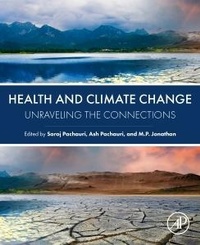
Health and Climate Change
Unraveling the Connections
Published on 15. November 2024
Book
Paperback/Softback
564 pages
978-0-443-29240-8 (ISBN)
Description
Health and Climate Change: Unraveling the Connections researches the linkages between climate change and human health as reported from Mexico, the UK, USA, India, Bangladesh, Cameroon, Nigeria, and Cameroon. The book's chapters cover the multidimensional impacts of climate change on various aspects such as habitability, biodiversity, natural resources, and human health. This information from developed and developing countries will be of immense interest to the global audience of researchers, activists, governments, and others.
Climate change, one of the greatest challenges of the 21st century, has serious adverse effects on human health. Extreme climate events increase mortality and morbidity, the prevalence of water- and vector-borne diseases, malnutrition, and respiratory diseases. Climate change has serious effects on mental health. Mental health is impacted directly and indirectly resulting in mental illnesses and suicidal mortality. Global heating, due to the increasing greenhouse effect, has disturbed the energetic balance of the Earth and destroyed its fragile climate. It is creating an atmospheric imbalance with toxins that are affecting the human nervous system and, thereby, impacting health.
Climate change, one of the greatest challenges of the 21st century, has serious adverse effects on human health. Extreme climate events increase mortality and morbidity, the prevalence of water- and vector-borne diseases, malnutrition, and respiratory diseases. Climate change has serious effects on mental health. Mental health is impacted directly and indirectly resulting in mental illnesses and suicidal mortality. Global heating, due to the increasing greenhouse effect, has disturbed the energetic balance of the Earth and destroyed its fragile climate. It is creating an atmospheric imbalance with toxins that are affecting the human nervous system and, thereby, impacting health.
Reviews / Votes
"This book is a large, edited volume, consisting of 21 chapters on health problems related to human-caused climate change. The articles range very widely in topic, length, detail, and quality.... does an excellent job of sampling the wide universe of climate change and health.... the coverage of microplastics and Sargassum weed (as pollutant) is so outstanding that it can be a major resource.... For general accounts of mental health and vulnerable populations, it provides valuable introductions. For solutions, it provides a few offerings that need extension. For microplastics and Sargassum weed, it provides accounts that anyone interested in public health aspects of these issues, especially in the 'global South', really should read.... Public health workers and other people with interests in the health aspects of climate change will want and need to consult this work for the specific cases that are covered in detail, especially microplastics, Sargassum, and vulnerable populations in the geographical areas covered." Review by Eugene Anderson, PhD (University of California, Riverside), (c)Doody's Review Service 2025. Doody's Score: 88, 3 StarsMore details
Language
English
Place of publication
San Diego
United States
Publishing group
Elsevier Science Publishing Co Inc
Target group
Professional and scholarly
Product notice
Paperback (trade)
Unsewn / adhesive bound
Dimensions
Height: 236 mm
Width: 191 mm
Thickness: 28 mm
Weight
1116 gr
ISBN-13
978-0-443-29240-8 (9780443292408)
Copyright in bibliographic data and cover images is held by Nielsen Book Services Limited or by the publishers or by their respective licensors: all rights reserved.
Schweitzer Classification
Other editions
Additional editions
Saroj Pachauri MD | Ash Pachauri | M. P. Jonathan
Health and Climate Change
Unraveling the Connections
E-Book
11/2024
Elsevier
€162.99
Available for download
Persons
As a public health physician, Dr. Pachauri has been extensively engaged with research on family planning, maternal and child health, sexual and reproductive health and rights, HIV and AIDS, and poverty, gender and youth. In 1996, she joined as Regional Director, South and East Asia, Population Council and established its regional office in New Delhi which she managed until 2014. In 2011, she was awarded the prestigious title of Distinguished Scholar, an honor rarely bestowed.
She worked with the Ford Foundation's New Delhi Office (1983-1994) and supported child survival, women's health, sexual and reproductive health, and HIV and AIDS programs. Before that, she worked with the International Fertility Research Program (IFRP) which was later renamed Family Health International (1971-1975) and the India Fertility Research Programme (1975-1983). She designed and monitored multi-centric clinical trials globally to assess the safety and effectiveness of fertility control technologies. During 1962-1971, as faculty of the Departments of Preventive and Social Medicine at the Lady Hardinge Medical College, New Delhi and the Institute of Medicine Sciences, Varanasi, she helped to develop this new discipline.
She has published seven books and contributed chapters to 20 books. She has over 100 publications in peer-reviewed journals and several articles in print media.
Dr. Ash Pachauri has a PhD in Decision Behavior and a Master's Degree in International Management. He worked with McKinsey and Company before pursuing a career in the social development arena, Dr. Pachauri's experience in the fields of public health and management emerges from a range of initiatives including those of The Bill and Melinda Gates Foundation, Program for Appropriate Technology in Health (PATH), United Nations Development Programme (UNDP), International Planned Parenthood Federation (IPPF), and Centers for Disease Control (CDC) in the US. He is a co-editor of three books and has contributed chapters to over six books and has more than 50 publications. He is Technical Adviser to the World Health Organization on Self-Care global guidelines.
Dr. M.P. Jonathan has proficient expertise in the fields of marine geochemistry and trace metal pollution of aquatic environments. He earned a doctorate in the field of geology from the University of Madras, Chennai, India. He is the author of more than 140 research articles on numerous multidisciplinary aspects of coastal pollution in reputed journals. With a wide vision to generate a database of the pollution status in tourist beaches all over the world, he has completed 10 countries till date and it is expanding year by year to other countries. He is a great teacher in orienting and inspiring young researchers to develop an urge for writing good scientific articles through his "Art of Scientific Writing? course. He has partaken in various bilateral and mega scientific research projects in India, Mexico, South Africa, Colombia, and Ecuador which deal with coastal pollution and development/mitigation efforts through mangroves. His research interests include geochemical process in aquatic systems, environmental geology, tsunami (past and present), microplastic degradation, fish toxicology, Geographic Information System (GIS) applications and innovative approaches in pollution studies. Presently, he works as a research professor and is also a Member of National System of Researchers (Sistema Nacional de Investigadores - SNI Level III) of the National Council for Humanities and Technological Sciences [Consejo Nacional de Humanidades Ciencias y Tecnologias (CONAHCYT)]. He also attests his abilities as the Coordinator of Doctorate program at the Center for Interdisciplinary Studies on Environment and Development [Centro Interdisciplinario de Investigaciones y Estudios sobre Medio Ambiente y Desarrollo (CIIEMAD)], National Polytechnic Institute [Instituto Politecnico Nacional (IPN)], Mexico City, Mexico. In addition, he acted an Executive Council Member (Consejo General Consultivo 2019-20) of IPN, Mexico City, Mexico. He is also an editorial committee member of the Environmental Monitoring and Assessment Journal (Springer Verlag) and Environmental Pollution (Elsevier) and is a member/reviewer of leading journals of Elsevier and Springer Verlag Publishers.
She worked with the Ford Foundation's New Delhi Office (1983-1994) and supported child survival, women's health, sexual and reproductive health, and HIV and AIDS programs. Before that, she worked with the International Fertility Research Program (IFRP) which was later renamed Family Health International (1971-1975) and the India Fertility Research Programme (1975-1983). She designed and monitored multi-centric clinical trials globally to assess the safety and effectiveness of fertility control technologies. During 1962-1971, as faculty of the Departments of Preventive and Social Medicine at the Lady Hardinge Medical College, New Delhi and the Institute of Medicine Sciences, Varanasi, she helped to develop this new discipline.
She has published seven books and contributed chapters to 20 books. She has over 100 publications in peer-reviewed journals and several articles in print media.
Dr. Ash Pachauri has a PhD in Decision Behavior and a Master's Degree in International Management. He worked with McKinsey and Company before pursuing a career in the social development arena, Dr. Pachauri's experience in the fields of public health and management emerges from a range of initiatives including those of The Bill and Melinda Gates Foundation, Program for Appropriate Technology in Health (PATH), United Nations Development Programme (UNDP), International Planned Parenthood Federation (IPPF), and Centers for Disease Control (CDC) in the US. He is a co-editor of three books and has contributed chapters to over six books and has more than 50 publications. He is Technical Adviser to the World Health Organization on Self-Care global guidelines.
Dr. M.P. Jonathan has proficient expertise in the fields of marine geochemistry and trace metal pollution of aquatic environments. He earned a doctorate in the field of geology from the University of Madras, Chennai, India. He is the author of more than 140 research articles on numerous multidisciplinary aspects of coastal pollution in reputed journals. With a wide vision to generate a database of the pollution status in tourist beaches all over the world, he has completed 10 countries till date and it is expanding year by year to other countries. He is a great teacher in orienting and inspiring young researchers to develop an urge for writing good scientific articles through his "Art of Scientific Writing? course. He has partaken in various bilateral and mega scientific research projects in India, Mexico, South Africa, Colombia, and Ecuador which deal with coastal pollution and development/mitigation efforts through mangroves. His research interests include geochemical process in aquatic systems, environmental geology, tsunami (past and present), microplastic degradation, fish toxicology, Geographic Information System (GIS) applications and innovative approaches in pollution studies. Presently, he works as a research professor and is also a Member of National System of Researchers (Sistema Nacional de Investigadores - SNI Level III) of the National Council for Humanities and Technological Sciences [Consejo Nacional de Humanidades Ciencias y Tecnologias (CONAHCYT)]. He also attests his abilities as the Coordinator of Doctorate program at the Center for Interdisciplinary Studies on Environment and Development [Centro Interdisciplinario de Investigaciones y Estudios sobre Medio Ambiente y Desarrollo (CIIEMAD)], National Polytechnic Institute [Instituto Politecnico Nacional (IPN)], Mexico City, Mexico. In addition, he acted an Executive Council Member (Consejo General Consultivo 2019-20) of IPN, Mexico City, Mexico. He is also an editorial committee member of the Environmental Monitoring and Assessment Journal (Springer Verlag) and Environmental Pollution (Elsevier) and is a member/reviewer of leading journals of Elsevier and Springer Verlag Publishers.
Editor
Public Health Specialist, Trustee, Center for Human Progress, New Delhi, India, and Director, the POP (Protect Our Planet) Movement, New York, USA
Director, Center for Human Progress, New Delhi, India, and Senior Mentor, the POP (Protect Our Planet) Movement, New York, USA
Professor and Researcher, Centro Interdisciplinario de Investigaciones y Estudios sobre Medio Ambiente y Desarrollo (CIIEMAD), Instituto Politecnico Nacional (IPN), Ciudad de Mexico, Mexico
Content
Theme 1: The Impact of Climate Change on Human Health Due to Anthropogenic Activities
1. Global warming impact on earth: Damage to human health
2. Understanding the dynamics of climate stress and mental health in urban and rural India
3. The intricate relationship between the human brain and anthropogenic global warming: The impact of global warming on mental health
4. Scorching heat impacts on health: Increasing deaths from mental health problems
5. Proposing a post-metaphysical thought for meeting the challenge of climate change
Theme 2: The Impact on Microplastics, Endocrinal Disrupting Agents, and Sargassum on Health
6. Enemies of the hormones: Microplastics and endocrine disruptors impacting public health
7. Effects and impacts of microplastics on marine system: A global review
8. The impact of sargassum on human health: A study in Mexico
9. Massive presence of sargassum on the coasts of Quintana Roo, Mexico and its relationship with human health and air quality
Theme 3: Impact of Climate Change on Vulnerable Populations Across Varied Regions Using the Lens of Equity and Justice
10. Child health equity: The health effects of climate change on children in frontline communities
11. Climate change and health issues: An afrocentric perspective
12. Health impact of climate change in Bangladesh
13. Climate change and its impact on women in South Asia: Evidence from a gender lens
14. Civilization resilience: A new perspective for addressing climate change and health threats
Theme 4: Interdisciplinary, Multisectoral, and Multilevel Interventions to Mitigate the Effects of Climate Change
15. Unravelling the mental health effects of people in communities affected by extreme climate in
16. A case for nature: Nature-based climate solutions and their public health co-benefits
17. Active participation of youth in addressing climate change issues
18. Climate change, health, and leadership: Four principles for responding to complex challenges
19. Facing the climate health challenge: Role of governmental and non-governmental efforts in India
20. Climate change-WASH services-health nexus: The Indian case
21. The giving economy: A future of negatively priced goods and services
1. Global warming impact on earth: Damage to human health
2. Understanding the dynamics of climate stress and mental health in urban and rural India
3. The intricate relationship between the human brain and anthropogenic global warming: The impact of global warming on mental health
4. Scorching heat impacts on health: Increasing deaths from mental health problems
5. Proposing a post-metaphysical thought for meeting the challenge of climate change
Theme 2: The Impact on Microplastics, Endocrinal Disrupting Agents, and Sargassum on Health
6. Enemies of the hormones: Microplastics and endocrine disruptors impacting public health
7. Effects and impacts of microplastics on marine system: A global review
8. The impact of sargassum on human health: A study in Mexico
9. Massive presence of sargassum on the coasts of Quintana Roo, Mexico and its relationship with human health and air quality
Theme 3: Impact of Climate Change on Vulnerable Populations Across Varied Regions Using the Lens of Equity and Justice
10. Child health equity: The health effects of climate change on children in frontline communities
11. Climate change and health issues: An afrocentric perspective
12. Health impact of climate change in Bangladesh
13. Climate change and its impact on women in South Asia: Evidence from a gender lens
14. Civilization resilience: A new perspective for addressing climate change and health threats
Theme 4: Interdisciplinary, Multisectoral, and Multilevel Interventions to Mitigate the Effects of Climate Change
15. Unravelling the mental health effects of people in communities affected by extreme climate in
16. A case for nature: Nature-based climate solutions and their public health co-benefits
17. Active participation of youth in addressing climate change issues
18. Climate change, health, and leadership: Four principles for responding to complex challenges
19. Facing the climate health challenge: Role of governmental and non-governmental efforts in India
20. Climate change-WASH services-health nexus: The Indian case
21. The giving economy: A future of negatively priced goods and services