

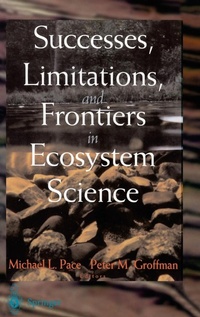
Successes, Limitations, and Frontiers in Ecosystem Science
1st Edition
Published on 1. December 1998
Book
Hardback
XVIII, 499 pages
978-0-387-98476-6 (ISBN)
Description
Ecosystem research has emerged in recent decades as a vital, successful, and sometimes controversial approach to environmental science. This book emphasizes the idea that much of the progress in ecosystem research has been driven by the emergence of new environmental problems that could not be addressed by existing approaches. By focusing on successes and limitations of ecosystems studies, the book explores avenues for future ecosystem-level research.
More details
Edition
1., 998
Language
English
Place of publication
New York, NY
United States
Target group
College/higher education
Professional and scholarly
Research
Product notice
sewn/stitched
Cloth over boards
Illustrations
XVIII, 499 p., 25 s/w Tabellen
90 figures
Dimensions
Height: 241 mm
Width: 160 mm
Thickness: 34 mm
Weight
939 gr
ISBN-13
978-0-387-98476-6 (9780387984766)
DOI
10.1007/978-1-4612-1724-4
Schweitzer Classification
Other editions
Additional editions
Michael L. Pace | Peter M. Groffman
Successes, Limitations, and Frontiers in Ecosystem Science
E-Book
12/2013
Springer
€53.49
Available for download
Michael L. Pace | Peter M. Groffman
Successes, Limitations, and Frontiers in Ecosystem Science
Book
08/1998
Springer
€53.49
Shipment within 5-7 days
Persons
Content
Introduction: Needs and Concerns in Ecosystem Science * Cultural Eutrophication of Inland, Estuarine, and Coastal Waters * Managing Forests as Ecosystems: A Success Story or a Challenge Ahead? * Wastelands to Wetlands: Links Between Habitat Protection and Ecosystem Science * Riparian Forest Ecosystems as Filters for Nonpoint Source Pollution * Ecological Research in Agricultural Ecosystems: Contributions to Ecosystem Science and to the Management of Agronomic Resources * Progress in Understanding Biogeochemical Cycles at Regional to Global Scales * Acid Deposition Research and Ecosystem Science: Synergistic Successes * Empirical and Theorectical Ecology as a Basis for Restoration: An Ecological Success Story * Limitations to Intellectual Progress in Ecosystem Science * Improving Links Between Ecosystem Scientists and Managers * The Need for Large-Scale Experiments to Assess and Predict the Response of Ecosystems to Perturbation * Ecosytem Approaches to the Management and Allocation of Critical Resources * Ecosystems and Problems of Measurement at Large Spatial Scales * Integration of Ecophysiological and Biogeochemical Approaches to Ecosystem Dynamics * Simulation Modeling in Ecosystem