

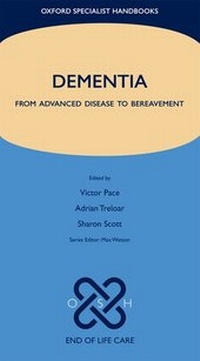
Dementia
From advanced disease to bereavement
Published on 7. July 2011
Book
Paperback/Softback
448 pages
978-0-19-923780-7 (ISBN)
Description
The Oxford Specialist Handbooks series provides readers with clear, concise information on all that is needed to successfully train in the medical sub-specialties. Each book gives an overview of clearly defined procedures, skills, guidelines, and technologies and provides practical tips and case studies to supplement hands-on experience. Where appropriate, each book complements the revised curriculum as developed by the Specialist Advisory Committees.
Dementia is a growing issue, exacerbated by improvements in health care which have led to an ageing population; currently three quarters of a million people suffer from dementia in the UK, and this is expected to rise to 1.8 million by 2050. This book concentrates on advanced disease and addresses issues such as pain management, decision-making, spiritual needs, communication, the Mental Health Capacity Act, dementia in the younger patient, and the carer's perspective.
Written by specialists, this book will be invaluable for doctors and nurses involved in palliative medicine, geriatrics, and old-age psychiatry, and the generalist who treats the patient with dementia.
Dementia is a growing issue, exacerbated by improvements in health care which have led to an ageing population; currently three quarters of a million people suffer from dementia in the UK, and this is expected to rise to 1.8 million by 2050. This book concentrates on advanced disease and addresses issues such as pain management, decision-making, spiritual needs, communication, the Mental Health Capacity Act, dementia in the younger patient, and the carer's perspective.
Written by specialists, this book will be invaluable for doctors and nurses involved in palliative medicine, geriatrics, and old-age psychiatry, and the generalist who treats the patient with dementia.
Reviews / Votes
This book pulls together recent evidence to produce a practical, up to date guide to its management. It is mainly aimed at specialists or trainees in palliative medicine, old age psychiatry or medicine of old age, but will be of use to many other professionals. * St Christopher's Hospice *More details
Series
Language
English
Place of publication
Oxford
United Kingdom
Target group
Professional and scholarly
Doctors and nurses involved in palliative medicine, geriatrics, and old-age psychiatry, and the generalist who treats the patient with dementia.
Illustrations
6 black and white line drawings
Dimensions
Height: 181 mm
Width: 110 mm
Thickness: 14 mm
Weight
210 gr
ISBN-13
978-0-19-923780-7 (9780199237807)
Copyright in bibliographic data and cover images is held by Nielsen Book Services Limited or by the publishers or by their respective licensors: all rights reserved.
Schweitzer Classification
Persons
Dr Victor Pace trained in palliative medicine in London and has been consultant at St Christopher's Hospice since 1999. He set up and led the Palliative Care for Dementia Project, in Croydon, London, for four years; this was the first project nationally to provide specialist palliative care input systematically to patients with advanced dementia and to study the problems faced by these patients and their families. He is a member of the National Council for Palliative Care Dementia Working Group and has contributed to a number of their publications. He has also been on working groups for NICE and the National End of Life Care Programme on care in advanced dementia. His other main interest is the use of nonsteroidal anti-inflammatory drugs in palliative care.
Dr Adrian Treloar is a Consultant in Old Age Psychiatry at Oxleas NHS Trust and a Visiting Senior Lecturer at the Institute of Psychiatry, London. In addition to being in charge of Medical Education for Oxleas NHSF Trust from 1999 to 2007, he produced research and helped to write national guidance on the ethics of Covert Administration of medicines. He has developed considerable expertise in the management of dementia through till death at home, and has lectured nationally and internationally on the palliative care of Dementia, as well as delirium and the management of Parkinson's disease. He has pioneered advanced care of dementia at home, enabling several dozen patients to live at home until their death, and has both researched and developed understanding of how this can be achieved. He is currently working with the National Council for Palliative Care as a member of their cross cutting dementia working group.
Sharon Scott is a Registered General Nurse and over the past 16 years has gained expert knowledge and skills in providing specialist palliative care by combining clinical experience with research and academic study. Clinical experience includes hospice in-patient care, hospital palliative care overseas and community palliative care in the UK. Over the past four years she has played a leading role in developing and managing a dementia palliative care service in London. During this time she gained invaluable experience in the care of people with advanced dementia and their carers. Working with patients, carers, services and core providers enabled her to highlight gaps in service provision and care and initiate measures to address these issues and improve quality of care. Sharon provides palliative care in dementia education programmes for care homes, lectures on courses in dementia care and presents nationally on this subject.
Dr Adrian Treloar is a Consultant in Old Age Psychiatry at Oxleas NHS Trust and a Visiting Senior Lecturer at the Institute of Psychiatry, London. In addition to being in charge of Medical Education for Oxleas NHSF Trust from 1999 to 2007, he produced research and helped to write national guidance on the ethics of Covert Administration of medicines. He has developed considerable expertise in the management of dementia through till death at home, and has lectured nationally and internationally on the palliative care of Dementia, as well as delirium and the management of Parkinson's disease. He has pioneered advanced care of dementia at home, enabling several dozen patients to live at home until their death, and has both researched and developed understanding of how this can be achieved. He is currently working with the National Council for Palliative Care as a member of their cross cutting dementia working group.
Sharon Scott is a Registered General Nurse and over the past 16 years has gained expert knowledge and skills in providing specialist palliative care by combining clinical experience with research and academic study. Clinical experience includes hospice in-patient care, hospital palliative care overseas and community palliative care in the UK. Over the past four years she has played a leading role in developing and managing a dementia palliative care service in London. During this time she gained invaluable experience in the care of people with advanced dementia and their carers. Working with patients, carers, services and core providers enabled her to highlight gaps in service provision and care and initiate measures to address these issues and improve quality of care. Sharon provides palliative care in dementia education programmes for care homes, lectures on courses in dementia care and presents nationally on this subject.
Editor
Consultant in Palliative Medicine, St Christopher's Hospice, London, UK
Consultant and Senior Lecturer in Old Age Psychiatry, Oxleas NHS Foundation Trust, London, UK
Senior Research Nurse, Marie Curie Palliative Care Research Unit, Department of Mental Health Sciences, University College London, UK
Content
Abbreviations ; 1. Introduction to dementia ; 2. Dementia and its management ; 3. Young onset dementia ; 4. Advanced dementia ; 5. An overview of palliative care ; 6. Distress in dementia ; 7. Principles of physical symptom assessment in dementia ; 8. Pain and pain control ; 9. Other physical symptoms ; 10. Mental distress and psycho-behavioural problems ; 11. Managing disability in dementia ; 12. Intercurrent illness ; 13. Deciding on appropriate intervention ; 14. The terminal phase ; 15. Bereavement ; 16. Communication ; 17. Person centred dementia care ; 18. Choice, capacity, care and the law ; 19. Spiritual care ; 20. Provision of appropriate care ; 21. A family carer's perspective ; 22. Caring for the carers ; 23. Some other therapies ; 24. Financial issues ; Appendix 1 - Further information ; Appendix 2 - Some relevant drug interactions ; Appendix 3 - Important neurochemical syndromes ; Appendix 4 - Body dermatomes