

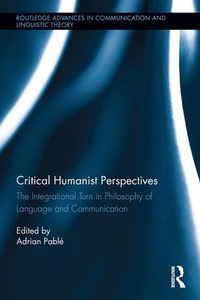
Critical Humanist Perspectives
The Integrational Turn in Philosophy of Language and Communication
1st Edition
Published on 22. May 2017
Book
Hardback
308 pages
978-1-138-65671-0 (ISBN)
Description
The present book is a collection of scholarly reflections on the theme of humanism from an integrational linguistic perspective. It studies humanist thought in relation to the philosophy of language and communication underpinning it and considers the question whether being a 'humanist' binds one to a particular view of language. The contributions to this volume explore whether integrational linguistics, being informed by a non-mainstream semiology and adopting a lay linguistic perspective, can provide better answers to contentious ontological and epistemological questions concerning the humanist project - questions having to do with the self, reason, authenticity, creativity, free agency, knowledge and human communication. The humanist perspectives adopted by the contributors to this volume are critical insofar as they start from semiological assumptions that challenge received notions within mainstream linguistics, such as the belief that languages are fixed-codes of some kind, that communication serves the purpose of thought transfer, and that languages are prerequisites for communication.
More details
Series
Language
English
Place of publication
London
United Kingdom
Publishing group
Taylor & Francis Ltd
Target group
College/higher education
Professional and scholarly
Postgraduate and Professional
Illustrations
2 s/w Abbildungen, 2 s/w Photographien bzw. Rasterbilder
2 Halftones, black and white; 2 Illustrations, black and white
Dimensions
Height: 234 mm
Width: 156 mm
Weight
521 gr
ISBN-13
978-1-138-65671-0 (9781138656710)
Copyright in bibliographic data and cover images is held by Nielsen Book Services Limited or by the publishers or by their respective licensors: all rights reserved.
Schweitzer Classification
Other editions
Additional editions
Adrian Pable
Critical Humanist Perspectives
The Integrational Turn in Philosophy of Language and Communication
Book
09/2019
1st Edition
Routledge
€69.60
Shipment within 15-20 days
Adrian Pable
Critical Humanist Perspectives
The Integrational Turn in Philosophy of Language and Communication
E-Book
05/2017
Routledge
€63.49
Available for download
Adrian Pable
Critical Humanist Perspectives
The Integrational Turn in Philosophy of Language and Communication
E-Book
05/2017
Routledge
€63.49
Available for download
Person
Adrian Pable is Associate Professor of English at the University of Hong Kong.
Content
PART I
1 Introduction: humanism, existentialism and integrational semiology (Adrian Pable)
PART II Integrating humanism 2 Secular humanist discourses on rationality: exploring questions in the philosophy of language and communication (Adrian Pable)
3 Bedrock concepts and integrational theory: selves, animals and legal persons (Christopher Hutton)
4 The nature of language and the language of nature: Rabindranath Tagore's Sabda Tattwo or The Essence of Words as an integrationist text (Rukmini Bhaya Nair)
5 An integrationist perspective on African philosophy (Sinfree B. Makoni and Cristine G. Severo)
PART III Integrating linguistics 6 Can integrational linguistics be integrated with (critical) discourse analysis? (Michael Toolan)
7 Indeterminacy in sociolinguistic and integrationist theory (Jon Orman)
8 Towards human concepts of language meaning and text comprehension (Charlotte Conrad)
PART IV Integrating systems and agency
9 The notion of an integrated system (Dorthe Duncker)
10 Humanist machines: an integrationist critique of mechanical models (David Bade)
PART V Integrating freedom and creativity 11 Mr. Micawber anticipates Feist : transformations of mental labour (Julian Warner)
12 Language and freedom vol 1: the abstract and the concrete (Peter E. Jones)
13 Emotional labour and the neoliberal entrepreneurial self at work and in the home: emotions as privatised individual capital or revolutionary social praxis? (Paul J. Thibault)
PART VI Integrating humanist models of education 14 Freedom of speech in a therapeutic age (Dennis Hayes)
15 'Crazy English' and individual English learners: an integrationist critique of English education as a business in China (Feifei Zhou)
PART VII Discussion: integrationism, anti-humanism and the suprasubjective (Paul Cobley)
1 Introduction: humanism, existentialism and integrational semiology (Adrian Pable)
PART II Integrating humanism 2 Secular humanist discourses on rationality: exploring questions in the philosophy of language and communication (Adrian Pable)
3 Bedrock concepts and integrational theory: selves, animals and legal persons (Christopher Hutton)
4 The nature of language and the language of nature: Rabindranath Tagore's Sabda Tattwo or The Essence of Words as an integrationist text (Rukmini Bhaya Nair)
5 An integrationist perspective on African philosophy (Sinfree B. Makoni and Cristine G. Severo)
PART III Integrating linguistics 6 Can integrational linguistics be integrated with (critical) discourse analysis? (Michael Toolan)
7 Indeterminacy in sociolinguistic and integrationist theory (Jon Orman)
8 Towards human concepts of language meaning and text comprehension (Charlotte Conrad)
PART IV Integrating systems and agency
9 The notion of an integrated system (Dorthe Duncker)
10 Humanist machines: an integrationist critique of mechanical models (David Bade)
PART V Integrating freedom and creativity 11 Mr. Micawber anticipates Feist : transformations of mental labour (Julian Warner)
12 Language and freedom vol 1: the abstract and the concrete (Peter E. Jones)
13 Emotional labour and the neoliberal entrepreneurial self at work and in the home: emotions as privatised individual capital or revolutionary social praxis? (Paul J. Thibault)
PART VI Integrating humanist models of education 14 Freedom of speech in a therapeutic age (Dennis Hayes)
15 'Crazy English' and individual English learners: an integrationist critique of English education as a business in China (Feifei Zhou)
PART VII Discussion: integrationism, anti-humanism and the suprasubjective (Paul Cobley)