

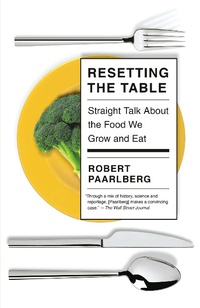
Resetting the Table
Straight Talk About the Food We Grow and Eat
Published on 8. March 2022
Book
Paperback/Softback
368 pages
978-0-525-56681-6 (ISBN)
Description
A bold, science-based corrective to the groundswell of misinformation about food and how it's produced, examining in detail local and organic food, food companies, nutrition labeling, ethical treatment of animals, environmental impact, and every other aspect from farm to table.
Consumers want to know more about their food—including the farm from which it came, the chemicals used to grow it, its nutritional value, how the animals were treated, and the costs to the environment. They are being told that buying organic foods, unprocessed and sourced from small local farms, is the most healthful and sustainable option. But what if we’re wrong? In Resetting the Table, Robert Paarlberg reviews the evidence and finds abundant reason to disagree. He delineates the ways in which global food markets have in fact improved our diet, and how "industrial" farming has recently turned green, thanks to GPS-guided precision methods that cut energy use and chemical pollution. He makes clear that America's serious obesity crisis does not come from farms, or from food deserts, but instead from "food swamps" created by food companies, retailers, and restaurant chains. And he explains how, though animal welfare is lagging behind, progress can be made through continued advocacy, more progressive regulations, and perhaps plant-based imitation meat. He finds solutions that can make sense for farmers and consumers alike and provides a road map through the rapidly changing worlds of food and farming, laying out a practical path to bring the two together.
Consumers want to know more about their food—including the farm from which it came, the chemicals used to grow it, its nutritional value, how the animals were treated, and the costs to the environment. They are being told that buying organic foods, unprocessed and sourced from small local farms, is the most healthful and sustainable option. But what if we’re wrong? In Resetting the Table, Robert Paarlberg reviews the evidence and finds abundant reason to disagree. He delineates the ways in which global food markets have in fact improved our diet, and how "industrial" farming has recently turned green, thanks to GPS-guided precision methods that cut energy use and chemical pollution. He makes clear that America's serious obesity crisis does not come from farms, or from food deserts, but instead from "food swamps" created by food companies, retailers, and restaurant chains. And he explains how, though animal welfare is lagging behind, progress can be made through continued advocacy, more progressive regulations, and perhaps plant-based imitation meat. He finds solutions that can make sense for farmers and consumers alike and provides a road map through the rapidly changing worlds of food and farming, laying out a practical path to bring the two together.
More details
Language
English
Place of publication
New York
United States
Publishing group
Random House USA Inc
Product notice
Paperback (trade)
Illustrations
39 PHOTOGRAPHS IN TEXT
Dimensions
Height: 203 mm
Width: 135 mm
Thickness: 22 mm
Weight
349 gr
ISBN-13
978-0-525-56681-6 (9780525566816)
Copyright in bibliographic data and cover images is held by Nielsen Book Services Limited or by the publishers or by their respective licensors: all rights reserved.
Schweitzer Classification
Other editions
Additional editions
E-Book
02/2021
Vintage
€11.49
Available for download
Person
ROBERT PAARLBERG is adjunct professor of public policy at the Harvard Kennedy School and an associate at Harvard's Weatherhead Center. He has been a member of the Board of Agriculture and Natural Resources at the National Research Council, a member of the Board of Directors at Winrock International, and a consultant to the International Food Policy Research Institute, the U.S. Agency for International Development, and the Bill and Melinda Gates Foundation. He is the author of Starved for Science, Food Politics, and The United States of Excess. He lives in Massachusetts.