

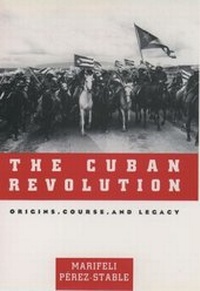
The Cuban Revolution
Origins, Course, and Legacy
2nd Edition
Published on 3. December 1998
Book
Paperback/Softback
288 pages
978-0-19-512749-2 (ISBN)
Description
This timely study provides a re-examination of the achievements and failures of the Cuban revolution. The Cuban Revolution places the revolution firmly within the context of twentieth century Cuban history, beginning with the inauguration of the republic in 1902 to Castro's triumphant entry into Santiago de Cuba in 1959, and hightlights the factors - such as a one-crop (sugar) economy and U.S. intereference in Cuban affairs - which made Cuba susceptible to revolution. While identifying nationalism and the struggle for social justice as the legitimate forces behind the revolution, Perez-Stable also provides a fresh insight into the problems facing Castro's Cuba. Arguing that the revolution actually ended in 1970, she blames its defeat on the regime's profitable yet doomed dependence on the Soviet Union and on the failure of Cuba's leaders to diversity the country's economy, sustain development, or create democratic institutions. The Cuban Revolution also focuses special attention on Cuba's confrontation with the United States.
This second edition has been updated to include an entirely new chapter with coverage of the changes affecting Cuba's policies and economy since the disintegration of the Soviet Union and the failure of communism in general, as well as a new preface, an up-to-date bibliography, and a thoroughly revised concluding chapter summing up the prospects and possibilities of Cuba's future in the twenty-first century.
This second edition has been updated to include an entirely new chapter with coverage of the changes affecting Cuba's policies and economy since the disintegration of the Soviet Union and the failure of communism in general, as well as a new preface, an up-to-date bibliography, and a thoroughly revised concluding chapter summing up the prospects and possibilities of Cuba's future in the twenty-first century.
Reviews / Votes
"An excellent and intellectually honest appraisal of how and why the socialist dream collapsed in Cuba, laying responsibility where it belongs: at the feet of the Cuban government."--Juan M. del Aguila, Emory UniversityPraise for the previous edition:
"This is by far the best work I have read on contemporary Cuba. It is a competent study that strives for -- and achieves -- remarkable impartiality. The Cuban Revolution conveys the probing intelligence and profound thoughtfulness that produces permanence. It is a work no just for a single season but for a very long time." --Franklin W. Knight, The John Hopkins University
"What we have in The Cuban Revolution is the most complete, sustained intellectual effort to do with the Cuban revolution what dozens of authors have done for the Mexican -- to indicate the native roots of the rebellion and, most importantly, to demonstrate how these roots were of primordial significance in determining the evolution of the revolution over the course of nearly haft a century. This is no small achievement, and it establishes
Perez-Stable as a major voice in the study of Latin American politics and society." --Lars Schoultz, University of North Carolina
More details
Edition
2nd edition
Language
English
Place of publication
New York
United States
Target group
Professional and scholarly
Edition type
New edition
Illustrations
bibliography, index
Dimensions
Height: 235 mm
Width: 155 mm
Thickness: 19 mm
Weight
432 gr
ISBN-13
978-0-19-512749-2 (9780195127492)
Copyright in bibliographic data and cover images is held by Nielsen Book Services Limited or by the publishers or by their respective licensors: all rights reserved.
Schweitzer Classification
Other editions
Previous edition

Marifeli Perez-Stable
The Cuban Revolution
Book
12/1993
Oxford University Press Inc
€14.80
Article exhausted; check for reprint
Content
PREFACE ; PREFACE TO THE FIRST EDITION ; CONTENTS ; LIST OF TABLES ; LIST OF ACRONMYMS ; INTRODUCTION ; 1. Meidated Sovereignty, Monoculture, and Development ; 2. Politics and Society, 1902-1958 ; 3. Revolution and Radical Nationalism, 1959-1961 ; 4. Revolution and Inclusive Development ; 5. Politics and Society, 1961-1970 ; 6. Politics and Society, 1971-1986 ; 7. Revolution, Rectification, and Contemporary Socialism ; 8. The Invisible Crisis: Stability and Change in 1990s Cuba ; CONCLUSION ; BIBLIOGRAPHY ; INDEX